I will be at the South Central Seminar in the History of Early Modern Philosophy this weekend, so I'll likely be quiet until Sunday. I really don't like the ending of the third poem, although it captures Lady Philosophy's point very well.
Milky Way
Once a year at the end of day
I pack my bag to walk the Milky Way
through all there is and all there was;
on every side a hundred billion suns
rise and bloom and slowly pass away.
And somewhere in the coursing night
where the spiral arms are lost to sight
my heart begins to sigh and softly pray:
all this flame and all this light,
the planets, clouds, and splendors bright,
are fragile as the dust and shattered clay.
Ever they are perched on high
to catch some distant lullaby;
and after ever, never comes,
empty voids and endless years
devoid of even sorrow's tears:
such are the thoughts you overhear
when you pack your bag some autumn day
to walk the path of the Milky Way.
Unclouded
Sun with passion
leaps up, a steed
at the trumpet.
Cons. Phil. 1m2
Depth-drowning, his once-sharp mind
now is made dull with darkness of brine
and this man, now far from shore,
whipped by wave, and wind, and wind more,
treads in water, in cold, in despair,
who once trod earth in open air.
Once he observed the vital sun
and the stars that around the light moon run
and the evenstar bright in the twilight west
which leaps in the morrow in dancing jest,
and studied the world in effect and cause,
knew how wave and wind have their laws,
how stars dance in circle and sphere,
how the sun rises up to make all things clear,
how spring is warm and calls to light
the blossoms that cheer and render earth bright,
how autumn brings harvest to finish the round,
fruit of the earth, grain from the ground.
But he who the secrets of nature had spied
lies low, the heights of his mind now denied,
weighed down by the chains binding him now
to look at the dust, not a man but a cow.
Thursday, October 22, 2009
Absences in the Common Uneasiness of Life
Every one knows, that the mind will not be kept from contemplating what it loves in the midst of crowds and business. Hence come those frequent absences, so observable in conversation; for whilst the body is confined to present company, the mind is flown to that which it delights in. If God then be the object of our desires, we shall relieve ourselves in the common uneasiness of life, by contemplating His beauty. For certainly there cannot be a higher pleasure than to think that we love and are beloved by the most amiable and best Being. Whom the more we contemplate the more we shall desire, and the more we desire the more we shall enjoy. This desire having the pre-eminence of all other desires, as in every other thing so particularly in this, that it can't be disappointed; no one who brings a sincere heart, being ever rejected by this divine lover. Whose eyes pierce the soul, as He can't be deceiv'd by imposture, so He never mistakes or neglects the faithful affection; which too seldom finds ways to make itself understood among mortals, even by those who pretend to be the most discerning, but who give themselves up to the flatterers and deceivers, whilst they treat the plain and honest person with the utmost outrage.
Mary Astell, The Christian Religion as Profess'd by a Daughter of the Church of England (from here)
Tuesday, October 20, 2009
A Question about Bosch's Invidia
One of Hieronymus Bosch's most famous (and also least surreal) paintings is his tabletop painting, The Seven Deadly Sins and the Four Last Things. The wheel at the center of the painting shows, as you might expect, representations of the seven deadly sins: luxuria (extravagance), gula (gluttony), avaricia (greed), accidia (sloth), ira (wrath), invidia (envy), and superbia (pride). Much of the symbolism is actually fairly straightforward, considering that we are talking about Bosch, who excels in the weird. For instance, avarice is represented by a judge leaning in to consider what someone is saying while his hand deftly and smoothly reaches back behind him to take a coin from someone who wants a case decided a certain way. There's certainly something deliberate about the fact that, only of all the sins, the person representing pride is alone -- well, alone except for the demon holding a mirror in which she admires herself. And the list can be continued. But for the life of me, I can't quite figure out what's going on in the invidia frame. It's notable that everyone is looking at what other people are doing, and you notice the dog who has several bones at his feet is nonetheless looking up at the one bone he doesn't have. But I don't quite understand what's going on in the scene. What are the human figures doing that represents envy? Is it gossip? But what's going on with the heavily burdened person who is walking away? Any help would be appreciated.


Monday, October 19, 2009
Break, Break, Break
'Break, break, break'
by Alfred Tennyson
Break, break, break,
On thy cold gray stones, O Sea!
And I would that my tongue could utter
The thoughts that arise in me.
O well for the fisherman’s boy,
That he shouts with his sister at play!
O well for the sailor lad,
That he sings in his boat on the bay!
And the stately ships go on
To their haven under the hill;
But O for the touch of a vanish’d hand,
And the sound of a voice that is still!
Break, break, break
At the foot of thy crags, O Sea!
But the tender grace of a day that is dead
Will never come back to me.
Saturday, October 17, 2009
The Dominion of Aristotle (Repost)
This is a reposted version, somewhat revised, of a post originally published in 2007.
Dante Alighieri is a very philosophical poet, but he's something of an odd bird with regard to his philosophy. This comes out very strikingly in the fourth book of the Convivio. One of his major concerns in this book is to address a claim made by Frederick the Great, that gentilezza or nobility is ancestral wealth and fine manners. Dante is firmly against this bit of philosophical legislation on the part of an Emperor; and in arguing against the right of the Emperor to address the issue, he makes some very strong, very unusual claims.
The Emperor, Dante says, exists due to the human need for society, which we establish in order to live a happy life (because we can't provide everything necessary for such a life ourselves). The complete fulfillment of this need can only exist when all human societies are united into a single principality, with a Monarch capable of keeping all the lesser kings in line. Thus, the perfection of the human species requires a "universal and indisputable office of command," the office of the Emperor. By experience, says Dante, we have found that the Emperor should be Roman, because the Latin race is seen to have a natural talent for the exercise of rule and acquisition of power, and because in history God in his divine providence clearly gave sway to the Romans. Rome had a special birth, a special development, a special end. The world needs a Roman Emperor, someone who can be "rider of the human will," who can have authority over all practical, voluntary activities.
That's a strong claim, and an unusual one, but that's not the claim I was talking about. The claim I was talking about was this: in contrast to the practical realm, the philosophical realm is not governed by the Emperor but by Aristotle, to whom we are all required to render "faith and obedience." Yes, obedience. For Dante, Aristotle is to philosophy what the Emperor is to politics; he exercises a universal and indisputable office of command as the teacher and leader of human reason. Here is what Dante says, in the Lansing translation (IV, 6):
It's hard to get more plain than that. Other philosophers deserve our respect inasmuch as they approximate to Aristotle, and Aristotle, like a Pope in spiritual matters or an Emperor in political matters, because of "his singular and almost divine genius," is to hold full sway. He is il sommo Filosofo, the supreme philosopher, the Philosopher himself. He is "invested with complete power". This power is not opposed to the Emperor's power, but requires it and is required by it; without the Emperor's authority, Aristotle's authority is weak, and without Aristotle's authority, the Emperor's authority is dangerous. To have good government, each must keep to its domain, and each must exercise unconditional authority over that domain. It's clear enough that this means mostly the primacy of Aristotle in ethical matters -- it is chiefly for this reason that the Emperor needs to respect the domain of Aristotle. And it is worth pointing out that the actual result of this is the freedom of philosophy from every external imposition: neither the Emperor nor the Pope have any direct say in philosophical matters. But we still have Aristotle as the philosopher-king of philosophy itself.
That is a very strong, very unusual claim. Needless to say, even Aristotelians would usually balk at the idea that Aristotle not only deserves respect but complete trust and obedience as the Supreme and Sovereign Philosopher. But Dante is not just any Aristotelian; he is in a sense the most vehemently Aristotelian Aristotelian of them all, the one who holds that philosophy was given to Aristotle by God as his own personal empire. Etienne Gilson notes in Dante and Philosophy that this odd sort of move is actually very characteristic of Dante's thought. In every realm of human endeavor, there is need for a proper ammaestramento, instruction by a proper authority. So Dante divides human life into distinct and air-tight domains, each with its proper authority, each such authority subject only to God in that domain. Such thinking pervades the Divine Comedy. Gilson points out that throughout the Comedy Dante repeatedly condemns those who try to usurp authority (as he would see it) -- thus Pope Boniface is in hell -- but repeatedly forgives those who, whatever their errors, tried to preserve distinct domains. Thus he's very forgiving of the Fraticelli (and thus Joachim) even though he thinks they went too far, because they insisted that the Church should keep to spiritual things and leave matters of property to the Empire. And he's also very forgiving of Siger, even though he probably thinks he went too far, because Siger tried to preserve the distinct authority of Aristotle. So Siger and Joachim are lauded in heaven by their more saintly earthly opponents, Aquinas and Bonaventure. As Gilson sums it up:
[Etienne Gilson, Dante and Philosophy. David Moore, tr. Harper & Row (New York: 1963), p. 156]
That's what you can call an extreme commitment to subsidiarity. And, as I said, it's a very strong, very unusual sort of philosophical viewpoint.
Dante Alighieri is a very philosophical poet, but he's something of an odd bird with regard to his philosophy. This comes out very strikingly in the fourth book of the Convivio. One of his major concerns in this book is to address a claim made by Frederick the Great, that gentilezza or nobility is ancestral wealth and fine manners. Dante is firmly against this bit of philosophical legislation on the part of an Emperor; and in arguing against the right of the Emperor to address the issue, he makes some very strong, very unusual claims.
The Emperor, Dante says, exists due to the human need for society, which we establish in order to live a happy life (because we can't provide everything necessary for such a life ourselves). The complete fulfillment of this need can only exist when all human societies are united into a single principality, with a Monarch capable of keeping all the lesser kings in line. Thus, the perfection of the human species requires a "universal and indisputable office of command," the office of the Emperor. By experience, says Dante, we have found that the Emperor should be Roman, because the Latin race is seen to have a natural talent for the exercise of rule and acquisition of power, and because in history God in his divine providence clearly gave sway to the Romans. Rome had a special birth, a special development, a special end. The world needs a Roman Emperor, someone who can be "rider of the human will," who can have authority over all practical, voluntary activities.
That's a strong claim, and an unusual one, but that's not the claim I was talking about. The claim I was talking about was this: in contrast to the practical realm, the philosophical realm is not governed by the Emperor but by Aristotle, to whom we are all required to render "faith and obedience." Yes, obedience. For Dante, Aristotle is to philosophy what the Emperor is to politics; he exercises a universal and indisputable office of command as the teacher and leader of human reason. Here is what Dante says, in the Lansing translation (IV, 6):
That Aristotle is the most worthy of faith and obedience may be proved as follows. Among workmen and craftsmen of various arts and activities which are ordained to a single final activity or art, the craftsman or workman pursuing such an end must above all be obeyed and trusted by everyone as being he alone who considers the final end of all the other ends. Hence the knight should be trusted by the sword-maker, the bridle-maker, the saddle-maker, the shield-maker, and all trades that are established for the purpose of achieving the goals of chivalry. Since all human activities require a final end, namely the end of human life to which man is directed insofar as he is human, the master or the craftsman who studies this and reveals it to us should be obeyed and trusted above all others. That man is Aristotle: he therefore is the most worthy of faith and obedience.
It's hard to get more plain than that. Other philosophers deserve our respect inasmuch as they approximate to Aristotle, and Aristotle, like a Pope in spiritual matters or an Emperor in political matters, because of "his singular and almost divine genius," is to hold full sway. He is il sommo Filosofo, the supreme philosopher, the Philosopher himself. He is "invested with complete power". This power is not opposed to the Emperor's power, but requires it and is required by it; without the Emperor's authority, Aristotle's authority is weak, and without Aristotle's authority, the Emperor's authority is dangerous. To have good government, each must keep to its domain, and each must exercise unconditional authority over that domain. It's clear enough that this means mostly the primacy of Aristotle in ethical matters -- it is chiefly for this reason that the Emperor needs to respect the domain of Aristotle. And it is worth pointing out that the actual result of this is the freedom of philosophy from every external imposition: neither the Emperor nor the Pope have any direct say in philosophical matters. But we still have Aristotle as the philosopher-king of philosophy itself.
That is a very strong, very unusual claim. Needless to say, even Aristotelians would usually balk at the idea that Aristotle not only deserves respect but complete trust and obedience as the Supreme and Sovereign Philosopher. But Dante is not just any Aristotelian; he is in a sense the most vehemently Aristotelian Aristotelian of them all, the one who holds that philosophy was given to Aristotle by God as his own personal empire. Etienne Gilson notes in Dante and Philosophy that this odd sort of move is actually very characteristic of Dante's thought. In every realm of human endeavor, there is need for a proper ammaestramento, instruction by a proper authority. So Dante divides human life into distinct and air-tight domains, each with its proper authority, each such authority subject only to God in that domain. Such thinking pervades the Divine Comedy. Gilson points out that throughout the Comedy Dante repeatedly condemns those who try to usurp authority (as he would see it) -- thus Pope Boniface is in hell -- but repeatedly forgives those who, whatever their errors, tried to preserve distinct domains. Thus he's very forgiving of the Fraticelli (and thus Joachim) even though he thinks they went too far, because they insisted that the Church should keep to spiritual things and leave matters of property to the Empire. And he's also very forgiving of Siger, even though he probably thinks he went too far, because Siger tried to preserve the distinct authority of Aristotle. So Siger and Joachim are lauded in heaven by their more saintly earthly opponents, Aquinas and Bonaventure. As Gilson sums it up:
And where, it will be said, are those who wish to exercise [authority] where they do not have it? They are in Hell. And it may indeed be said that they alone have put themselves there by their violation of the holy law of divine Justice which is not only the supreme creator of the constitutive orders of nature and supernature, but also the inexorable protector of the authorities which it has wisely placed at their head. There is no greater crime than to betray the divine order, and it is betraying it to refuse to follow Aristotle in the matter of philosophy, because philosophy is the daughter of God and it was God Himself Who desired that it should be taught to us by Aristotle. But it is no less a crime for a Franciscan to betray St. Francis, for a Dominican to betray St. Dominic, for a subject to betray the Emperor, for a Christian to betray the Gospel, and the worst crime of all, the one which in this world gives rise to disorders, abuses, wars and miseries without number, is to betray all forms of authority at once through a desire to install one of them, which is competent in its sphere, in the place of those which are equally so in theirs, for each form of authority is master in its own house and even the humblest of all is directly responsible to God alone.
[Etienne Gilson, Dante and Philosophy. David Moore, tr. Harper & Row (New York: 1963), p. 156]
That's what you can call an extreme commitment to subsidiarity. And, as I said, it's a very strong, very unusual sort of philosophical viewpoint.
Friday, October 16, 2009
A Bonfire of Bibles
I was hoping to do a substantive post about Hume tonight, but I'm quite tired and have a great many logic quizzes to grade. But while taking a short break I came across this post about a recent book-burning at a church in North Carolina. The church's announcement:
Actually, it almost sounds like fun. We Americans don't have enough bonfires, and in its own weird way there is something extraordinarily striking about the very idea of eating good fried chicken and fixings while singing hymns around a Halloween bonfire of Bibles and Gospel music CDs. Chesterton or (perhaps better yet) O'Connor could write a stunningly good story about it. And, despite being a bit of bibliophile, I am pretty much indifferent to bookburning as such; I don't regard it as seriously different from any other form of symbolic protest, and while I think such protests are usually silly, there are worse things. But I always wonder where they are getting the books. Surely Amazing Grace Baptist Church isn't recommending that people steal the books first; but how many people attending a church like Amazing Grace are going to have handy copies of Westcott & Hort, or the writings of Mother Teresa and the Pope?
Halloween Book Burning
Burning Perversions of God’s Word
October 31, 2009
7:00 PM – Till
Great Preaching and Singing
Come to our Halloween book burning. We are burning Satan’s bibles like the NIV, RSV, NKJV, TLB, NASB, NEV, NRSV, ASV, NWT, Good News for Modern Man, The Evidence Bible, The Message Bible, The Green Bible, ect. These are perversions of God’s Word the King James Bible.
We will also be burning Satan’s music such as country , rap , rock , pop, heavy metal, western, soft and easy, southern gospel , contempory Christian , jazz, soul, oldies but goldies, etc.
We will also be burning Satan’s popular books written by heretics like Westcott & Hort , Bruce Metzger, Billy Graham , Rick Warren , Bill Hybels , John McArthur, James Dobson, Charles Swindoll , John Piper, Chuck Colson, Tony Evans, Oral Roberts, Jimmy Swagart, Mark Driskol, Franklin Graham , Bill Bright, Tim Lahaye, Paula White, T.D. Jakes, Benny Hinn , Joyce Myers, Brian McLaren, Robert Schuller, Mother Teresa , The Pope , Rob Bell, Erwin McManus, Donald Miller, Shane Claiborne, Brennan Manning, William Young, etc.
We are not burning Bibles written in other languages that are based on the TR. We are not burning the Wycliffe, Tyndale, Geneva or other translations that are based on the TR.
We will be serving Bar-b-Que Chicken, fried chicken, and all the sides.
If you have any books or music to donate, please call us for pick-up. If you like you can drop them off at our church door anytime. Thanks.
Actually, it almost sounds like fun. We Americans don't have enough bonfires, and in its own weird way there is something extraordinarily striking about the very idea of eating good fried chicken and fixings while singing hymns around a Halloween bonfire of Bibles and Gospel music CDs. Chesterton or (perhaps better yet) O'Connor could write a stunningly good story about it. And, despite being a bit of bibliophile, I am pretty much indifferent to bookburning as such; I don't regard it as seriously different from any other form of symbolic protest, and while I think such protests are usually silly, there are worse things. But I always wonder where they are getting the books. Surely Amazing Grace Baptist Church isn't recommending that people steal the books first; but how many people attending a church like Amazing Grace are going to have handy copies of Westcott & Hort, or the writings of Mother Teresa and the Pope?
Thursday, October 15, 2009
Transverberation
Today is the feast day of Teresa of Avila.
Teresa of Avila, Life, IV.5
The most famous event in Teresa's life is the Transverberation, the subject of the famous sculpture by Bernini. She describes the event in Chapter XXIX:
(The Carmelites celebrate the Transverberation itself on August 26.)
It is certainly true that very frequently the joy I have in that the multitude of Thy mercies is made known in me, softens the bitter sense of my great faults. In whom, O Lord, can they shine forth as they do in me, who by my evil deeds have shrouded in darkness Thy great graces, which Thou hadst begun to work in me? Woe is me, O my Maker! If I would make an excuse, I have none to offer; and I only am to blame. For if I could return to Thee any portion of that love which Thou hadst begun to show unto me, I would give it only unto Thee, and then everything would have been 19 safe. But, as I have not deserved this, nor been so happy as to have done it, let Thy mercy, O Lord, rest upon me.
Teresa of Avila, Life, IV.5
The most famous event in Teresa's life is the Transverberation, the subject of the famous sculpture by Bernini. She describes the event in Chapter XXIX:
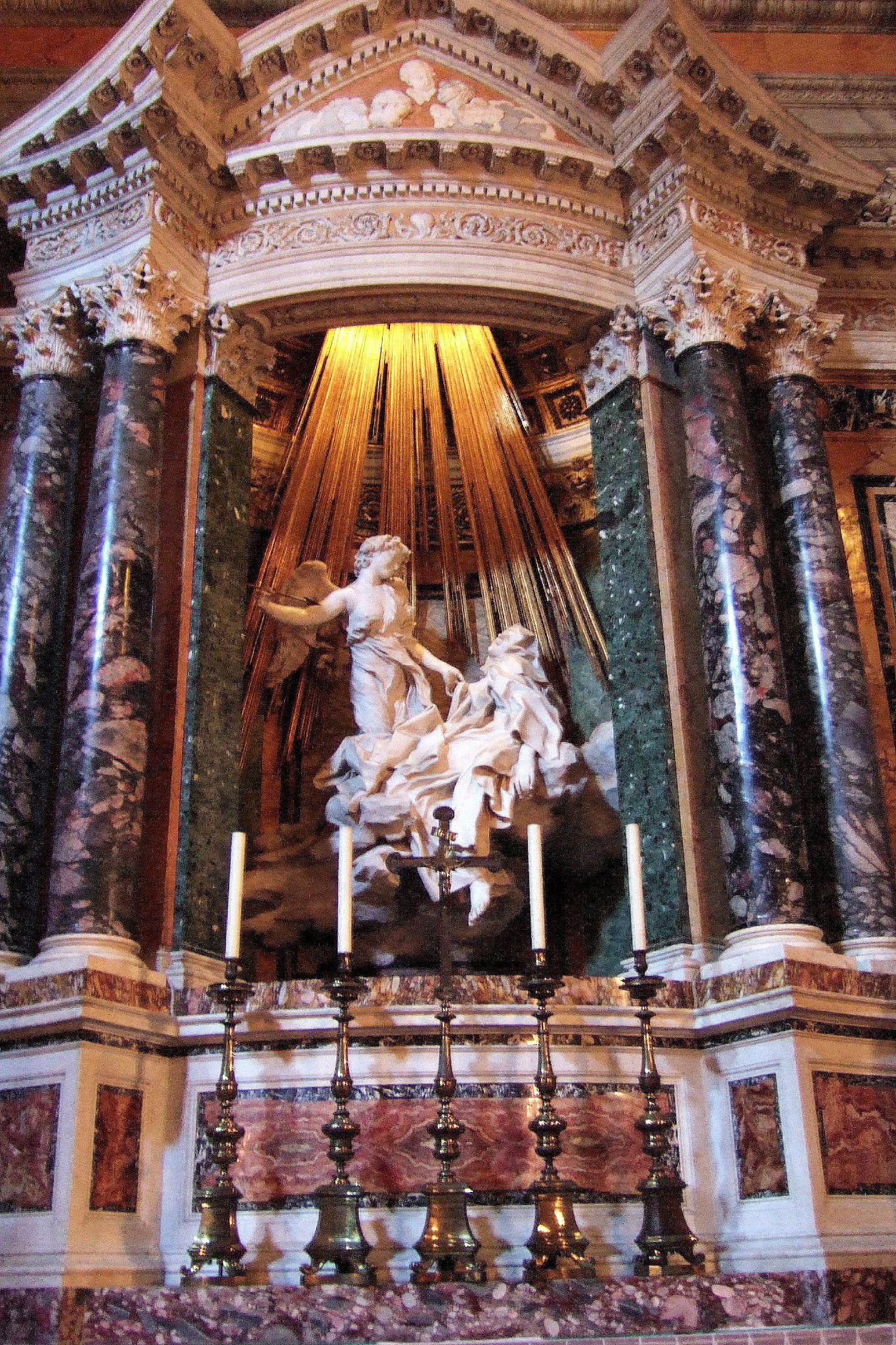
I saw in his hand a long spear of gold, and at the iron's point there seemed to be a little fire. He appeared to me to be thrusting it at times into my heart, and to pierce my very entrails; when he drew it out, he seemed to draw them out also, and to leave me all on fire with a great love of God. The pain was so great, that it made me moan; and yet so surpassing was the sweetness of this excessive pain, that I could not wish to be rid of it. The soul is satisfied now with nothing less than God. The pain is not bodily, but spiritual; though the body has its share in it, even a large one. It is a caressing of love so sweet which now takes place between the soul and God, that I pray God of His goodness to make him experience it who may think that I am lying.
(The Carmelites celebrate the Transverberation itself on August 26.)
Subscribe to:
Posts (Atom)