Saturday, October 04, 2014

Violations of Remotion

The principle of remotion in natural theology can be put, roughly and at first approximation, in something like these terms:

(R) God is known only by causal inference from effects, in such a way as not to fall under a genus.

The basic implication of this is that we know God not by having a definition of His nature, which would require identifying a genus and specific difference for deity, but only by differences that are not specific differences, which themselves arise from specific causal inferences.

One thing that is fairly easy to see is that lots of arguments in analytic philosophy of religion appear to violate this principle; you can often recognize them by conditionals beginning, "If God exists..." (although conditionals of this form do not in themselves violate the principle of remotion). For instance, here is a standard simple version of an argument from gratuitous evils:

(P1) If God exists, then there is no gratuitous evil in the world.
(P2) There is gratuitous evil in the world.
(C) Therefore, God does not exist.

On its own, this is fine, but the obvious question is why one would accept (P1). And it is here that the violation often occurs. So, for instance, a commonly given reason given for (P1) is something along the lines that it follows from the nature of God, who as a morally perfect being would necessarily, given his power, wisdom, and goodness, not allow evil he has no morally adequate reason to allow. All three of the italicized phrases, or anything equivalent to them, raise immediate questions relevant to remotion: talking about what follows from the nature of God appears to require some kind of real definition of God's nature itself; the rationale appears to identify God as falling within the genus of morally perfect beings; and the necessity seems to be the kind of natural necessity that comes from knowing the real definition of a thing's nature. But what binds it all together is what we do not get, which is any establishment of the content of these terms from a causal inference that does not make any assumptions about the genus of the cause. All the terms can be used in a way consistent with (R); but they can only do so in combination with a causal inference of the kind noted in (R), which then fixes the content of the term.

Here is another one:

(P1) If a perfectly loving God exists, reasonable nonbelief does not occur.
(P2) Reasonable nonbelief occurs.
(C) Therefore a perfectly loving God does not exist.

All well and good, but what is the justification for (P1)? A common justification is that a perfectly loving God would necessarily be open to a personal relationship with every willing person. But, again, this 'necessarily' seems to require the kind of necessity resulting from its being implied by the real definition of a nature, and there is no hint of what kind of causal inference would give one the relevant content of the term 'perfectly loving'.

It is perhaps not especially surprising that atheistic arguments tend not to fix the content of the terms they apply to God by giving the causal inference to God's existence that would fix them; but there has to be at least some hypothetical or for-the-sake-of-argument inference, or the argument violates the principle of remotion.

Here is a theistic argument that also, as usually understood, violates the principle of remotion.

(P1) If God is perfectly loving, God saves all those who can possibly in any way be saved.
(P2) God is perfectly loving.
(P3) Therefore God saves all those who can possibly in any way be saved.

Again, all well and good, but the question arises as to how one knows (P1), and again the usual answers do not seem to appeal to a causal inference or avoid the assumption that we have a real definition of God's nature from which we draw a necessary conclusion.

There are many views on which violation of remotion is not a problem; my point is not that this is an issue arising all the way across the board. Rather, my point is that the principle of remotion is regularly violated, and the arguments thus created are inconsistent with, already ruled out by, any view that accepts the principle of remotion. It is in fact the case that there are a lot of historical theologians (Jewish, Christian, and Muslim) who accept the principle of remotion, either explicitly or by accepting things that effectively imply it, which is, of course, where I got it. And for anyone who accepts the principle of remotion, a great many arguments one finds in analytic philosophy of religion look as if they are, not tight arguments dealing with rigorous necessities, but sloppy reasoning involving pure speculation.

Friday, October 03, 2014

Xenophon's Hiero

Hieron, or Hiero, as it is usually called in English, is a short non-Socratic dialogue that Xenophon uses to discuss the relationship between happiness and power. It also briefly touches on the same topic as that of the Cyropaedia, namely, how to have a society in which the ruled want to be ruled. It was a very popular work among Renaissance humanists.

You can read Hiero online in English at the Perseus Project.

The Characters

  Simonides of Ceos
Simonides was one of the great lyric poets of ancient Greece. He lived in the late sixth or early fifth century BC. His poetry often had a didactic cast, and he was reputed to be a wise man; quite a few of his sayings have survived, although it is, of course, possible, that some of them just collected around him because of his reputation. He is the poet whose poem Socrates and Protagoras argue over in Plato's Protagoras; there and elsewhere in the Platonic dialogues there seem to be suggestions that he is excessively inclined to pander to power -- one of his innovations as a poet was to write hymn-like poetry to eminent men, as if they were already heroes.

  Hiero
Hiero was what the Greeks called a tyrant -- he came to power through means that were not exactly legal or customary -- in the Greek city of Syracuse in Sicily. He was a ruthless ruler, but also an active patron of the arts, inviting poets and philosophers from all over the Greek world to his court, including Simonides.

The Plot and The Thought

Simonides asks Hiero how the lives of a private citizen and a tyrant differ. Hiero asks Simonides to remind him of the joys and sorrows of a private citizen, and Simonides talks about the things we all know -- we get pleasure and pain through the senses, and pleasure from sleep, and the like, to which Hiero responds that he doesn't understand why anyone would think things would be different for a despot. Simonides suggests that the despot has more pleasures and fewer pains by the same channels. Hiero responds that the reverse is true. They cannot devote themselves to entertainments like a private citizen can, for instance.

Simonides points out that the despot receives more praise, but Hiero counters that it is mostly flattering and self-serving, and thus not as pleasant as it might seem. Similar problems arise for the pleasures of smell and taste. Simonides suggests despots have greater sexual pleasures; Hiero counters that a despot cannot marry a woman of superior or equal family, and he has many things that interfere with the passion that makes sex sweet.As for young men, the despot can never be sure that they comply from genuine affection or from mere obedience -- and they are often the very people involved in plots against the despot. Simonides continues with the luxurious dwellings of despots, but Hiero's counter is that a despot must always live and move in his own country as if he were in enemy territory, and they cannot have friendships in the way private citizens can. Further, while a private citizen might crave a nicer house or some such, the despot is not satisfied with such things; he craves entire cities and the like.

Moreover, a tyrant cannot relate to admirable people the way a private citizen can:

They recognize a stout-hearted, a wise or an upright man as easily as private citizens do. But instead of admiring such men, they fear them,—the brave lest they strike a bold stroke for freedom, the wise lest they hatch a plot, the upright lest the people desire them for leaders. When they get rid of such men through fear, who are left for their use, save only the unrighteous, the vicious and the servile,—the unrighteous being trusted because, like the despots, they fear that the cities may some day shake off the yoke and prove their masters, the vicious on account of the licence they enjoy as things are, the servile because even they themselves have no desire for freedom. (5.1-2)

Hiero continues in this vein for some time, leading Simonides naturally to ask why people work so hard to be despots, if all of this is true. He suggests that it might be desire for honor. Hiero dismisses this, however, saying that tyrants have honor in much the same way tyrants have romantic relationships, so Simonides asks why he doesn't just stop being a tyrant. To this Hiero replies that the greatest misery of being a tyrant is that you cannot stop being a tyrant.

Simonides suggests that tyrants have the advantage that, even if their own honors are not desirable, they can most easily confer honors and benefits on others; but Hiero insists that a tyrant is often forced to do things that will cause other people to hate him. Simonides points out that this can be handled by delegation and can be compensated for by contests and prizes. To this Hiero at last replies that it makes sense, and asks Simonides what he would do with mercenaries, who make a tyrant unpopular. Simonides' suggestion is that the mercenaries should be used not as a private bodyguard, but as a guard for the whole community. Simonides also offers advice on how the tyrant should use his wealth, namely, that he should devote it to the common good of the city. The most important victory of one city over another is the victory of greater prosperity: a tyrant who devotes all of his means to this will draw the affection of citizens and the sincere praise of the world.

He ends his counsel with a summation of his point:

Take heart then, Hiero; enrich your friends, for so you will enrich yourself. Exalt the state, for so you will deck yourself with power. Get her allies [for so you will win supporters for yourself]. Account the fatherland your estate, the citizens your comrades, friends your own children, your sons possessions dear as life. And try to surpass all these in deeds of kindness. For if you out-do your friends in kindness, it is certain that your enemies will not be able to resist you.

And if you do all these things, rest assured that you will be possessed of the fairest and most blessed possession in the world; for none will be jealous of your happiness. (11.13-15)

Thus the secret to overcoming all the travails involved in being a tyrant is to cease to be despotic and work for the common good of all.

*****

Quotations are from the Marchant (or perhaps Bowerstock) translation at the Perseus Project.

Recollection and Longing

...[W]e may term poetry the mind's transcendent recollection of the eternal. For the first and most ancient poetry, as the common memory of the human race—its higher organ of remembrance—passes on from century to century, and from nation to nation; and though ever dressing itself in the changing fashion of the day, yet, through all time, it refers us back to the primary and eternal.

Music, on the other hand, is eminently an art of longing. To this it owes all its ravishing enchantments—its magic and irresistible charms. In music, however, as in every other form of art, the higher and the earthly—the soul, as it were, and the body—the heavenly longing and the terrestrial are often blended together in the same note and tone, so as scarcely to be discriminated.

Friedrich von Schlegel, Philosophy of Language, Morrison, tr., p. 419.

Thursday, October 02, 2014

On Arguing with Polytheists

John Michael Greer, who is himself a polytheist, somewhere notes that most arguments used by atheists don't make any sense against polytheists; and it doesn't take much to show this to be true. I was put in mind of this today by someone talking about how, to an atheist, 'God', like 'Zeus', does not refer to anything that exists.

The problem, of course, is that polytheists can usually point to their gods, at least some of them. We see this with the dialogue Epinomis. If you asked Philip of Opus, assuming that he was the author, whether the god Ouranos existed, all Philip would have to do is take you outside and point up at the sky. And he could also point out Zeus to you, without any trouble whatsoever; later Roman polytheists, of course, following along, would point to the same exact, obviously existing, thing, and tell you that it was Jupiter. The entire reason we call it Jupiter is because some polytheists pointed it out as their god, Jupiter. 'Zeus' refers to something that exists; someone who disbelieves in Zeus just thinks that the existing thing is not, in fact, a god.

In general, the rule with polytheists is that they cannot be refuted by arguing that their gods simply don't exist; as I said, they can usually point to at least some of their gods. The only way a polytheist can generally be refuted is to argue that what he is pointing to in the world is not actually divine; arguing that it doesn't exist is not a viable way to go. Long ago, in reading something or other on (I think) scientific reduction, I came across a passage in which the author repeatedly used the example of Thor's Hammer: Once lightning was thought to be Thor's Hammer, and now it is known that it is electrical discharge. It was, of course, just a stand-in example, rather than any serious comment about Mjölnir. But if you were to ask any actual Asatruar, he will point out that in Ásatrú, there is no denial of the electric discharge description when one uses the Mjölnir description; the point was never that lightning was an ordinary warhammer, which any ancient Viking could easily have already told you it wasn't, but that it was Mjölnir, i.e., lightning, which is Thor's, and it is called a warhammer because it can do what a warhammer or battle-ax does on a scale suitable for a god. And no matter how thoroughly atheistic your theory of electricity is, I can without any hesitation guarantee that it has not established the nonexistence of lightning.

This is, interestingly enough, a feature that polytheists share with pantheists; it is even more obviously impossible to argue that what the pantheist calls 'God' does not exist, because you have only to look around to see that it does. The only question is whether it is, as they say, divine.

Wednesday, October 01, 2014

Voilà mes fleurs!

Jeter des fleurs
by Sainte Thérèse de Lisieux


Air : Oui, je le crois, elle est immaculée.

Jésus, mon seul amour, au pied de ton calvaire,
Que j'aime, chaque soir, à te jeter des fleurs!
En effeuillant pour toi la rose printanière,
Je voudrais essuyer tes pleurs!

Jeter des fleurs!... c'est t'offrir en prémices
Les plus légers soupirs, les plus grandes douleurs.
Mes peines, mon bonheur, mes petits sacrifices
Voilà mes fleurs!

Seigneur, de ta beauté mon âme s'est éprise;
Je veux te prodiguer mes parfums et mes fleurs.
En les jetant pour toi sur l'aile de la brise,
Je voudrais enflammer les coeurs!

Jeter des fleurs! Jésus, voilà mon arme
Lorsque je veux lutter pour sauver les pécheurs.
La victoire est à moi: toujours je te désarme
Avec mes fleurs!

Les pétales des fleurs caressant ton Visage
Te disent que mon coeur est à toi sans retour.
De ma rose effeuillée, ah! tu sais le langage,
Et tu souris à mon amour...

Jeter des fleurs! redire tes louanges,
Voilà mon seul plaisir sur la rive des pleurs.
Au ciel j'irai bientôt avec les petits anges
Jeter des fleurs.

28 juin 1896.

From here. It is, of course, Saint Thérèse's feast day today; known as the Little Flower, she is also a Doctor of the Church.

Plato and Xenophon

So Plato's all done, and as to what's left, it's mostly a question of how much of Xenophon to do. I definitely want to do Hiero. It would be nice to do Anabasis and Hellenica, but they make a fairly massive task; since Socrates appears briefly in both, I might just do something on Socrates' appearance in each, and leave tackling them in full to another time. I also want to get in Plutarch's dialogue on Socrates' daimonion, and I would like to do Aristophanes' The Clouds, which made fun of Socrates and would be the only source actually contemporary with Socrates, to top it all off. I might leave Apuleius and Libanius for another time, although the latter might be interesting to compare to Xenophon.

Plato: Widely Recognized as Authentic

Charmides
Phaedrus: Part I, Part II, Part III, Part IV
Ion
Hippias Minor
Gorgias: Part I, Part II, Part III, Part IV
Lysis
Timaeus: Part I, Part II
Critias
Euthydemus
Meno
Menexenus: Part I, Part II
Theaetetus
Euthyphro
Cratylus
Sophist
Statesman
Apology
Crito
Phaedo: Part I, Part II
Symposium
Republic: Part I, Part II, Part III, Part IV
Parmenides
Protagoras: Part I, Part II
Philebus
Laws: Part I, Part II, Part III, Part IV


Plato: Heavily Disputed

Alcibiades Major
Clitophon
The Platonic Letters: 7,8
Hippias Major


Plato: Usually Regarded as Spurious

The Platonic Definitions
Halcyon
Sisyphus
Demodocus
Eryxias
Axiochus
Rival Lovers
Theages
De Justo
De Virtute
Hipparchus
Alcibiades Minor
The Platonic Letters: 1,5,9,12 ; 2,4,10,13 ; 3,6,11
The Platonic Epigrams
Minos
Epinomis


Xenophon
Memorabilia: Book I, Book II, Book III, Book IV
Apology
Symposium
Oeconomicus
Cyropaedia: Part I, Part II


Related Posts

Some Thoughts Toward Reading Plato's Dialogues
The Golden Villain of Athens
Sydenham's Scheme for the Platonic Dialogues
Hermocrates: A Non-Reading
The Last Days of Socrates
Philosophos: A Non-Reading
A Philosophical Bendideia
Life in This Present Hades


Still to do

Xenophon: Hiero, Cynegeticus (possibly), Anabasis (probably only in part), Agesilaus (possibly), Constitution of Sparta (probably not), Hellenica (probably only in part), Hipparchikos (possibly), Hippike (possibly), Poroi (possibly)

Aristophanes: The Clouds (possibly)

Plutarch: Socrates' Daimonion, Life of Socrates (possibly)

Apuleius: The God of Socrates (possibly)

Libanius: Defense of Socrates (possibly)

Tuesday, September 30, 2014

Xenophon's Cyropaedia (Books V-VIII)

Book V

Cyrus calls Araspas, an old Mede friend of his, to take care of the Lady of Susa, who has been captured and given to Cyrus. Araspas, after beginning his duty, asks Cyrus if he has ever seen her; Cyrus has not (well, he has seen her, but she was veiled). Araspas points out that she is stunningly beautiful, perhaps the most beautiful woman in that whole part of the world, and says that Cyrus must see for himself. Cyrus refuses, since if she is really beautiful, he might fall in love and neglect his duties. This leads to a long philosophical discussion between them about whether falling in love is voluntary or not, with Araspas arguing that it is voluntary and Cyrus pointing out problems with this. Unfortunately, in taking care of the beautiful woman for Cyrus, who is graceful and courteous and grateful for his assistance, Araspas falls in love with her.

In the meantime Cyrus gets confirmation of the continuance of several of the alliances he has made, then sets off with his cavalry to visit Gobryas. Gobryas is hospitable and Cyrus confirms his promise. Gobryas is surprised at how plain the food the Persians set for themselves is, but he quickly comes to realize that their temperance is part of their excellence as soldiers. Gobryas joins formally into the alliance, and they all march away.

Cyrus, however, is reflecting on how he can make his enemy weaker, and consults with Gobryas and the Hyrcanian king about who else might join their alliance. The Hyrcanian mentions the Cadusians and Sacians. Gobryas mentions that he knows of a man, of a small but important kingdom, whom the current king, while still a prince, castrated out of jealousy. However, to get to him in order to join forces, they would have to march by the walls of Babylon, a vast city in Assyrian hands which can field an army even larger than that of Cyrus. Nonetheless, Cyrus decides that this is what they must do. However, they must not do it in secret; they must do it in a way that makes the enemy afraid.

At Babylon, the Assyrians are disinclined to do battle, because they are still in the midst of preparations. So Cyrus has Gobryas, whose change in loyalties has not yet gotten abroad, ride up to the city and ask the king to fight Cyrus and protect his country. The Assyrian king gives a rude answer. When Gobryas returns, Cyrus tells him to go to the eunuch king, whose name is Gadatas, when he can, but to keep any alliance secret. They arrange to have Gadatas reinforce one of the key Assyrian forts, so as to deliver it into Cyrus's hands, which he does. Having the fort makes it possible to unite forces with the Cadusians and the Sacians. This touches off several small chain reactions: the Hyrcanians, impressed at the swift success of Cyrus, send more troops, and a number of smaller, more local, Assyrian garrisons surrender.

At this time, however, Gadatas learns that the Assyrians are marching in retaliation against his kingdom. This creates a problem -- Gadatas can get there in a day and a half, although perhaps not before the Assyrians, but Cyrus's army, which is really needed, is now so large that it will move much more slowly, and will take about a week. Gadatas heads out and Cyrus summons his men to organize the march. The men are impressed, since it turns out that Cyrus remembers their names, and Xenophon notes that Cyrus regards it as a tool of his trade: if you want to honor a man, you must remember his name, and if you know someone's name, he will strive harder not to let you down.

Due to the treachery of one of his officers, Gadatas is ambushed by the Assyrians; Gadatas and his men flee, but as Cyrus has been marching quickly and with good organization, they soon run into Cyrus. Cyrus is a bit surprised at finding Gadatas going the wrong direction, but on understanding the situation, he destroys the ambushing army.

The Cadusians, meanwhile, have been at the rear of the march and are starting to be restless. The Cadusian prince takes it into his head to do some raiding without letting anyone else know. They run into the army of the Assyrian king, so that many Cadusians are destroyed before they can get back to Cyrus's army. Cyrus helps the Cadusians to return to bury their dead and they ravage the country in retaliation for the losses. At this point, Cyrus sends a message the Assyrian king, saying that if the Assyrian will let farmers who have supported Cyrus continue to work their farms, he, Cyrus, will treat laborers for the Assyrian in the same way. The Assyrian king's advisors beg him to take the offer, so both sides agree that the farmers will have peace, and that war will only be between the soldiers.

Cyrus returns to the border of Assyria and Media and captures three forts -- one by assault, one by intimidation, and one, through Gadatas, by persuasion. He then sends to Cyaxares to arrange a war council. Cyaxares is jealous of the huge alliance that Cyrus has pulled together in so little time. Cyrus, however, reassures him that his honor is not injured by the success of Cyrus, and that all that Cyrus has done is for his uncle's benefit. So they reconcile.

Book VI

A major question now arises as to whether the alliance army should be disbanded. Gadatas is a vehement supporter of the importance of continuing. There's a general sense among the captains, especially the Hyrcanian and Cadusian leaders, that continuing is essential. Cyrus assures them he has no actual intention of disbanding, but there are serious problems on the horizon: winter is coming, rivals are gathering, provisions are mostly exhausted. So his proposal is that they need simultaneously to cut off the enemy's ability to hole up in strongholds while establishing strongholds themselves. Thus the first step in planning is to procure siege engines and builders.

Meanwhile, Araspas, in love with the Lady of Susa (whose name, we learn a little later, is Pantheia), has been proposing a union with her. She, however, deeply in love with her husband, consistently refused to move one step in that direction. In anger, he threatened her; and at this she appealed to Cyrus. Caught doing something he should not have been doing, Araspas was ashamed and afraid. But Cyrus had use for him; he sent Araspas to Lydia to spy on the Assyrian king, who was building forces there. They decide to arrange a cover story, in which word will be let around that Araspas deserted Cyrus. When word gets out that Araspas has deserted and fled, Pantheia sees an opportunity, and sends to Cyrus, saying that even though Araspas was unfaithful, she can vouch for the loyalty of her husband, Abradatas, especially since he also has reasons to hate the current Assyrian king. He lets her send a message, and Abradatas joins the alliance.

At this time, emissaries come from India with monetary support for Cyrus. He convinces them to send three people to the Assyrian king under the pretence of beginning an alliance. They return with information that the Assyrian's allies, under Croesus, are forming a vast army. Cyrus rallies the morale of his men and determines to move quickly to avoid fear spreading in his ranks. He finishes preparations and organizes the march. As they approach Croesus's army, Araspas returns, and Cyrus clears his name in public. Araspas provides precise information about the disposition of the enemy, allowing Cyrus to plan his countertactics. Abradatas takes a key position in the lines, although he has to draw lots to beat the Persians to it. Pantheia helps him with his armor, weeping. She follows behind his chariot for a while, but eventually he must tell her to take heart and fare well.

Book VII

The battle proceeds. Cyrus's counterplan works, although there are a few hitches (including his horse being killed), requiring him to make swift adjustments. Croesus flees to Sardis. Cyrus follows, taking Sardis and capturing Croesus. During the capture of Sardis, the Chaldaeans abandoned their posts to raid the houses. He calls their leaders and tells them to leave; when they beg to stay, he allows it only on the condition that they give what they took to those who kept their station.

Cyrus then meets with Croesus and works out a deal in which the army will not plunder the city or carry off prisoners of war as long as the Lydians give generously from their treasuries. Croesus tells his story. He sent to the Oracle at Delphi, but failing to ask the god if he needed anything, he tested the god by asking if he would have children. The god, but only after many gifts, said there were; the children were indeed born but one was mute and the other died early in life. Croesus sent to the gods again and asked how to live a happy life. The god replied, "Knowing yourself, Croesus, you will pass through it happily" (7.2.20). Croesus took this as a claim that he would be happy, since, he thought, there is nothing easier than knowing oneself. Croesus blames his loss on his taking the generalship, thus showing that he did not, in fact, know himself, since if he had, he would have had the sense to recognize that he was not one who could outmaneuver Cyrus. Cyrus promises protection for his family.

The next morning, Cyrus asks why he hasn't seen Abradatas, and receives the news that Abradatas died in battle. Cyrus immediately goes to the place Abradatas lies dead, where his wife is weeping beside him. Cyrus tries to comfort her and then leaves. Then Pantheia takes out a dagger and stabs herself in the chest, placing her head on her husband's chest as she died. The eunuchs attending her stab themselves and die with her. Cyrus makes sure the sacrifices and funeral are appropriate to their stature.

While Cyrus is making siege machines at Sardis, the Carians have a civil war, and both sides appeal to Cyrus. He sends an army with one of his captains, Adousius, to handle the matter. To each side Adousios says that their side was more just and that it was important to keep their alliance secret. He gets permissions to fortify the fortresses of each side with Persians -- then takes them over. He pressures the leaders to make peace under the Persian cloak. At the same time, Cyrus sends another army under Hystaspas against the Phrygians; Hystaspas is successful. Cyrus returns to Babylon, conquering people here and there as the opportunity arises.

Babylon's walls are very impressive, and not certainly breachable by the siege engines they have, so Cyrus proposes that hunger may be a better way to get past it. Chrysantas proposes the river flowing through the city, but it is too deep. Cyrus starts building massive trenches. The people inside are not worthy; they are very well provisioned, and can last for years and years if they absolutely have to do so. Using the trenches, he draws water off from the river so that it becomes traversable. They then march up the river into the city and take it. Gobryas and Gadatas kill the Assyrian king. Cyrus establishes himself as king in the city. This is a new kind of problem for him, since Babylon is a huge city, but he immediately sets about handling things in his customary way.

Book VIII

Cyrus sets his kingdom in good working order, and even throws in a bit of showmanship:

We think we learned of Cyrus that he did not believe that rulers must differ from their subjects by this alone, by being better, but he also thought they must bewitch them. (8.1.40)

He even makes use of things like platform shoes and cosmetics to make a good impression.

The biggest challenge, though, is what to do with stronger subjects who might take it into their heads to rule. So he handles it the Cyrus way:

In the first place, he continually made his benevolence of soul every bit as visible as he could, for he believed that just as it is not easy to love those who seem to hate you, or to be well disposed toward those who are ill disposed toward you, so also those known as loving and as being well disposed could not be hated by those who held that they were love. (8.2.1)

He also gives gifts freely and sets up contests among potential rivals for achieving great deeds, thus making them rivals with each other, not him, and getting praise for encouraging virtue. He has the Pheraulas the commoner organize a great procession and rewards him greatly for his success; and, indeed, had a general policy of honoring most those who did the best, regardless of what else might be said about them.

Once things are established in Babylon, he takes a trip back home, visiting Cyaxares in Media and Cambyses in Persia. Cambyses names Cyrus his heir and Cyrus marries Cyaxares's daughter. Then he returned to Babylon, where he prospered:

Human beings were so disposed to him that every nation though they got less if they did not send to Cyrus whatever fine thing either naturally grew in their land, was raised there, or was made by art; and so too with every city, and every private person thought that he would become wealthy if he could gratify Cyrus in something. For Cyrus, taking from each whatever the givers had in abudance, gave in return what he perceived them to be lacking. (8.6.23)

Xenophon then tells of his death, when he was very old, and very powerful. After Cyrus's death, however, the empire fell apart, for it was Cyrus alone who held it together. And thus Xenophon ends the book by summarizing the deterioration of the Persians.

Additional Comments on the Work

* Cyrus definitely made an impact on the world;
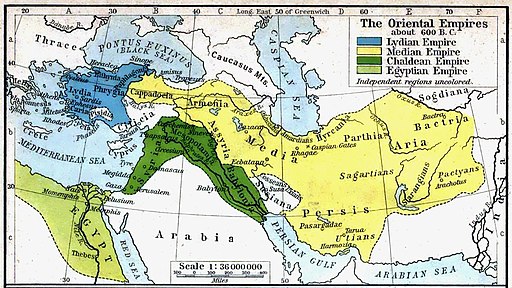
Median Empire

Achaemenid Empire 559 - 330 (BC)

* While Cyrus is obviously the main character of the work, the Assyrian king plays an important role. The Assyrian king falls so completely to Cyrus not just because he is unjust (although he is), but because he does the opposite of what Cyrus does: he rules people in such a way that they hate him. Gobryas lost a son to him; Gadatas was castrated; he attempted to take Pantheia from Abradatas; and the Hyrcanians, Cadusians, and Sacians are all badly used by the Assyrians. Cyrus, on the other side, does everything right to make people want to be ruled by him.

* There are many, many different stories about the Fall of Babylon. Xenophon seems to be following Herodotus in at least broad outlines. The Cyrus Cylinder commissioned by Cyrus claims that the Babylonians opened their gates to him freely. Most sources that give a name take the Assyrian king to be Nabonidus, although sometimes they take him to be captured in Babylon, sometimes in a battle after Babylon, and sometimes killed and sometimes not; the Biblical book of Daniel says it was Belshazzar (Belsharusar), who was Nabonidus's son and not actually the king (although it's very possible he was co-regent by that point). What seems to be the one common thread in it all is that Cyrus captured Babylon suddenly, unexpectedly, and definitively, so that no one knew exactly what happened.

* One of the notable themes throughout (and which would make it a good basis for a movie!) is that Cyrus will set something up that will come to fruition considerably later. To take just one example, he gets the Armenians and Chaldaeans to send messengers to India in Book III, then proceeds through a considerable part of a military campaign before the Indians finally come back with monetary support in Book VI. He is also very good at taking advantage of whatever happens to be at hand and setting it in motion for his ends. But, of course, the major key to his success is that he repeatedly treats people so that they know that being in his good graces is a very good place to be. He dominates because, when he does, everyone benefits.

*********

Quotations are from Xenophon, The Education of Cyrus, Wayne Ambler, tr., Cornell UP (Ithaca, NY: 2001).