Florence: Duomo
Additional views:
Some details:
Another view from the Palazzo Vecchio:
Florence: Palazzo Vecchio
A different view of the Palazzo Vecchio:
The top of the Torre; notice the stairs:
A painting of Hercules:
A view from a window. On the left, the Duomo. On the right, the tower of the Museo Bargello.
Looking northwest out over Florence:
Tuscan hills rising behind Santa Croce:
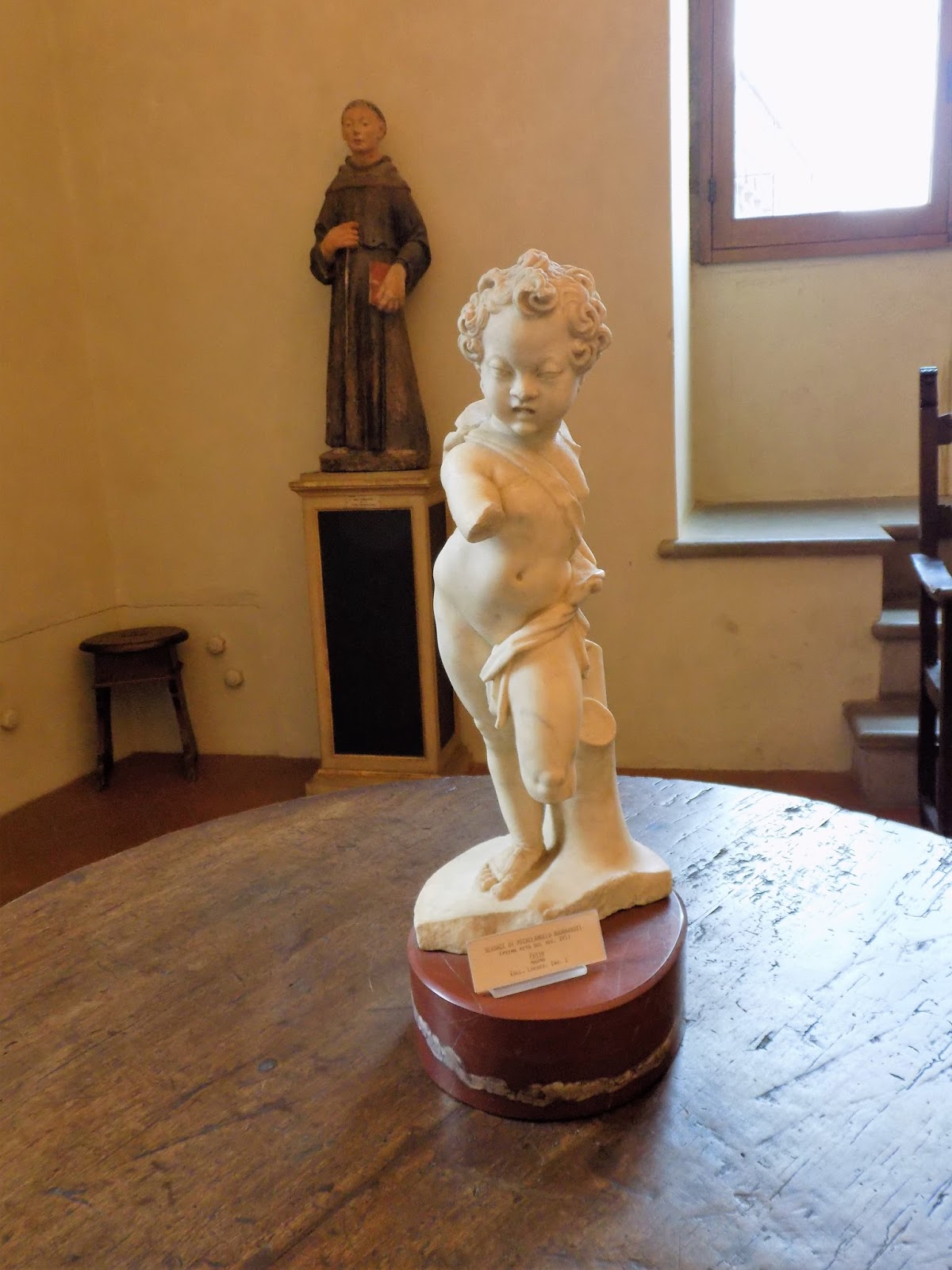
A putto statue:
Looking up at the Torre:
Another view of the David copy in the Piazza della Signoria:
A closer look at the Hercules statue in the Loggia:
to be continued
Saturday, April 23, 2016
Clear Shine the Hills
Of a Toyokuni Color-Print
by William Ernest Henley
Was I a Samurai renowned,
Two-sworded, fierce, immense of bow?
A histrion angular and profound?
A priest? a porter?--Child, although
I have forgotten clean, I know
That in the shade of Fujisan,
What time the cherry-orchards blow,
I loved you once in old Japan.
As here you loiter, flowing-gowned
And hugely sashed, with pins a-row
Your quaint head as with flamelets crowned,
Demure, inviting--even so,
When merry maids in Miyako
To feel the sweet o' the year began,
And green gardens to overflow,
I loved you once in old Japan.
Clear shine the hills; the rice-fields round
Two cranes are circling; sleepy and slow,
A blue canal the lake's blue bound
Breaks at the bamboo bridge; and lo!
Touched with the sundown's spirit and glow,
I see you turn, with flirted fan,
Against the plum-tree's bloomy snow . . .
I loved you once in old Japan!
Envoy
Dear, 'twas a dozen lives ago;
But that I was a lucky man
The Toyokuni here will show:
I loved you--once--in old Japan.
The third stanza comes very near to flawless.
Friday, April 22, 2016
Some Poem Drafts
Except for the last one, all of these are inspired by other poems. The first is based on a passage in the Kalevala (Runo 21); the second on one of the odes of Gregory of Narek, the images of which it follows fairly closely (it is 13A in Terian's The Festal Works of St. Gregory of Narek); the third on a short stretch of passage from the Old English poem The Seafarer; the fourth from one of the poems in Ezra Pound's Cathay.
Ale
Ale, you are the drink delicious,
stripping sorrow from the drinker,
bringing song to all the people;
may they shout with mouths sweet-gilded
as the lords are made to wonder,
ladies, too, to contemplate it.
Soon the song will fade and falter,
joys will fall to shameful silence,
if the ale is brewed too badly,
if the drink has not its goodness;
soon the singers lose their voices,
soon the songs are dim and tepid,
soon the guests are dull with quiet,
soon the songbirds stop rejoicing,
if the beer is sour and wretched.
Ale, you are the drink delicious,
bringing joy to any people,
urging song upon their voices;
may your brew be laughter golden,
may your taste be pure and good!
Gregory of Narek Sings of the Transfiguration
The gem-rose was bright, sunlit;
a bloom spread above from the sea;
from the far, wide sea it burst.
It glittered like fruit, like saffron,
like fruit in thick leaves, psalm-sung,
in David's fair song remembered.
In bright rose-bouquet hues shone.
Rose were the branches of poplar,
cedar and cypress rose high.
The valley-lily shone brightly.
North wind blew softly, a breeze;
from the south showered gentle mists.
Dew kissed the lily, pearl-like,
droplets of bright dew from sun-clouds.
All bright stars circle on high,
constellations bright like lilies.
Praise to the Father, the Son,
the Holy Spirit, Three and One.
Seafaring
I ache, grim-ridden, this ship a place of cares,
waves a-wilding,
anxious nightwatch extending
in worry at trembling cliffs.
Cold-enchained my feet, frost-bound, chill-clasped,
but cares boil hot in the heart,
hunger eating from inside the sea-tired soul.
Mei Sheng Ponders
Verdant the verdure by the river,
where willows overflow the way,
the lady, pale and pausing,
puts forth small hand upon the door.
Once a lady of the nighttime,
she became a drunkard's lady;
he leaves in drunkenness and stumbling.
Too often is she alone.
Misery
May this verse into oblivion fall,
and nevermore remembered be,
that none may of your life recall
or save you for a memory;
may none remember how you lied,
or how our love within you died.
So I curse you, though it curse me!
May this verse into oblivion fall,
that none your treasons may revive,
that none your evil may recall,
that none may think you once alive;
may your shade through silence glide
who in this life our love denied.
So I curse you, though it curse me!
Apud Quem Vivunt
An interesting passage by Aquinas:
A privilege is a law that concerns itself with a single person; the examples of those sanctified in the womb that Aquinas has in mind would be the Virgin Mary, the prophet Jeremiah, and John the Baptist.
...pueri in maternis uteris existentes nondum prodierunt in lucem, ut cum aliis hominibus vitam ducant. Unde non possunt subiici actioni humanae, ut per eorum ministerium sacramenta recipiant ad salutem. Possunt tamen subiici operationi Dei, apud quem vivunt, ut quodam privilegio gratiae sanctificationem consequantur, sicut patet de sanctificatis in utero.Aquinas [ST 3.68.11 ad 1, my translation; Dominican Fathers translation here]
Children in the maternal womb have not yet been born so as to lead a life with other human beings. Thus they are not able to be subject to human action so as by such ministry to receive the sacrament [of baptism] unto salvation. They are able however, to be subject to the action of God, in Whose presence they live, so as to attain by a sort of privilege sanctifying grace, as is obvious with those sanctified in the womb.
A privilege is a law that concerns itself with a single person; the examples of those sanctified in the womb that Aquinas has in mind would be the Virgin Mary, the prophet Jeremiah, and John the Baptist.
Thursday, April 21, 2016
PSA
obtuse: unintelligent, stupid; from Latin obtusus, dull, blunt, the state belonging to the edge of a blade that has been heavily beaten.
obscure: difficult to understand, not widely known, hidden in darkness; from Latin obscurus, dark, hidden, unintelligible, secret, as in something covered up.
abstruse: difficult to understand; from Latin abstrusus, concealed, hidden away, as in something pushed out of view.
obscure: difficult to understand, not widely known, hidden in darkness; from Latin obscurus, dark, hidden, unintelligible, secret, as in something covered up.
abstruse: difficult to understand; from Latin abstrusus, concealed, hidden away, as in something pushed out of view.
St. Anselm on 'Facere' and Making Someone Dead
Today is the feast of St. Anselm of Canterbury. A bit of something from Anselm's philosophical fragments (I use Jasper Hopkins's translation).
The Latin for 'doing/causing' here is facere, which means, 'making something so'; as Anselm notes, we can substitute it for any verb, even paradoxically one that means making something not to be so. We'll just look at what can be meant when we talk about making something to be such-and-such.
He gives examples, which we can go through; I'll call the people in question John and Bob.
(1) John makes Bob dead (directly)
Thus, if I say, "John makes it so that Bob is dead", I can mean that John actually kills Bob (his action in and of itself makes Bob dead).
(2) (2) John does not make Bob not to be dead (directly)
If I say, "John makes it so that Bob is dead", I could also mean that Bob is dead, and John is able to make him not-dead, but is not doing so.
(3) John makes Bob dead (by making something else make him dead)
If I say, "John makes it so that Bob is dead", I could also mean that John arranged it so that something else would make Bob die -- for instance, by hiring an assassin.
(4) John makes Bob dead (by not making something else make him not dead)
Anselm's examples are if John made it so that Bob is dead by not giving Bob a weapon to defend himself when someone was attacking him, or by not stopping the killer from killing Bob.
(5) John makes Bob dead (by making something else not make him not dead)
In (4), John made Bob to be dead by not giving him a weapon to defend himself; in (5), John might make Bob to be dead by removing his weapon so he can't defend himself.
(6) John does not make Bob not to be dead (by not making something else not make him dead)
So here John makes Bob to be dead by not making the thing that killed Bob not to be.
As he sums up:
One could imagine a mystery novel built around these ways of making someone dead.
Anselm goes on to note that the same classification applies if we are talking about causing something not to exist -- after all, if John makes Bob to be dead, that's the same as making him not alive. Likewise, not causing something to be works in a similar way, since if John makes Bob to be dead, he does not make him to continue living, so, although the examples are less obvious, we could talk about ineffective causes of death in just the same way we talked above about effective ones. In fact, we have four sets of six:
making Bob to be dead
not making Bob not to be dead
making Bob not to be alive
not making Bob to be alive
The reason is the paradox noted above: facere (like doing in English) can substitute for any verb, including those that mean not doing something.
For those interested in modal logic, Sara Uckelman has an interesting paper on what agentive logic would fit Anselm's discussion of facere best.
Let us now understand doing (causing) in terms of a classification. Since a doing (causing) is always either in relation to being or in relation to not-being, (as has been said), we will be obliged to add “to be” or “not to be” to the distinct modes of doing (causing) in order for them to be clearly distinguished.
The Latin for 'doing/causing' here is facere, which means, 'making something so'; as Anselm notes, we can substitute it for any verb, even paradoxically one that means making something not to be so. We'll just look at what can be meant when we talk about making something to be such-and-such.
Accordingly, we speak in six modes about causing [to be]: in two modes when a cause (A.1) causes to be, or (A.2) does not cause not to be, that very thing which it is said to cause [to be]; and in four modes when it (A.3 - A.6) either does or does not cause something else to be or not to be. For, indeed, we say of any given thing “It causes something to be” either because it (1) causes-to-be the very thing which it is said to cause [to be], or because it (2) does not cause this very thing not to be, or because it (3) causes something else to be, or because it (4) does not cause something else to be, or because it (5) causes something else not to be, or because it (6) does not cause something else not to be.
He gives examples, which we can go through; I'll call the people in question John and Bob.
(1) John makes Bob dead (directly)
When someone who kills a man with a sword is said to cause him to be dead, [it is said] in the first mode. For he directly (per se) causes the very thing which he is said to cause.
Thus, if I say, "John makes it so that Bob is dead", I can mean that John actually kills Bob (his action in and of itself makes Bob dead).
(2) (2) John does not make Bob not to be dead (directly)
If I say, "John makes it so that Bob is dead", I could also mean that Bob is dead, and John is able to make him not-dead, but is not doing so.
(3) John makes Bob dead (by making something else make him dead)
If I say, "John makes it so that Bob is dead", I could also mean that John arranged it so that something else would make Bob die -- for instance, by hiring an assassin.
(4) John makes Bob dead (by not making something else make him not dead)
Anselm's examples are if John made it so that Bob is dead by not giving Bob a weapon to defend himself when someone was attacking him, or by not stopping the killer from killing Bob.
(5) John makes Bob dead (by making something else not make him not dead)
In (4), John made Bob to be dead by not giving him a weapon to defend himself; in (5), John might make Bob to be dead by removing his weapon so he can't defend himself.
(6) John does not make Bob not to be dead (by not making something else not make him dead)
It accords with the sixth mode when the one who did not cause the killer not to be armed, by removing his weapons, is accused of having killed the victim—or when the man who did not lead the intended victim away so that he would not be in the presence of the killer is so accused. These individuals too did not kill directly. Rather, they killed indirectly—viz., by not causing something else not to be.
So here John makes Bob to be dead by not making the thing that killed Bob not to be.
As he sums up:
Now, in the five modes after the first mode efficient causes do not cause what they are said to cause. Nevertheless— since the second mode does not cause not to be what the first mode causes to be, and since the third mode causes something else to be, and the fourth mode causes something else not to be, and the fifth mode does not cause something else to be, and the sixth mode does not cause something else not to be—efficient causes are said to cause what the first mode causes (as I have exemplified in every mode).
One could imagine a mystery novel built around these ways of making someone dead.
Anselm goes on to note that the same classification applies if we are talking about causing something not to exist -- after all, if John makes Bob to be dead, that's the same as making him not alive. Likewise, not causing something to be works in a similar way, since if John makes Bob to be dead, he does not make him to continue living, so, although the examples are less obvious, we could talk about ineffective causes of death in just the same way we talked above about effective ones. In fact, we have four sets of six:
making Bob to be dead
not making Bob not to be dead
making Bob not to be alive
not making Bob to be alive
The reason is the paradox noted above: facere (like doing in English) can substitute for any verb, including those that mean not doing something.
For those interested in modal logic, Sara Uckelman has an interesting paper on what agentive logic would fit Anselm's discussion of facere best.
Wednesday, April 20, 2016
A Quick Trip to Italy, Part XIV
The most famous sightseeing spot in Milan, of course, is at the church of Santa Maria delle Grazie, which we see here from inside its courtyard:
Santa Maria delle Grazie was built under the Sforza family. The Dominican convent to which it was attached was designed by the great Milanese architect Guiniforte Solari. It's not known for sure who designed the church itself. The traditional attribution is to Donato Bramante, but it could also be designed by Giovanni Antonio Amadeo; both architects were active in the Duchy of Milan during the right time period -- indeed, they sometimes collaborated. I didn't get any pictures of the inside of the church, but you can take a virtual tour online, with Italian commentary if you'd like it (click the fourth icon for the view of the inside of the church). It actually looks better online; it was quite dim and unlit when we were there. The church was hit by Allied bombardment in 1943, and was severely damaged. The refectory was almost destroyed, too, with one wall alone surviving, which had to be held up by sandbags. On that wall is the reason why Santa Maria delle Grazie is one of the most famous sightseeing attractions in the world: in the late fifteenth century Leonardo da Vinci painted a mural for the monks to look at while eating, The Last Supper. Unfortunately, you need reservations well in advance to get in to see it, and we were not able to get reservations for the time we were in Milan.
We were running out of time, so we headed back to the hotel. We stopped briefly, however, at another Milanese attraction, the Castello Sforzesco. Here is one of its towers (the Torrione di Santo Spirito, I believe):
The most famous architectural element of the Sforza Castle is the Torre del Filarete, seen here from inside the Cortile delle Armi:
It gets its name from its architect, Antonio di Pietro Averlino, more commonly known as Filarete. He was a Florentine who spent most of his career in Rome, but had to flee the city at some point when he was accused of trying to steal the head of John the Baptist (i.e., the relic that the Romans had traditionally claimed was the head of the Baptizer) from the church of San Silvestro in Capite. He eventually came to Milan to work on the Duomo and was hired to help restore the glory of Sforza Castle, which had seen better days by that point. (It was nearly destroyed by the republicans of the Golden Ambrosian Republic, and so Francesco's Sforza's restoration was a deliberate statement of warning to, and superiority over, any republican sympathizers.) The current Filarete Tower was restored in the early twentieth century on the basis of old drawings.
Here we look opposite of the Torre del Filarete to the Porta Giovia and Torre di Bona:
A large number of museums can be found throughout the castle. Like much of the Milan, the castle was heavily damaged in World War II; the museums help make restoration and preservation viable.
We were, however, running out of time, so we headed out....
One of the more striking buildings in Milan is the Milano Centrale railway station, which is a mix of Art Nouveau and Art Deco. It was opened in the 1930s. It was designed by architect Ulisse Stachini and deliberately modeled on Union Station in Washington, DC, although a number of changes were introduced into the original design, particularly under Mussolini. Here we catch a brief glimpse of one wing of it at night, looking across the Piazza Duca d'Aosta:
And the next day we flew away. Here are the Alps from Malpensa Airport; somewhere out there, out of sight, is Switzerland:
I'll follow at some point with some miscellaneous pictures.
Subscribe to:
Posts (Atom)