Somewhere or Other
by Christina Rossetti
Somewhere or other there must surely be
The face not seen, the voice not heard,
The heart that not yet—never yet—ah me!
Made answer to my word.
Somewhere or other, may be near or far;
Past land and sea, clean out of sight;
Beyond the wandering moon, beyond the star
That tracks her night by night.
Somewhere or other, may be far or near;
With just a wall, a hedge, between;
With just the last leaves of the dying year
Fallen on a turf grown green.
Saturday, July 23, 2016
Beyond the Wandering Moon
Maronite Year LXI
Youssef Antoun Makhluf was born in 1828 in Bekaa Kafra in the mountains of Lebanon. He eventually entered the Lebanese Maronite Order; he then took the name Sharbel, or Charbel, and studied briefly under St. Nemetulla Kassab. In 1874, he became a monastic hermit, and he died on December 24, 1898. Pope Paul VI beatified him in 1965 and raised him to the general calendar in 1977.
Feast of St. Sharbel
Romans 8:28-29; Matthew 13:36-43
O Christ our Light, You fill the earth with light;
You choose worthy teachers to teach Your Church,
securing the good of those who love God,
molding Your people into Your image.
You give Your saints the word of life and truth;
as flame to flame they kindle ardent faith,
each a star to show us the path of life.
From Sharbel's hermitage a great light shines:
through his prayers we receive salvation,
through his intercessions, health of spirit.
O Sharbel, you found the pearl of great price,
giving everything that you might have it.
Our Lord Jesus Christ called you to follow,
and without hesitation you followed.
Feast of St. Sharbel
Romans 8:28-29; Matthew 13:36-43
O Christ our Light, You fill the earth with light;
You choose worthy teachers to teach Your Church,
securing the good of those who love God,
molding Your people into Your image.
You give Your saints the word of life and truth;
as flame to flame they kindle ardent faith,
each a star to show us the path of life.
From Sharbel's hermitage a great light shines:
through his prayers we receive salvation,
through his intercessions, health of spirit.
O Sharbel, you found the pearl of great price,
giving everything that you might have it.
Our Lord Jesus Christ called you to follow,
and without hesitation you followed.
Friday, July 22, 2016
Dashed Off XVI
This takes me up to December 25, 2014 in my notebooks.
Every method is a means with a degree of appropriateness to a context and to an end.
The method of doubt establishes that mind has a teleology.
An event requires location (space), duration (time), and actuality (cause).
respect for individuals as protection against mobbing
A theory drawn from or supported by experiments must be interpreted in ways consistent with the possibility and existence of those experiments and the viability of the supporting inferences.
The chief problem with most theories of punishment is detachment of punishment from questions of justice.
(1) Scriptural memorial of the work of Christ
(2) liturgical enactment of the work of Christ
Scripture as implicate Tradition; Tradition as explicate Scripture. Scripture as Tradition in rule; Tradition as Scripture in life.
Tradition as that which is required fully to unfold Scripture
1 Cor 11:23 & the nature of Tradition
Private revelations as probable confirmations and suggestive clarifications.
Form is that which is capable of having likeness to other forms. (Less trivial than it sounds, particularly with respect to cognition.) Matter is that which limits this capability in form (although form may, e.g., insofar as it has reference to matter, have intrinsic limitations as well).
the capital vices as disorders of humanity itself
Truths about bad deeds are easily poisoned by lies, for people will believe anything about those whom they regard as clearly having done wrong.
"How could that which does not make a man worse, make his life worse?" (Marcus Aurelius)
"We are all working together to complete one work; some of us knowingly and consciously and the others consciously." (Marcus Aurelius)
mereotopology as a theory of distinction and relations among the distinguished
faith expressed in works, in authority, in memory, in tradition, in institution, in reasoning, in ascetic life, in mystical life
It is curious that naturalists have a tendency to reject purely formal accounts of mathematics (platonistic) in favor of purely teleological ones (constructivistic).
the intrinsic structure of observation as the most fundamental issue in philosophy of science (note that this includes but is not reducible to the structure of perception)
mereotopological structures implicit in experimentation
the importance of boundary-to-experiment for experimentation -- with some kinds of experiment, this is very clear; boundaries need to be in place for reasons of avoiding contamination, isolating effects, and simplifying reasoning about the experiment
act, potency, and the principle of causality as the intrinsic structure of sensations
the martyr's prize, the tyrant's eternal torment by fire: 4 Macc 9:9, 9:31-32, 10:10-11, 10:15, 11:3, 12:12, 12:18, 13;15, 18:3-5, 18:18, 18:22-23
4 Macc 13:16 -- 'the full armor of self-control, which is divine reason'
4 Macc 14:7 -- 'the seven days of creation move in choral dance around religion'
4 Macc 16:25 -- 'those who die for the sake of God live to God, as do Abraham and Isaac and Jacob and all the patriarchs'
4 Macc 17:6 -- 'for your childbearing was from Abraham the father'
4 Macc 17:21 -- 'they having become as it were a ransom for the sin of our nation'
4 Macc 17:22 -- 'through the blood' & 'through their death as a hilasterion' (cp Rm 3:25, Hb 9:11-15, 1 Pt 1:19, 1 Jn 1:7)
Purity is primarily purity of reason.
inquiry into angelic knowledge as inquiry into contemplative life
the preparticles of a particle (preparticular properties) -- even the old atomoi had geometrical preparticles
Two problems w/ common Calvinist approaches to Scripture (which otherwise are often excellent): (1) ambiguity about what Scripture is; (2) treatment of all Scripture as positive law even when it is clearly not being an arbitrary authority but teaching reasons.
pleasure as fineza
Aristotelian logic takes known-making as important.
experimental reasoning as proof by sign/example
continuum : composition :: discrete number : division
aesthetic criticism and the involution of art
All technical skills are refined by an aesthetic criticism appropriate to them.
style as a relation to a medium
the aesthetics of philosophical system (we already see this in much of the comparison of scholasticism and cathedral architecture)
Kardinsky's three internal necessities of art: (1) personal expression; (2) Zeitgeist; (3) helping the cause of art
creativity in experimentation, experiments as works of art
experiment as an extrinsic teleological organization of intrinsic final causes
the depreciation of final and formal causes in modern thought as related to the tendency to ignore the character and conditions of experiment
To predict the future course of scientific inquiry would be to produce it before it was produced. (cp Hulme on creativity in art)
experiment // architecture
in being constructed of design solutions
angelic knowledge : contemplation :: angelic speech : magisterial teaching
Act and potency is how we explain two becoming one.
Our intellect is not of singulars directly not because they are singular but because our minds are acquainted with singulars that are material.
angelic knowledge & angelic speech as limit concepts
recreational use of sophisms
Philosophical or political response to evil is only the vigilance of a siege or leaguer, not an uprooting.
Magic tricks are less often unwound by analysis than by history.
principle of causality as integral to identity: if appearances A remain the same while reality R changes, some cause must maintain A as R changes; if reality R changes, some cause must change it
Tools are a kind of sign, so all animals capable of sign use above a certain sophistication are capable of tool use.
'Full of grace' is used by the angel not merely as a description but as a title under which she may be hailed.
Jesus (1) will be great; (2) will be called Son of the Most High; (3) will be given by God the throne of David his father; (4) will rule over the house of Jacob forever; (5) will have no end to his kingdom; (6) will be called holy, the Son of God.
What is manifested through the prophetic writings is manifested in the fulfillment of them.
To endure in the face of evil and difficulty is in and of itself a good.
sense of Scripture as type of the Spirit's work of Tradition
Benefits and harms obviously must be evaluated not merely quantitatively but also qualitatively.
Christ offers Himself (1) on the altar of the world; (2) on the altar of the Cross; (3) on the altars of His people through His priests; (4) at the Throne of God.
The sacrifice of Christ on the Cross is offered on the altar under the sign of the separation of Body and Blood.
enacted vs unenacted memorial
hierarchies of art structured by the two poles of ingenuity-based rendering in visible way of the universal essence, and technical copying of the particular appearance
rhyparography
models as analogical experiments
Intellect 'is a part of ourselves, and we ascend toward it.' (Plotinus)
reproduction as economic system
a dusk of images
the link between the sublime and the purifying
Medieval commentaries often called Lamentations 'Lamentation of Lamentations' to highlight parallel with Song of Songs; seems to be due to Paschasius Radbertus.
Lamentations and salutiferus dolor
Lamentations read morally as an account of human fallenness & repentance; allegorically as an account of persecution
giving one's cheek to the smiter: Lam 3:30 // Mt 5:39
Lam 4:20-22 & atonement
"There are only three ways of judging the prophets: they told the truth, deliberately invented a tale, or were victims of an illusion." Herschel, God in Search of Man
transmission of original sin as negative image of transmission of original justice; the transmission of original justice as parallel/analogous to sacred Tradition
Adam / Christ
Head of humanity / Head of Mystical Body
human solidarity / charitable union of members in Mystical Body
original justice / impress of Christ through faith and sacrament
generation (genealogy) / tradition
fake-awesome as misdirected sublimity (C. Hodge)
Balaam's Ass as a type of the Church (Irenaeus)
obligations arising from summation of possible actions with respect to (1) happiness of oneself; (2) happiness of others; (3) self-harm; (4) harming of others
omniscience Ps 139:1-6
omnipresence Ps 139:7-12
omnipotence Ps 139:13-16
holiness Ps 139:17-24
"each of us has been the Adam of his own soul" (2 Baruch 54:19)
Sir 3:3 & Jesus' honoring of his Father as atonement for sins
Tob 12:9 & Jesus' works of mercy as atonement for sins
'Generations' in Genesis seems to suggest an inheritance or reception-from (note particular 2:4, but also 6:9, where it seems it must include more than mere descent).
The Church teaches not only by laying down definitive limits but also by giving nondefinitive central lines. (Church approval & encouragement of popular devotions is a good example.)
bread of God Lv 3:11,16; 21:6,8,17,22f.
washed with water Lv 8:6-9
anointed with oil Lv8:12
consecrated by sacrifice Lv 8:14ff
David made king (1) privately in Bethlehem (1 Sam 16:13); (2) over Judah in Hebron (2 Sam 2:4); (3) over all Israel in Hebron (2 Sam 5:3)
The canon of the more difficult reading is simply that simple elimination of difficulty may always be done to eliminate difficulty, but introduction of difficulty requires special causal explanation. (i.e., it is based on the asymmetry of removal and addition)
As the sacraments are the presence of Christ and His Spirit, priests serve them and are not lords of them.
impartial spectator and the virtue of prudence (when Smith uses 'prudence', of course, he means something very narrow)
Note esp. his discussion of systems based on propriety, in which he holds that the propriety must be determined by "the sympathetic feelings of the impartial and well-informed spectator"
honor & tradition as integral to large-scale and extensive forms of caring
Without honor, caring becomes betrayal.
the general structure of the Pentateuch as the general structure of reception of revelation
original justice as intrinsic covenant, as radical solidarity, as that which unites priesthood, prophecy, and royalty in a unified (unfragmented) seminal form
To think of Christian life as encounter is not bold enough.
Interpretation of a text is limited by one's ability to discover its final causes.
The starting point of philosophical theology is -- everything available.
knowledge of good and evil as being situated so as to pronounce on what is to be done (see W. Malcolm Clark's 1969 article on this, which is quite a good start)
Merismus is always toned or valenced.
"Life is not made for delicate souls." (Seneca)
"An ugly man, if alive, is more beautiful than a man portrayed in a statue, however beautiful it may be." (Plotinus)
progress of calendar calculation, music, architecture in the liturgical commonwealth
the role of analogies of analogies in theory formation
Jer 1:10 & the papacy (Innocent III)
Melchizedek as a type of the papacy (Innocent III)
what is useful in common as approximation of the just
"every friendship is found in community" (Aristotle)
style as the presence of the author
People most fear death as powerlessness or else as ending of delight.
Titus 2:11-14 & the cardinal virtues
The first step in being a true friend to another is being a true friend to oneself.
Writing on its own presupposes an immense number of things about sensation and cognition.
The good of friendship cannot be reduced to pleasure or preference-satisfaction, although some friendships are constituted by mutual pursuit of pleasure or preference-satisfaction.
plurality of societies and plurality of hopes
A totalitarian regime attempts to eliminate sources of hope.
galley effect and perspective
Doctor debet habere fundamentum doctrinae, et perfectionem.
certain forms of higher criticism as giving heed to fables (purely speculative scenarios) and endless genealogies (of texts)
sophrosyne in Titus
cinema as a visual medium for exhibiting aspiration (sometimes by negative): aspiration made visible and audible in a followable narrative
Without honor and tradition, there is no romance; not because every romantic must directly draw on them but because every action is recognized as romantic only in light of them.
the baptism of John & Jesus as participating in Jewish prophetic tradition (// circumcision and Jesus as participating in Jewish covenant)
symbolism as the natural cognitive environment of human beings
(1) The means to an end can only be agreeable where the end is agreeable. (T 3.3.1.9 (SBN 577))
(2) Means to an end are only valued so far as the end is valued. (T 3.3.6.2 (SBN 619))
(3) Whoever chooses the means chooses the end. (T 3.2.7.4 (SBN 536)
(4) It is a contradiction in terms that anything pleases as a means to an end where the end itself in no wise affects us. (EPM 5.17 (SBN 219))
Liberalizing an institution without breaking it is not a straightforward matter; the danger is that one will achieve the goal at the cost of making people think it not worth their time and energy in the first place.
the danger of not appreciating Scripture in its own right, of using it solely as a means for addressing this question or that
Every method is a means with a degree of appropriateness to a context and to an end.
The method of doubt establishes that mind has a teleology.
An event requires location (space), duration (time), and actuality (cause).
respect for individuals as protection against mobbing
A theory drawn from or supported by experiments must be interpreted in ways consistent with the possibility and existence of those experiments and the viability of the supporting inferences.
The chief problem with most theories of punishment is detachment of punishment from questions of justice.
(1) Scriptural memorial of the work of Christ
(2) liturgical enactment of the work of Christ
Scripture as implicate Tradition; Tradition as explicate Scripture. Scripture as Tradition in rule; Tradition as Scripture in life.
Tradition as that which is required fully to unfold Scripture
1 Cor 11:23 & the nature of Tradition
Private revelations as probable confirmations and suggestive clarifications.
Form is that which is capable of having likeness to other forms. (Less trivial than it sounds, particularly with respect to cognition.) Matter is that which limits this capability in form (although form may, e.g., insofar as it has reference to matter, have intrinsic limitations as well).
the capital vices as disorders of humanity itself
Truths about bad deeds are easily poisoned by lies, for people will believe anything about those whom they regard as clearly having done wrong.
"How could that which does not make a man worse, make his life worse?" (Marcus Aurelius)
"We are all working together to complete one work; some of us knowingly and consciously and the others consciously." (Marcus Aurelius)
mereotopology as a theory of distinction and relations among the distinguished
faith expressed in works, in authority, in memory, in tradition, in institution, in reasoning, in ascetic life, in mystical life
It is curious that naturalists have a tendency to reject purely formal accounts of mathematics (platonistic) in favor of purely teleological ones (constructivistic).
the intrinsic structure of observation as the most fundamental issue in philosophy of science (note that this includes but is not reducible to the structure of perception)
mereotopological structures implicit in experimentation
the importance of boundary-to-experiment for experimentation -- with some kinds of experiment, this is very clear; boundaries need to be in place for reasons of avoiding contamination, isolating effects, and simplifying reasoning about the experiment
act, potency, and the principle of causality as the intrinsic structure of sensations
the martyr's prize, the tyrant's eternal torment by fire: 4 Macc 9:9, 9:31-32, 10:10-11, 10:15, 11:3, 12:12, 12:18, 13;15, 18:3-5, 18:18, 18:22-23
4 Macc 13:16 -- 'the full armor of self-control, which is divine reason'
4 Macc 14:7 -- 'the seven days of creation move in choral dance around religion'
4 Macc 16:25 -- 'those who die for the sake of God live to God, as do Abraham and Isaac and Jacob and all the patriarchs'
4 Macc 17:6 -- 'for your childbearing was from Abraham the father'
4 Macc 17:21 -- 'they having become as it were a ransom for the sin of our nation'
4 Macc 17:22 -- 'through the blood' & 'through their death as a hilasterion' (cp Rm 3:25, Hb 9:11-15, 1 Pt 1:19, 1 Jn 1:7)
Purity is primarily purity of reason.
inquiry into angelic knowledge as inquiry into contemplative life
the preparticles of a particle (preparticular properties) -- even the old atomoi had geometrical preparticles
Two problems w/ common Calvinist approaches to Scripture (which otherwise are often excellent): (1) ambiguity about what Scripture is; (2) treatment of all Scripture as positive law even when it is clearly not being an arbitrary authority but teaching reasons.
pleasure as fineza
Aristotelian logic takes known-making as important.
experimental reasoning as proof by sign/example
continuum : composition :: discrete number : division
aesthetic criticism and the involution of art
All technical skills are refined by an aesthetic criticism appropriate to them.
style as a relation to a medium
the aesthetics of philosophical system (we already see this in much of the comparison of scholasticism and cathedral architecture)
Kardinsky's three internal necessities of art: (1) personal expression; (2) Zeitgeist; (3) helping the cause of art
creativity in experimentation, experiments as works of art
experiment as an extrinsic teleological organization of intrinsic final causes
the depreciation of final and formal causes in modern thought as related to the tendency to ignore the character and conditions of experiment
To predict the future course of scientific inquiry would be to produce it before it was produced. (cp Hulme on creativity in art)
experiment // architecture
in being constructed of design solutions
angelic knowledge : contemplation :: angelic speech : magisterial teaching
Act and potency is how we explain two becoming one.
Our intellect is not of singulars directly not because they are singular but because our minds are acquainted with singulars that are material.
angelic knowledge & angelic speech as limit concepts
recreational use of sophisms
Philosophical or political response to evil is only the vigilance of a siege or leaguer, not an uprooting.
Magic tricks are less often unwound by analysis than by history.
principle of causality as integral to identity: if appearances A remain the same while reality R changes, some cause must maintain A as R changes; if reality R changes, some cause must change it
Tools are a kind of sign, so all animals capable of sign use above a certain sophistication are capable of tool use.
'Full of grace' is used by the angel not merely as a description but as a title under which she may be hailed.
Jesus (1) will be great; (2) will be called Son of the Most High; (3) will be given by God the throne of David his father; (4) will rule over the house of Jacob forever; (5) will have no end to his kingdom; (6) will be called holy, the Son of God.
What is manifested through the prophetic writings is manifested in the fulfillment of them.
To endure in the face of evil and difficulty is in and of itself a good.
sense of Scripture as type of the Spirit's work of Tradition
Benefits and harms obviously must be evaluated not merely quantitatively but also qualitatively.
Christ offers Himself (1) on the altar of the world; (2) on the altar of the Cross; (3) on the altars of His people through His priests; (4) at the Throne of God.
The sacrifice of Christ on the Cross is offered on the altar under the sign of the separation of Body and Blood.
enacted vs unenacted memorial
hierarchies of art structured by the two poles of ingenuity-based rendering in visible way of the universal essence, and technical copying of the particular appearance
rhyparography
models as analogical experiments
Intellect 'is a part of ourselves, and we ascend toward it.' (Plotinus)
reproduction as economic system
a dusk of images
the link between the sublime and the purifying
Medieval commentaries often called Lamentations 'Lamentation of Lamentations' to highlight parallel with Song of Songs; seems to be due to Paschasius Radbertus.
Lamentations and salutiferus dolor
Lamentations read morally as an account of human fallenness & repentance; allegorically as an account of persecution
giving one's cheek to the smiter: Lam 3:30 // Mt 5:39
Lam 4:20-22 & atonement
"There are only three ways of judging the prophets: they told the truth, deliberately invented a tale, or were victims of an illusion." Herschel, God in Search of Man
transmission of original sin as negative image of transmission of original justice; the transmission of original justice as parallel/analogous to sacred Tradition
Adam / Christ
Head of humanity / Head of Mystical Body
human solidarity / charitable union of members in Mystical Body
original justice / impress of Christ through faith and sacrament
generation (genealogy) / tradition
fake-awesome as misdirected sublimity (C. Hodge)
Balaam's Ass as a type of the Church (Irenaeus)
obligations arising from summation of possible actions with respect to (1) happiness of oneself; (2) happiness of others; (3) self-harm; (4) harming of others
omniscience Ps 139:1-6
omnipresence Ps 139:7-12
omnipotence Ps 139:13-16
holiness Ps 139:17-24
"each of us has been the Adam of his own soul" (2 Baruch 54:19)
Sir 3:3 & Jesus' honoring of his Father as atonement for sins
Tob 12:9 & Jesus' works of mercy as atonement for sins
'Generations' in Genesis seems to suggest an inheritance or reception-from (note particular 2:4, but also 6:9, where it seems it must include more than mere descent).
The Church teaches not only by laying down definitive limits but also by giving nondefinitive central lines. (Church approval & encouragement of popular devotions is a good example.)
bread of God Lv 3:11,16; 21:6,8,17,22f.
washed with water Lv 8:6-9
anointed with oil Lv8:12
consecrated by sacrifice Lv 8:14ff
David made king (1) privately in Bethlehem (1 Sam 16:13); (2) over Judah in Hebron (2 Sam 2:4); (3) over all Israel in Hebron (2 Sam 5:3)
The canon of the more difficult reading is simply that simple elimination of difficulty may always be done to eliminate difficulty, but introduction of difficulty requires special causal explanation. (i.e., it is based on the asymmetry of removal and addition)
As the sacraments are the presence of Christ and His Spirit, priests serve them and are not lords of them.
impartial spectator and the virtue of prudence (when Smith uses 'prudence', of course, he means something very narrow)
Note esp. his discussion of systems based on propriety, in which he holds that the propriety must be determined by "the sympathetic feelings of the impartial and well-informed spectator"
honor & tradition as integral to large-scale and extensive forms of caring
Without honor, caring becomes betrayal.
the general structure of the Pentateuch as the general structure of reception of revelation
original justice as intrinsic covenant, as radical solidarity, as that which unites priesthood, prophecy, and royalty in a unified (unfragmented) seminal form
To think of Christian life as encounter is not bold enough.
Interpretation of a text is limited by one's ability to discover its final causes.
The starting point of philosophical theology is -- everything available.
knowledge of good and evil as being situated so as to pronounce on what is to be done (see W. Malcolm Clark's 1969 article on this, which is quite a good start)
Merismus is always toned or valenced.
"Life is not made for delicate souls." (Seneca)
"An ugly man, if alive, is more beautiful than a man portrayed in a statue, however beautiful it may be." (Plotinus)
progress of calendar calculation, music, architecture in the liturgical commonwealth
the role of analogies of analogies in theory formation
Jer 1:10 & the papacy (Innocent III)
Melchizedek as a type of the papacy (Innocent III)
what is useful in common as approximation of the just
"every friendship is found in community" (Aristotle)
style as the presence of the author
People most fear death as powerlessness or else as ending of delight.
Titus 2:11-14 & the cardinal virtues
The first step in being a true friend to another is being a true friend to oneself.
Writing on its own presupposes an immense number of things about sensation and cognition.
The good of friendship cannot be reduced to pleasure or preference-satisfaction, although some friendships are constituted by mutual pursuit of pleasure or preference-satisfaction.
plurality of societies and plurality of hopes
A totalitarian regime attempts to eliminate sources of hope.
galley effect and perspective
Doctor debet habere fundamentum doctrinae, et perfectionem.
certain forms of higher criticism as giving heed to fables (purely speculative scenarios) and endless genealogies (of texts)
sophrosyne in Titus
cinema as a visual medium for exhibiting aspiration (sometimes by negative): aspiration made visible and audible in a followable narrative
Without honor and tradition, there is no romance; not because every romantic must directly draw on them but because every action is recognized as romantic only in light of them.
the baptism of John & Jesus as participating in Jewish prophetic tradition (// circumcision and Jesus as participating in Jewish covenant)
symbolism as the natural cognitive environment of human beings
(1) The means to an end can only be agreeable where the end is agreeable. (T 3.3.1.9 (SBN 577))
(2) Means to an end are only valued so far as the end is valued. (T 3.3.6.2 (SBN 619))
(3) Whoever chooses the means chooses the end. (T 3.2.7.4 (SBN 536)
(4) It is a contradiction in terms that anything pleases as a means to an end where the end itself in no wise affects us. (EPM 5.17 (SBN 219))
Liberalizing an institution without breaking it is not a straightforward matter; the danger is that one will achieve the goal at the cost of making people think it not worth their time and energy in the first place.
the danger of not appreciating Scripture in its own right, of using it solely as a means for addressing this question or that
Rome, Naples et Florence: October 1816, Part I
We are currently on page 13.
[1er octobre]
Stendhal reflects that the art of Italy, like that of much of Europe, is in shambles: music is «le seul art qui vive encore en Italie». The claim that there are two routes to pleasure in music, «la sublime harmonie» and «la mélodie délicieuse» is an interesting one, although I can't speak to the quality of Stendhal's music history in his discussion of it.
Most of the rest of the day's entry is the Story of Gina, which seems a fairly commonplace story of lovers. I suppose it connects to Stendhal's prior comment connecting the living music of Italy with love. It's possibly notable that Stendhal's Charterhouse of Parma has a character named Gina, although, since I have never read it, I also cannot speak to whether there is any influence on the book to be found here.
[2 octobre]
I confess it took me more than a bit to figure out what chétive was supposed to tell us. So we now learn that Soliva is puny like a man of genius, which is a description I intend to use of someone at some point in the future. And we get more description of the opera, Testa di bronzo, this time focusing on the cast.
[3 octobre]
The orchestra of Milan lacks brio; it is good for sweetness rather than forcefulness, in contrast to the Parisian orchestra of Favart. Thus Stendhal's recipe for a perfect orchestra:
Alessandro Rolla was a musical innovator and the music teacher of Paganini, and was the orchestra director at La Scala from 1802 to 1833. His music was often quite intense -- hence the gossip, which Stendhal also gives, that his music gave women "attacks of nerves".
Alas, I have no idea what Stendhal is trying to convey by his final analogy between French authors and Italian composers.
[4 octobre]
Finally something other than music! Bernardino Luini was a sixteenth century painter whose works are found throughout Northern Italy. Here is Luini's Adoration of the Magi, which I believe was once at Soronno, but now is at the Louvre:

Daniele Crespi is seventeenth century; since Correggio is Stendhal's favorite painter, his saying that he has the sense of Correggio is a high compliment.
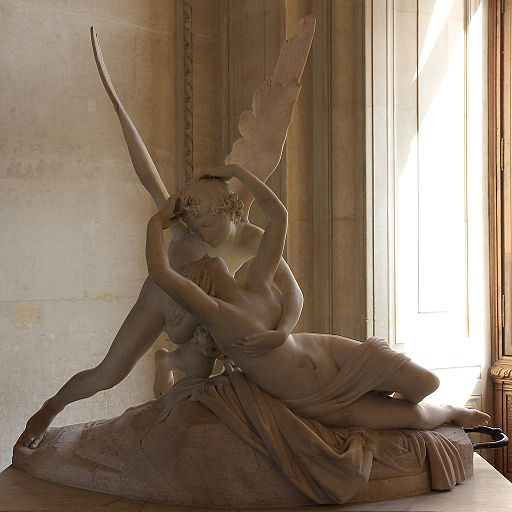
According to Daniel Muller's notes, Antonio Litta (1745-1820) was made duke by Napoleon, and was a particularly high muck-a-muck of Napoleonic Italy. Antonio Canova was the greatest sculptor of the day; it was on his advice that the British Museum bought the Elgin marbles. I don't know what statues by Canova Stendhal would have seen, but Canova's most famous work is Psyche Revived by Cupid's Kiss, which gives a sense of his neoclassical style:
And then more opera. I suppose you really need to appreciate opera to appreciate Stendhal.
The Edinburgh Review gets rather biting with Stendhal's comments on Milan, for perhaps not entirely objective reasons:
David Muller describes this as «un ton un peu pincé». One can hardly blame the reviewer, though. That aside, it's another example of Stendhal's somewhat odd choices in comparisons. And, in any case, you can add 'more chatty than Cicero' to your list of ready insults.
We get a mention of Italian ice cream, and Stendhal is indeed right that it is divine.
[6 octobre]
More of the singing of Angelica Catalani.
If I understand the publication timeline correctly, the Milan entries ended here in the original 1817 edition, and then the work went briefly through Parma and Bologna to get to Florence. In later editions we get a good deal more of Milan.
[7 octobre]
Lady Fanny Harley apparently had a very beautiful face.
[8 octobre]
So beautiful that we're going to talk about it some more.
In seriousness, though, it's interesting that everything we get about Lady Fanny Harley's face is stated entirely in terms of how it reminds Stendhal of paintings. It reminds me of Eco's monks, who always describe things through books.
And there's a break of nearly two weeks in the entries, so we'll pick up again in two weeks on page 34 with bonhomie italienne.
[1er octobre]
Stendhal reflects that the art of Italy, like that of much of Europe, is in shambles: music is «le seul art qui vive encore en Italie». The claim that there are two routes to pleasure in music, «la sublime harmonie» and «la mélodie délicieuse» is an interesting one, although I can't speak to the quality of Stendhal's music history in his discussion of it.
Most of the rest of the day's entry is the Story of Gina, which seems a fairly commonplace story of lovers. I suppose it connects to Stendhal's prior comment connecting the living music of Italy with love. It's possibly notable that Stendhal's Charterhouse of Parma has a character named Gina, although, since I have never read it, I also cannot speak to whether there is any influence on the book to be found here.
[2 octobre]
I confess it took me more than a bit to figure out what chétive was supposed to tell us. So we now learn that Soliva is puny like a man of genius, which is a description I intend to use of someone at some point in the future. And we get more description of the opera, Testa di bronzo, this time focusing on the cast.
[3 octobre]
The orchestra of Milan lacks brio; it is good for sweetness rather than forcefulness, in contrast to the Parisian orchestra of Favart. Thus Stendhal's recipe for a perfect orchestra:
Dans un orchestre parfait, les violons seraient français, les instruments à vent allemands, et le reste italien, y compris le chef d'orchestre.
Alessandro Rolla was a musical innovator and the music teacher of Paganini, and was the orchestra director at La Scala from 1802 to 1833. His music was often quite intense -- hence the gossip, which Stendhal also gives, that his music gave women "attacks of nerves".
Alas, I have no idea what Stendhal is trying to convey by his final analogy between French authors and Italian composers.
[4 octobre]
Finally something other than music! Bernardino Luini was a sixteenth century painter whose works are found throughout Northern Italy. Here is Luini's Adoration of the Magi, which I believe was once at Soronno, but now is at the Louvre:

Daniele Crespi is seventeenth century; since Correggio is Stendhal's favorite painter, his saying that he has the sense of Correggio is a high compliment.
According to Daniel Muller's notes, Antonio Litta (1745-1820) was made duke by Napoleon, and was a particularly high muck-a-muck of Napoleonic Italy. Antonio Canova was the greatest sculptor of the day; it was on his advice that the British Museum bought the Elgin marbles. I don't know what statues by Canova Stendhal would have seen, but Canova's most famous work is Psyche Revived by Cupid's Kiss, which gives a sense of his neoclassical style:

And then more opera. I suppose you really need to appreciate opera to appreciate Stendhal.
The Edinburgh Review gets rather biting with Stendhal's comments on Milan, for perhaps not entirely objective reasons:
About this period of his progress, breaks out that hatred of the English which never quite quits him during his whole journey. In the only remark upon Milan not connected with the theatre, he says the Milanese is remarkable for two things, 'la sagacité et la bonté;' and he adds, 'quand il discute, ile est contraire des Anglais, il est serré comme Tacite.' It is some comfort, however, to find that we are blamed in good company; for it seems, 'dés qu'il ecrit, il veut faire des belles phrase toscanes; et il plus bavard que Ciceron.'
David Muller describes this as «un ton un peu pincé». One can hardly blame the reviewer, though. That aside, it's another example of Stendhal's somewhat odd choices in comparisons. And, in any case, you can add 'more chatty than Cicero' to your list of ready insults.
We get a mention of Italian ice cream, and Stendhal is indeed right that it is divine.
[6 octobre]
More of the singing of Angelica Catalani.
If I understand the publication timeline correctly, the Milan entries ended here in the original 1817 edition, and then the work went briefly through Parma and Bologna to get to Florence. In later editions we get a good deal more of Milan.
[7 octobre]
Lady Fanny Harley apparently had a very beautiful face.
[8 octobre]
So beautiful that we're going to talk about it some more.
In seriousness, though, it's interesting that everything we get about Lady Fanny Harley's face is stated entirely in terms of how it reminds Stendhal of paintings. It reminds me of Eco's monks, who always describe things through books.
And there's a break of nearly two weeks in the entries, so we'll pick up again in two weeks on page 34 with bonhomie italienne.
Thursday, July 21, 2016
The Opposite of 'Hypocritical' Is...
...'penitent'.
This is actually quite clear if one reads Jesus's denunciations of hypocrisy in context. What makes hypocrisy actually wrong? That it is a way of refusing to repent of one's sins.
People who remark on brazen wrongdoers (whether they are speaking of themselves or others) that 'at least they are not hypocrites' have missed the point entirely.
This is actually quite clear if one reads Jesus's denunciations of hypocrisy in context. What makes hypocrisy actually wrong? That it is a way of refusing to repent of one's sins.
People who remark on brazen wrongdoers (whether they are speaking of themselves or others) that 'at least they are not hypocrites' have missed the point entirely.
Reading the Harm Principle Upside-Down
I happened to be reading through various posts and tweets on Mill's harm principle the other day, and found it interesting how confused they often are; some very notable mistakes. As far as I can tell, nobody has anywhere pointed out the errors, so I thought I'd do it just so that there is someone somewhere noting them.
The harm principle comes from Mill's On Liberty, Chapter I:
A common misinterpretation of this, no doubt due to the label that has come to be attached to it, seems to be that this is an authorization of harm -- that is, that it says that you can interfere with liberty of action when it harms another. This is upside-down -- despite the label 'harm principle', the principle is not about harm or response to it, but about protecting liberty. And Mill explicitly rules out any interpretation of the principle as telling you when you can intervene in Chapter V:
In other words, the harm principle does not tell us at all when the government intervene; it just claims that it is not even a legitimate option except when there is harm to others.
It's quite obvious, and no doubt was obvious to Mill (who was a close reader of Plato, who makes the point), that much depends on exactly what counts as harm. Mill, however, deliberately avoids going into any detail, arguably because for his purpose he wants to argue that this is one of the things that needs to be openly and freely discussed in a free society. One obvious question is whether verbal harms can count, and it seems to be a common view that the harm principle allows for this. However, even setting aside the fact that this is arguably against the very spirit of On Liberty, Mill seems to me to rule this out quite definitely as well.
The harm principle draws a distinction between public and personal interests -- society cannot interfere with what pertains merely to a person himself, but only where the person's actions become a real public concern in its own right. Mill guards against a simplistic understanding of this (although how well he does so is open to dispute); almost any private action has some kind of public consequence somewhere. However, if these public consequences are such as arise only through the "free, voluntary, and undeceived consent and participation" of the others involved, this is not what is meant. However one takes this, Mill is clear that the point is to protect liberty of thought and conscience from outside interference. And this, he insists, requires also the protection of the liberty of expressing and publishing opinions:
He will go later to say that liberty of thought and liberty of speaking and writing are inseparable, and he regards treating them as such to be part of what is required to have a free society in the first place.
Thus Mill's harm principle does not allow for the possibility of verbal harm, as such. There is still some wiggle-room -- Mill thinks you can in principle have public decency laws against pornography, for instance, because he allows for the possibility that one might have good arguments that it is harmful to society at large if not kept purely private, and arguably there are some kinds of verbal harassment that he would allow to be regulated because the way they are done makes it impossible for people to opt out (and thus their exposure to it is not free and voluntary). But in neither of these cases is there actually any notion that expressing and publishing an opinion, however atrocious or offensive, could possibly be regarded as harm on its own.
A third common misinterpretation, that the harm principle only applies to government, I have dealt with before; Mill is quite clear, as you can read in the passage above, that it also applies to interventions of public opinion (shaming and boycotting would be examples).
There are a lot of people who seem to like to talk the Millian talk, but make qualifications that are actually fatal to Mill's entire argument. You cannot be a classical liberal, in the sense in which Mill's On Liberty is definitive of the position, and also hold that speech, however atrocious, can be regulated on its own, even if only by nothing more than public shaming tactics. Trying to hold both requires reading the harm principle upside-down, as a restriction of liberty rather than (as intended by Mill) a basic protection of it.
The harm principle comes from Mill's On Liberty, Chapter I:
The object of this Essay is to assert on every simple principle, as entitled to govern absolutely the dealings of society with the individual in the way of compulsion and control, whether the means used be physical force in the form of legal penalties, or the moral coercion of public opinion. The principle is, that the sole end for which mankind are warranted, individually or collectively, in interfering with the liberty of action of any of their number, is self-protection. That the only purpose for which power can be rightfully exercised over any member of a civilised community, against his will, is to prevent harm to others.
A common misinterpretation of this, no doubt due to the label that has come to be attached to it, seems to be that this is an authorization of harm -- that is, that it says that you can interfere with liberty of action when it harms another. This is upside-down -- despite the label 'harm principle', the principle is not about harm or response to it, but about protecting liberty. And Mill explicitly rules out any interpretation of the principle as telling you when you can intervene in Chapter V:
...it must by no means be supposed, because damage, or probability of damage, to the interests of others, can alone justify the interference of society, that therefore it always does justify such interference.
In other words, the harm principle does not tell us at all when the government intervene; it just claims that it is not even a legitimate option except when there is harm to others.
It's quite obvious, and no doubt was obvious to Mill (who was a close reader of Plato, who makes the point), that much depends on exactly what counts as harm. Mill, however, deliberately avoids going into any detail, arguably because for his purpose he wants to argue that this is one of the things that needs to be openly and freely discussed in a free society. One obvious question is whether verbal harms can count, and it seems to be a common view that the harm principle allows for this. However, even setting aside the fact that this is arguably against the very spirit of On Liberty, Mill seems to me to rule this out quite definitely as well.
The harm principle draws a distinction between public and personal interests -- society cannot interfere with what pertains merely to a person himself, but only where the person's actions become a real public concern in its own right. Mill guards against a simplistic understanding of this (although how well he does so is open to dispute); almost any private action has some kind of public consequence somewhere. However, if these public consequences are such as arise only through the "free, voluntary, and undeceived consent and participation" of the others involved, this is not what is meant. However one takes this, Mill is clear that the point is to protect liberty of thought and conscience from outside interference. And this, he insists, requires also the protection of the liberty of expressing and publishing opinions:
The liberty of expressing and publishing opinions may seem to fall under a different principle, since it belongs to that part of the conduct of an individual which concerns other people; but, being almost of as much importance as the liberty of thought itself, and resting in great part on the same reasons, is practically inseparable from it.
He will go later to say that liberty of thought and liberty of speaking and writing are inseparable, and he regards treating them as such to be part of what is required to have a free society in the first place.
Thus Mill's harm principle does not allow for the possibility of verbal harm, as such. There is still some wiggle-room -- Mill thinks you can in principle have public decency laws against pornography, for instance, because he allows for the possibility that one might have good arguments that it is harmful to society at large if not kept purely private, and arguably there are some kinds of verbal harassment that he would allow to be regulated because the way they are done makes it impossible for people to opt out (and thus their exposure to it is not free and voluntary). But in neither of these cases is there actually any notion that expressing and publishing an opinion, however atrocious or offensive, could possibly be regarded as harm on its own.
A third common misinterpretation, that the harm principle only applies to government, I have dealt with before; Mill is quite clear, as you can read in the passage above, that it also applies to interventions of public opinion (shaming and boycotting would be examples).
There are a lot of people who seem to like to talk the Millian talk, but make qualifications that are actually fatal to Mill's entire argument. You cannot be a classical liberal, in the sense in which Mill's On Liberty is definitive of the position, and also hold that speech, however atrocious, can be regulated on its own, even if only by nothing more than public shaming tactics. Trying to hold both requires reading the harm principle upside-down, as a restriction of liberty rather than (as intended by Mill) a basic protection of it.
Wednesday, July 20, 2016
Notable Links, Notably Noted and Linked
* Robert J. Lang on the use of origami to improve optical systems.
* Mike Aquilina on philosophical ancestors of the Music of the Ainur
* There was a recent kerfuffle about celebrating Mass ad orientem rather than versus populum; Corpus Christi Watershed notes the current state of liturgical law on the subject.
* Geoffrey Pullum lets loose all guns against Strunk and White's The Elements of Style.
* Matthew Normand argues that psychologists would be better served by more careful causal studies of single cases than they are when trying to pull their conclusions out of statistics of populations.
* Gregory Stackpole on the contribution of monastic governance to some of our common expectations for good political systems: Part I (only the first part is currently up).
* Ian Ground on the philosophical analysis of ugliness.
* How Voltaire became rich by gaming the lottery.
* Ancient and Medieval Anesthesia at "Aliens in This World"
* Therese Ann Druart, Al-Farabi, at the SEP
Nadja Germann, Al Farabi's Philosophy of Society and Religion, at the SEP
Karen Gorodeisky, 19th Century Romantic Aesthetics, at the SEP
* The reasons for the success of the AR-15, at "DarwinCatholic"
* Eve Keneinan on Plato's tripartite account of the soul and on Intellect vs Imagination.
* Clothing in the Viking Age
* Sukaini Hirji on Aristotle on virtue and eudaimonia at Meena Krishnamurthy's blog, "Philosopher".
* The Vatican Library is digitizing its entire manuscript collection.
* How easy is it to move in late medieval and early modern armor? Contrary to the popular view, it is remarkably easy to do so.
* Ages ago, one of the things I argued here is that while a sense of disgust is not in any way sufficient for moral life, it is in fact (contrary to the views of a number of current moral philosophers) a necessary moral sentiment, and cultivating it in proper directions is an important part of moral life. I was reminded of this because of Anthony Esolen's recent article on the uses of disgust.
* Die Fuggerei was founded in Augsburg, Bavaria in 1516 by the Fugger banking family to be a community for the needy, and is still doing today what it was founded to do. To rent the apartments there was originally one Reinischer Gulden a year, so to keep the rent about the same as it has always been, the current rent is 0.88 euros a year. Obviously there are preconditions; one must be Catholic (and willing to say basic Catholic prayers each day as part of the religious life of the community), have lived in Augsburg for at least two years, and not, despite one's unfortunate circumstances, actually be in debt.
* Mike Aquilina on philosophical ancestors of the Music of the Ainur
* There was a recent kerfuffle about celebrating Mass ad orientem rather than versus populum; Corpus Christi Watershed notes the current state of liturgical law on the subject.
* Geoffrey Pullum lets loose all guns against Strunk and White's The Elements of Style.
* Matthew Normand argues that psychologists would be better served by more careful causal studies of single cases than they are when trying to pull their conclusions out of statistics of populations.
* Gregory Stackpole on the contribution of monastic governance to some of our common expectations for good political systems: Part I (only the first part is currently up).
* Ian Ground on the philosophical analysis of ugliness.
* How Voltaire became rich by gaming the lottery.
* Ancient and Medieval Anesthesia at "Aliens in This World"
* Therese Ann Druart, Al-Farabi, at the SEP
Nadja Germann, Al Farabi's Philosophy of Society and Religion, at the SEP
Karen Gorodeisky, 19th Century Romantic Aesthetics, at the SEP
* The reasons for the success of the AR-15, at "DarwinCatholic"
* Eve Keneinan on Plato's tripartite account of the soul and on Intellect vs Imagination.
* Clothing in the Viking Age
* Sukaini Hirji on Aristotle on virtue and eudaimonia at Meena Krishnamurthy's blog, "Philosopher".
* The Vatican Library is digitizing its entire manuscript collection.
* How easy is it to move in late medieval and early modern armor? Contrary to the popular view, it is remarkably easy to do so.
* Ages ago, one of the things I argued here is that while a sense of disgust is not in any way sufficient for moral life, it is in fact (contrary to the views of a number of current moral philosophers) a necessary moral sentiment, and cultivating it in proper directions is an important part of moral life. I was reminded of this because of Anthony Esolen's recent article on the uses of disgust.
* Die Fuggerei was founded in Augsburg, Bavaria in 1516 by the Fugger banking family to be a community for the needy, and is still doing today what it was founded to do. To rent the apartments there was originally one Reinischer Gulden a year, so to keep the rent about the same as it has always been, the current rent is 0.88 euros a year. Obviously there are preconditions; one must be Catholic (and willing to say basic Catholic prayers each day as part of the religious life of the community), have lived in Augsburg for at least two years, and not, despite one's unfortunate circumstances, actually be in debt.
Subscribe to:
Posts (Atom)