Today is the feast of St. Agnes, of course; thus the first two. The first is a very slight re-draft, the second new. St. Emerentiana, the friend who was stoned to death for praying at St. Agnes's tomb, has her feast day on the 23rd. They were both about fourteen years old, of course, and lived in the fourth century.
A Poem of St. Agnes
The little lambs on heaven's field
remind me of a girl who fought
against the darkness, for the fair,
whose heart was free from trembling fear,
who would not falter, did not fail,
but held her ground against the foe.
"I faithful stay to Spouse and Friend,
my Jesus; I am truly free
with him," she said, her voice not faint.
And then she bent her head, with faith
exposed her neck. The death-stroke fell.
Agnes and Emerentiana
The world in rage will not endure
a girl who hears a higher call;
to blood it turns a prayer pure
and destines her to velvet pall.
And should a girl on girl depend
to keep her image in her heart,
the world will hate as well her friend,
for friendship is the purest art.
It hates the pure; such will not bend,
through grace transcending scripted part.
Then sword will fall, or stones descend --
they yet unconquered meet their end.
Harbor
The world, this ship,
around the harbor sails
as sun and ships of heavy war
protect it from the gale.
The winds all blow in silent curves
by enchantment of a star:
thus roundly round the sailing goes
until the final war.
Two Tragedies
We take two turns to learn one truth:
therein the tragedy of youth.
We write our best, but smear the page:
therein the tragedy of age.
Waterfall
The azure-plaited naiads swim
beneath the falling water's foam;
the stars that grace the evening dim,
of finest-watered adamant,
reflect in eyes like ponds of blue --
and yet they are less fair than you.
Wednesday, January 21, 2015
Tuesday, January 20, 2015
The Thing You Grab as You Flee for Your Life
An interesting question: If you had to flee for your life, only taking what you could carry, knowing you might never come home again, what's the one precious thing you would be sure you had as you went out the door? I'm not sure I have a definite answer myself.
But many Iraqi Christians have had to answer that question for real in a hurry, and not hypothetically at leisure. Photographer Matt Cardy at a refugee camp for Iraqi Christians who have had to flee home has a short series of portraits of refugees with that one thing they had to grab as they fled. The portrait of Rafo Polis is the best one, but they are all poignant.
But many Iraqi Christians have had to answer that question for real in a hurry, and not hypothetically at leisure. Photographer Matt Cardy at a refugee camp for Iraqi Christians who have had to flee home has a short series of portraits of refugees with that one thing they had to grab as they fled. The portrait of Rafo Polis is the best one, but they are all poignant.
Grasp the Jewels Ere the Door Be Shut
Opportunity
by Walter Malone
One fateful hour may be life's diadem,
Each of its moments be a precious gem;
Then grasp the jewels ere the door be shut,
Lest thou shouldst lose thy palace for a hut.
Monday, January 19, 2015
Saint Wolf-Stone
Today is the feast of St. Wulfstan, also known as St. Wolstan or St. Wulstan. He was an Anglo-Saxon saint, all of whom are usually forgotten but all of whom had very interesting lives. Wulfstan was born in Warwickshire to a well-established family; but his family lost their lands when King Cnut invaded. He became priest and eventually joined the Benedictines. A major shift in the course of his life occurred when Bishop Ealdred of Worcester was chosen to be Archbishop of York. Actually to take position of the latter required papal approval, but Pope Nicholas refused to give Ealdred the approval unless he could guarantee that he would not hold both York and Worcester at the same time. Ealdred got Wulfstan elected. Unfortunately, the Archbishop of Canterbury, Stigand, was the reason why Nicholas was so insistent on the one-see rule: he was simultaneously Bishop of Winchester and Archbishop of Canterbury, and refused to let the former go. Because of that, Stigand was excommunicated. So Wulfstan was in the difficult position that the person who was technically over him and supposed to consecrate him was also excommunicated. So he was consecrated in 1062 by Ealdred instead, and just tried to live in peace with Stigand without officially recognizing him.
Those of you who know their basic English history know that 1062 puts Wulfstan's consecration right on the edge of one of the most significant events in English history, the Norman Conquest. King St. Edward the Confessor died in early January of 1066, touching off a massive crisis as different people claimed the right to succeed him. Harold Godwinson was crowned by Ealdred. The Archbishop of Canterbury had the right to do coronations, but, remember, Stigand was excommunicated. This would throw everything off; the Anglo-Saxons couldn't leave Stigand out for political reasons, but Harold also couldn't be crowned by an excommunicated bishop, which is why he was crowned by the Archbishop of York. However, the mere fact that Stigand assisted at the ceremony gave other claimants a way to argue that Harold was not actually legitimately crowned at all. Both Duke William of Normandy and King Harald Hardrada of Norway claimed that they were the true successor of St. Edward. After initially promising gains, the Norwegian army invading from the north in September was eventually crushed by Harold Godwinson, but only at great cost. In the meantime, William began invading from the south. William, of course, would defeat Harold at the Battle of Hastings in October. The Anglo-Saxons first attempted to put forward Edgar the Ætheling as the new successor, but then they lost their nerve and surrendered. William was crowned by Ealdred on Christmas Day.
In the meantime, trouble was brewing in the Church hierarchy. Stigand died. Lanfranc was appointed to Canterbury. Ealdred also died, and a man named Thomas succeeded him. But after so many years of York having the de facto primacy, Thomas of York was not willing to let it go. This led to a grave political crisis. Thomas would eventually be forced to submit by King William. Wulfstan supported Lanfranc and signed the Accord of Winchester affirming the primacy of Canterbury. You can see his signature below, the one farthest down on the left.
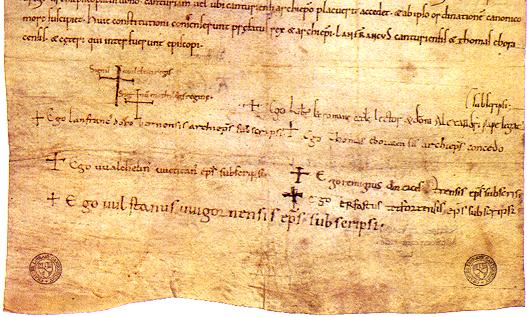
But the tensions between York and Canterbury would go on for years. (You see just how much trouble one excommunicated bishop causes for everyone else!)
In addition, there were still little rebellions going on everywhere. The last of these, and one of the most significant, was that Revolt of the Earls in 1075, which occurred while William was away in Normandy. Wulfstan played an active role in putting down the revolt; as the army of one of the Earls approached Worcestershire, he raised the fyrd of the shire, the fyrd being the Anglo-Saxon equivalent of a free militia. The fyrd managed to bog the army down, preventing it from meeting up with the other army of the Earls, which then had no other reinforcements as it met an even larger force. The Revolt failed. Perhaps because of this and his support of Lanfranc, after 1075 Wulfstan was the only Anglo-Saxon bishop in England. All the others who had not died had been forced out and replaced by Normans.
He was a very active bishop through his entire tenure. He did some massive building and rebuilding in his diocese; he founded the Great Malvern Priory during the reign of Edward the Confessor. With the help of Lanfranc he broke the back of the slave trade in southern England, where Bristol had been a notable slaver port. After Lanfranc's death, there was a period of four years during which there was no Archbishop of Canterbury. St. Anselm was eventually chosen, and Wulfstan was one of his consecrators. The lapse of four years had allowed York to get its strength back, and so much of St. Anselm's tenure as Archbishop was taken up with the struggle over the primacy, although Wulfstan missed most of it. He died 20 January 1095 and was canonized by Innocent III in 1203.
Those of you who know their basic English history know that 1062 puts Wulfstan's consecration right on the edge of one of the most significant events in English history, the Norman Conquest. King St. Edward the Confessor died in early January of 1066, touching off a massive crisis as different people claimed the right to succeed him. Harold Godwinson was crowned by Ealdred. The Archbishop of Canterbury had the right to do coronations, but, remember, Stigand was excommunicated. This would throw everything off; the Anglo-Saxons couldn't leave Stigand out for political reasons, but Harold also couldn't be crowned by an excommunicated bishop, which is why he was crowned by the Archbishop of York. However, the mere fact that Stigand assisted at the ceremony gave other claimants a way to argue that Harold was not actually legitimately crowned at all. Both Duke William of Normandy and King Harald Hardrada of Norway claimed that they were the true successor of St. Edward. After initially promising gains, the Norwegian army invading from the north in September was eventually crushed by Harold Godwinson, but only at great cost. In the meantime, William began invading from the south. William, of course, would defeat Harold at the Battle of Hastings in October. The Anglo-Saxons first attempted to put forward Edgar the Ætheling as the new successor, but then they lost their nerve and surrendered. William was crowned by Ealdred on Christmas Day.
In the meantime, trouble was brewing in the Church hierarchy. Stigand died. Lanfranc was appointed to Canterbury. Ealdred also died, and a man named Thomas succeeded him. But after so many years of York having the de facto primacy, Thomas of York was not willing to let it go. This led to a grave political crisis. Thomas would eventually be forced to submit by King William. Wulfstan supported Lanfranc and signed the Accord of Winchester affirming the primacy of Canterbury. You can see his signature below, the one farthest down on the left.

But the tensions between York and Canterbury would go on for years. (You see just how much trouble one excommunicated bishop causes for everyone else!)
In addition, there were still little rebellions going on everywhere. The last of these, and one of the most significant, was that Revolt of the Earls in 1075, which occurred while William was away in Normandy. Wulfstan played an active role in putting down the revolt; as the army of one of the Earls approached Worcestershire, he raised the fyrd of the shire, the fyrd being the Anglo-Saxon equivalent of a free militia. The fyrd managed to bog the army down, preventing it from meeting up with the other army of the Earls, which then had no other reinforcements as it met an even larger force. The Revolt failed. Perhaps because of this and his support of Lanfranc, after 1075 Wulfstan was the only Anglo-Saxon bishop in England. All the others who had not died had been forced out and replaced by Normans.
He was a very active bishop through his entire tenure. He did some massive building and rebuilding in his diocese; he founded the Great Malvern Priory during the reign of Edward the Confessor. With the help of Lanfranc he broke the back of the slave trade in southern England, where Bristol had been a notable slaver port. After Lanfranc's death, there was a period of four years during which there was no Archbishop of Canterbury. St. Anselm was eventually chosen, and Wulfstan was one of his consecrators. The lapse of four years had allowed York to get its strength back, and so much of St. Anselm's tenure as Archbishop was taken up with the struggle over the primacy, although Wulfstan missed most of it. He died 20 January 1095 and was canonized by Innocent III in 1203.
Sunday, January 18, 2015
Fortnightly Book, January 18
Descriptif : C'est un roc! C'est un pic! C'est un cap!
– Que dis-je, c'est un cap? C'est une péninsule!
Since I am likely to be unusually busy the next two weeks, I need something easier to get through -- shorter, perhaps, or a re-read. The fortnightly book is both: Edmond Rostand's Cyrano de Bergerac.
Rostand, of course, was a playwright, and Cyrano is his most successful play. In the first performance on December 28, 1897, Cyrano was played by Constant Coquelin, France's most famous actor. The performance made theatrical history, one measure of which was that after it was done the audience stayed in the theater, calling for an encore, talking about the play, for two straight hours. Translations were rapidly made, the theaters of the world began to perform it. It has been an international favorite ever since. A little-known fact about the play is that it is the source of the English word 'panache' -- in French it means the plume in a hat or helmet, and the English meaning is based on Rostand's Cyrano.
Cyrano de Bergerac was a real person, although he is highly fictionalized in the play. He was a playwright in the seventeenth century. He fought in the siege at Arras (not to be confused with the more famous and somewhat later Battle of Arras) in the Thirty Years' War. He was a student of Pierre Gassendi. His most famous plays tend to be quite fantastical, almost science-fiction-y, involving trips to the sun or the moon; they were quite influential, with people like Jonathan Swift and Edgar Allan Poe taking ideas from them. He died in 1655, for reasons not entirely known, at the age of 36. He did indeed have a big nose, although not quite so peninsular as one would imagine.

I'll be reading the work in Louis Untermeyer's blank verse translation, first done for The Limited Editions Club and carried over into the Heritage Press edition. The covers of the book are comb-marbled cloth. The typeface is mixed, with the spoken lines being in fourteen-point Times Roman, the stage directions in eight-point Times Roman, and the names of speakers in six-point News Gothic. It has twenty-one pen-and-brush colored drawings. In addition, it has a lagniappe, a little pamphlet, "Cyrano Composes a Ballade", in which Cyrano's famous improvised ballad in Act I is given in Rostand's original and seven different English translations of it. I present the first lines of each here.
(1) Je jette avec grâce mon feutre (Rostand 1897)
(2) I gaily doff my beaver low (Thomas and Guillemard 1898)
(3) My hat I toss lightly away (Kingsbury 1898)
(4) Lightly I toss my hat away (Hooker 1923)
(5) I doff my beaver with an air (Wolfe 1935)
(6) With nonchalance, I doff my hat (LeClercq 1939)
(7) With grace I cast my felt aside (Bissell and Van Wyck 1947)
(8) My hat is flung swiftly away (Untermeyer 1953)
The Eye for Truth
"...It is this realising of the importance of knowing the truth that prompts the search for truth and gives the eye for truth. I should not pull a man's eye out because he saw crooked. I should endeavour to make him see straight. The blind man does not see crooked because he does not see at all. And so the indifferent man avoids any admixture of superstition in his insight into the spiritual world because he has no insight at all."
Wilfrid Philip Ward, "The Wish to Believe" in Witnesses to the Unseen, and Other Essays, p. 297.
Saturday, January 17, 2015
William Shakespeare, The Histories
Introduction
Opening Passage: Since we're dealing with ten plays (although I'll only focus on the War of Roses plays below), it doesn't make sense to do an ordinary passage. But I thought it would be interesting to give a brief summary of how each play opens, because it shows how diverse the plays are.
King John: John with his mother Elinor receives the French ambassador Chatillon, and discovers that the French King lays claim to England.
Richard II: Richard II asks John of Gaunt about the accusation John's son Henry is bringing against Thomas Mowbray as he prepares to get a passive-aggressive revenge on both for causing a tumult earlier in his reign.
1 Henry IV: Henry IV notes that he finally has a bit of peace and intends to go to Jerusalem on Crusade; he will, of course, never be able to do so.
2 Henry IV: The goddess Rumour in a monologue explains how she has been spreading lies about the Battle of Shrewsbury.
Henry V: The Chorus in a monologue begs the audience's pardon for being unable to do justice to the tale.
1 Henry VI: The nobles of the realm begin to bicker and quarrel at Henry V's funeral.
2 Henry VI: Suffolk brings Margaret to be Henry VI's queen and with Henry VI's agreeing to Suffolk's negotiated treaty for the marriage, which involves simply giving away most of what his father won from France and receiving nothing but Margaret in return.
3 Henry VI: Warwick, York, and others discuss how King Henry VI and Queen Margaret managed to escape capture despite being almost in their grasp.
Richard III: Richard, who is perhaps unsurprisingly the chorus to his own play, reflects on the complete victory of his family with the ascension of his brother to the throne, and how it is not enough for him.
Henry VIII: A Prologue warns the audience that the tale is not a merry but a serious one.
Summary: The War of the Roses plays take us through seven kings: Richard II, Henry IV, Henry V, Henry VI, Edward IV, Edward V, and Richard III, stretching from 1398 to 1485. The history is sometimes stricter, sometimes looser, but all together the plays, despite being very different from each other, hang together remarkably well. Through it all we see an image of kingship, moving from Richard II, for whom the crown is something to which he was born, to Henry IV who deposed him, for whom the crown is something to hold by force, to Henry V, for whom the crown is a standard to which he must rise, to Henry VI, for whom being king is lesser and worldly matter, to Richard III, for whom kingship is merely a game of power.
I won't look in detail at each of the plays, but only focus on some of the interesting things that arise by reading them together. One of the emerging themes that I noticed was that of the King's name. Richard II, coming back to England and finding Henry Bolingbroke in virtual possession of everything, says, "Is not the King's name twenty thousand names?" (Act II, Scene 2). But the irony is that the King's name turns out to be practically worthless; it pulls no weight, whereas Bolingbroke's moves the kingdom. We get an echo of the same, as a sort of bookend, when Richard III says, "Besides, the King's name is a tower of strength, / Which they upon the adverse faction want" (Act V, Scene 3). But the King's name does no more good for Richard III than it did for Richard II.
The irony, though, is that the King's name can have power, and we see it manifested in 2 Henry VI (Act IV, Scene 8) when a popular uprising is broken by nothing other than the name of Henry V, who by this point has been dead for years. That shows the power of a King's name, as does Henry V itself, which portrays a king who lived so greatly that the play itself concedes that he will not fit on the stage -- he must instead fit into the hearts and minds of those who watch the play. Richard II failed to tend his garden, and was choked out by the weeds; Henry IV had all the capability, but having received his crown through illegitimate means finds all his competence devoted to keeping it; Henry VI is weak, having little enough ambition for the crown and no training to hold it; Richard III is a poisonous spider for whom all the accoutrements of kingship are mere tools for having his way. Henry V alone does anything that gives power to the King's name, combining the counsel of his father with his own competence and an excellent sense of his nation.
A theme that comes through clearly is the theme of might vs. right. This is most baldly shown in the opposition between Richmond and Richard III; Richmond's oration to his soldiers is all about justice and Richard III's oration to his soldiers is all about strength. But it is not a simplistic opposition. Richard II was rightful king, but he did not have the strength to hold the kingship. Henry IV was a much better man than Richard II, and had the strength, but his deposition of Richard is an illegitimate act that permeates like a kind of original sin all the reigns that follow. Henry VI is a good and pious man whose goodness is such as to make him weak and utterly unable to put his kingdom in order. The villain of the kings, the man who really believes -- insists, in fact -- that might is all that matters, is Richard III, of course. But his true opposite is not the pious but ineffective Henry VI; it is Henry V, who in his all-too-short reign can combine both power and justice.
One of the things that I found reading all the way through was that doing so brought out some smaller details that tend to be overlooked when we look at a play at a time. For instance, one starts noticing that there is a repeated linking of Falstaff with a failure to repent. His constant impenitence is as much part of his character as his boisterous wit, but it tends to get drowned out in any particular scene. It also becomes much clearer just how much of a potential disaster Falstaff is for the kingdom: he is thoroughly corrupt and is using Hal for his own ends, although part of the vastness of character of Shakespeare's Falstaff is that this is mixed in with a genuine affection for the Prince. Almost every time we see him he is quite literally destroying some key part of society, whether it be by mockery or by dissolution or by finding a way to turn public responsibility to private profit. He has no respect for office, for law, for order, and a kingdom in his hands would soon be taken by a plague of corruption. Richard II was partly brought down by corrupt flatterers; Falstaff would have been ten times worse than any of them, being vastly more capable, and thus capable of more corruption and more flattery. The dread of a regime dominated by Falstaff, which is expressed after the death of Henry IV by the princes and ministers of the kingdom, is not hyperbolic.
Another thing that I found noticeable reading all the way through was that it brings out more clearly the humor of Henry V -- or perhaps, more accurately, the humor of King Henry V himself. There are great many features of the play that show that this high-minded and noble king is in fact the same person as the wild Prince Hal. The kind of prank the King pulls on Bates and Fluellen, for instance, is exactly the sort that we see him pulling in the earlier plays as Prince Hal. He goes around in disguise in every play in which he is found. And he jokes a lot. I don't think this is an accident. Of all the Kings, Henry V is the only one who has a fully developed sense of humor, or even really much of a sense of humor at all, and I think this is integral to what makes him the greatest of the Kings. It is also, I think, the reason why Shakespeare seems so insistent that it is important both that Prince Hal have his wild days and that these don't define who he is. More on this point about humor in a moment.
I also gained something of an appreciation for Shakespeare's ability to convey action by very minimal means. His battle scenes are consistently brilliant, for all that they have to fit on a stage and mostly be conveyed by dialogue and some minor skirmishing. You get a sense of an immense flurry of things happening at Shrewsbury and Agincourt, or of an almost superhuman inevitability in the collapse of the English hold on France in the face of the whirlwind of Joan of Arc's supernatural ability -- as Shakespeare's 1 Henry VI would have it, a literally demonic ability.
I mentioned before that I also watched Orson Welles' Chimes at Midnight and listened to the Columbia Presents Shakespeare version of both parts of Henry IV. In addition, on Mrs Darwin's recommendation, I watched The Hollow Crown production, by the BBC, of the first four plays in the series. Richard II was excellent: Ben Whishaw manages an extraordinary feat in playing a Richard who is at once extraordinarily over the top, yet also surprisingly sympathetic and strangely plausible. It works almost perfectly, particularly given the very stylized way much of the movie is handled, which fits the play very well. It made me appreciate the play in entirely new ways. I very much liked Henry IV, Part 1 and Henry IV, Part 2; Jeremy Irons is a surprisingly good Henry IV, and Tom Hiddleston handles Prince Hal quite well, and Simon Russell Beale is the only Falstaff I've come across who can rival Welles's version of him. I found the switching around of scenes to be somewhat exasperating, since there often didn't seem much reason to do it, but they do still manage to convey the riot-and-tumult disorder that is important for the plays. What I'd look to end with, though, is the reasons why I think the Hollow Crown Henry V doesn't live up to the potential of the other three, even though it should be the crowning film.
There are some obvious technical problems. All of the movies are abridged to fit into two hours, and one can question this or that editing choice for most of them, but this is the only one that is definitely badly cut. The way this one is cut, we literally have instances in which characters speak to people who are not there, allude to events that did not happen, and say things that make no sense at all in the context actually given. The worst aspect of this is that you have conversations that are cut far too short to make sense while at the same time having long conversations and monologues that, while fine in themselves, seem interminable in comparison with all the overchopped scenes around them, which is made even worse by the strange tendency to chop action scenes more and talking scenes less.
The action is also surprisingly un-action-y. You have only to compare the Battle of Agincourt in this movie to the Battle of Agincourt in Kenneth Branagh's Henry V, or to the Battle of Shrewsbury in Orson Welles's Chimes at Midnight (which clearly influenced Branagh) to see how defective the battle here is. A scene that sums up the problem for me is one in which we see the heavy French cavalry on the field -- the costuming, incidentally, is one of the things done very well in this movie, and I was heartened to see something that actually looked somewhat like a heavy cavalry -- and are quietly sitting waiting. Meanwhile, we cut to English archers just across the field, who are still finishing setting up. Once the archers have finished their defensive preparations, the French cavalry trots across the relatively short distance between them and the archers have time to shoot all of them down before they are halfway across. In a real battle, if the archers were still setting up when the heavy cavalry, the heavy cavalry would charge across that field like madmen, because if you can get even just one or two knights all the way across, goodbye longbowmen! That's essentially what happened at the Battle of Patay in 1429: the English archers accidentally gave their position away before they were ready, and the French (who had almost nothing in their favor except heavy cavalry) mowed them down, turning what could have been another Agincourt into a rout of the English. French heavy cavalry are no good against English longbowmen with an open field and defensive preparations that will force the cavalry to slow down, but the way it was shown made no sense at all of that. And it's noticeable. I don't think you need to know even the tiny bit I know about cavalry to get the sense that the scene lacked tension. There's no real excuse for it, either; as I noted, Shakespeare's battles are already well done, so you just have to add icing on the cake.
But all of this is secondary. What I think is the greatest problem with the production brings me back to the humor of the play. Henry V is a funny play. It's easy to overlook this, in part because it follows 1 Henry IV and 2 Henry IV with their riotously comic scenes, and in part because the play is doing so much that's very serious. But Henry is a joker. We see this in the beginning when he's answering the Dauphin's gift of tennis balls:
Serious words, yes, but Henry is carrying over the tennis theme; mock, of course, is the sound that tennis balls make. The ways a good actor could bring this out are legion; it wouldn't take much at all. But it's important to recognize that it is there. Part of what Henry is doing is topping the Dauphin's joke.
This version didn't do much with the tennis ball scene, but that's always hit-and-miss, so I wasn't expecting it. But this movie has no real sense of humor. The actors sometimes manage to get it in, in bits and pieces, but as a whole, we get very little. Mistress Quickly's account of Falstaff's death, which should be bittersweet-funny, is hardly funny at all. The most facepalming case, I think, is when they bungle the prank with the gloves. It is very explicitly written as a prank in the play; he sets everybody up and then sends Exeter along to make sure that hot-tempered Fluellen doesn't kill poor Bates before anyone realizes what is going on. And as I noted above, it's exactly the kind of thing wild Prince Hal used to do. But here they chop it all up so it isn't clear what's going on, and Henry just comes across as a bit of an ass.
While that's an egregious example, it's not a load-bearing example. The real problem shows up in the relation between Henry and Kate. Henry V, of course, has what is one of the best -- I would say the best -- bawdy jokes in the history of English literature, in Act III, Scene 4. It's a short scene that builds characterization very quickly, and properly done needs to be quite funny -- it's basically a series of cute jokes culminating in a bawdy joke based on the fact that certain ordinary English words sound like dirty words in French. We learn from the scene that Katherine is intelligent, a bit saucy (the "Excusez-moi, Alice; écoutez" is hilarious in itself), entirely a lady, and yet has a bold sense of humor. Branagh's Henry V did fairly with it. It falls completely flat here, although Thierry does manage almost to save it with her reaction at the end. In some sense that makes it worse, because it shows that she could have pulled it off; but at least Thierry managed to get something essential out of it.
But the relative humorlessness carries over into one of the essential scenes of the play: Act V, Scene 2. It is this scene that establishes that Henry V's entire project has been completely a success. And part of what is essential is to establish that Henry and Katherine will get along well. We've already seen that the Princess has a sense of humor; and part of what makes their interaction work is that she does have a sense of humor and Henry at full blast is truly funny. Every time she says something, he turns it into a joke, and by joking he maneuvers her into a kiss, despite the fact that she clearly knows exactly what he is doing. The humor can be turned in many different ways, but the wooing needs to be done lightheartedly to set the tone for the end of the play, which is the same as the tone for a comedy, because this history is, in fact, structured like a comedy that ends in the victory of a marriage. It falls flat here, played too heavily. (I also don't understand why they got rid of Queen Isabel, who quite clearly needs to be involved, both for the impending marriage of Henry and Kate and the impending marriage of France and England in them.)
I've gone on about this at some length because humor is not a foreign intrusion into anything Shakespeare does; it is an integral part of the whole. This Henry needs to be connected with the Prince Hal of the previous plays. But more than this, his having a sense of humor is part of his greatness. It is his capacity for pranking that makes it possible for him to go around his army in disguise and talk with his men. It is impossible to imagine any other King in the series doing the same -- Richard II has too exalted a sense of himself, Henry VI is too distant from everything (notably he actively avoids talking with anyone he doesn't have to), Richard III is too outright evil to have a real sense of humor -- if Richard III finds something funny, you can bet it won't be to anyone else. Henry IV, we learn early in Richard II, gets much of his popularity from courtesy to common folk, and Henry V is certainly his father's son so far, but Henry IV can't really be imagined doing much more. Only Henry V could seriously strike up a solid conversation with some random soldier in his army; and the reason is the same reason that only he could play a joke on the same soldier. Because of this, I think it's important to take seriously the repeated insistence across all three Hal plays that in Hal's wild youth with Falstaff and Poins he was just learning the language, hiding his greatness, and the like. This is precisely how we see Henry unfold. And the result is that he's the only King who actually has any real feel for the life of the common person.
It's sometimes noted that a factor in the popularity of politicians is whether ordinary people could imagine having a beer with them. That's a good way to put the difference here. Of all the Kings, Henry V, who as Prince spent more than his share of time in a public house, is the only one you could literally sit down and chat over beer with. Richard II made the mistake of thinking that the greatness of a King lies in how high he is. But the greatness of a King is not in the height he can reach or how lowly he can be but in how he fills up the space between. Had Henry been in Richard's place, he would have had the commons on his side, just as the mere mention of his name manages to tame the common rabble in his son's day. And that is shown entirely by the fact that Henry V has a good humor -- you can play it as good nature or as friendly mischief or as a quiet sense of fun or as many other things, but it is certainly there -- and Richard has none. And this, I think, is a major part of the excellence of what we get in these plays. Leave it to Shakespeare to recognize that a true King to fulfill his God-given role needs, besides dignity and strength, humor.
Favorite Passage: There are lots of good passages, of course. This one struck me most this readthrough. It is the prayer of Henry V before Agincourt, and thus occupies a central place in the whole, and I think tells us a lot about how Shakespeare himself understood his War of the Roses cycle:
And God will listen to the prayer, as we later find; but it will only be a short respite, for the effects of Henry IV's deposition of Richard II have not yet finished working itself out....
Recommendation: Well, obviously, it's going to be highly recommended.
Opening Passage: Since we're dealing with ten plays (although I'll only focus on the War of Roses plays below), it doesn't make sense to do an ordinary passage. But I thought it would be interesting to give a brief summary of how each play opens, because it shows how diverse the plays are.
King John: John with his mother Elinor receives the French ambassador Chatillon, and discovers that the French King lays claim to England.
Richard II: Richard II asks John of Gaunt about the accusation John's son Henry is bringing against Thomas Mowbray as he prepares to get a passive-aggressive revenge on both for causing a tumult earlier in his reign.
1 Henry IV: Henry IV notes that he finally has a bit of peace and intends to go to Jerusalem on Crusade; he will, of course, never be able to do so.
2 Henry IV: The goddess Rumour in a monologue explains how she has been spreading lies about the Battle of Shrewsbury.
Henry V: The Chorus in a monologue begs the audience's pardon for being unable to do justice to the tale.
1 Henry VI: The nobles of the realm begin to bicker and quarrel at Henry V's funeral.
2 Henry VI: Suffolk brings Margaret to be Henry VI's queen and with Henry VI's agreeing to Suffolk's negotiated treaty for the marriage, which involves simply giving away most of what his father won from France and receiving nothing but Margaret in return.
3 Henry VI: Warwick, York, and others discuss how King Henry VI and Queen Margaret managed to escape capture despite being almost in their grasp.
Richard III: Richard, who is perhaps unsurprisingly the chorus to his own play, reflects on the complete victory of his family with the ascension of his brother to the throne, and how it is not enough for him.
Henry VIII: A Prologue warns the audience that the tale is not a merry but a serious one.
Summary: The War of the Roses plays take us through seven kings: Richard II, Henry IV, Henry V, Henry VI, Edward IV, Edward V, and Richard III, stretching from 1398 to 1485. The history is sometimes stricter, sometimes looser, but all together the plays, despite being very different from each other, hang together remarkably well. Through it all we see an image of kingship, moving from Richard II, for whom the crown is something to which he was born, to Henry IV who deposed him, for whom the crown is something to hold by force, to Henry V, for whom the crown is a standard to which he must rise, to Henry VI, for whom being king is lesser and worldly matter, to Richard III, for whom kingship is merely a game of power.
I won't look in detail at each of the plays, but only focus on some of the interesting things that arise by reading them together. One of the emerging themes that I noticed was that of the King's name. Richard II, coming back to England and finding Henry Bolingbroke in virtual possession of everything, says, "Is not the King's name twenty thousand names?" (Act II, Scene 2). But the irony is that the King's name turns out to be practically worthless; it pulls no weight, whereas Bolingbroke's moves the kingdom. We get an echo of the same, as a sort of bookend, when Richard III says, "Besides, the King's name is a tower of strength, / Which they upon the adverse faction want" (Act V, Scene 3). But the King's name does no more good for Richard III than it did for Richard II.
The irony, though, is that the King's name can have power, and we see it manifested in 2 Henry VI (Act IV, Scene 8) when a popular uprising is broken by nothing other than the name of Henry V, who by this point has been dead for years. That shows the power of a King's name, as does Henry V itself, which portrays a king who lived so greatly that the play itself concedes that he will not fit on the stage -- he must instead fit into the hearts and minds of those who watch the play. Richard II failed to tend his garden, and was choked out by the weeds; Henry IV had all the capability, but having received his crown through illegitimate means finds all his competence devoted to keeping it; Henry VI is weak, having little enough ambition for the crown and no training to hold it; Richard III is a poisonous spider for whom all the accoutrements of kingship are mere tools for having his way. Henry V alone does anything that gives power to the King's name, combining the counsel of his father with his own competence and an excellent sense of his nation.
A theme that comes through clearly is the theme of might vs. right. This is most baldly shown in the opposition between Richmond and Richard III; Richmond's oration to his soldiers is all about justice and Richard III's oration to his soldiers is all about strength. But it is not a simplistic opposition. Richard II was rightful king, but he did not have the strength to hold the kingship. Henry IV was a much better man than Richard II, and had the strength, but his deposition of Richard is an illegitimate act that permeates like a kind of original sin all the reigns that follow. Henry VI is a good and pious man whose goodness is such as to make him weak and utterly unable to put his kingdom in order. The villain of the kings, the man who really believes -- insists, in fact -- that might is all that matters, is Richard III, of course. But his true opposite is not the pious but ineffective Henry VI; it is Henry V, who in his all-too-short reign can combine both power and justice.
One of the things that I found reading all the way through was that doing so brought out some smaller details that tend to be overlooked when we look at a play at a time. For instance, one starts noticing that there is a repeated linking of Falstaff with a failure to repent. His constant impenitence is as much part of his character as his boisterous wit, but it tends to get drowned out in any particular scene. It also becomes much clearer just how much of a potential disaster Falstaff is for the kingdom: he is thoroughly corrupt and is using Hal for his own ends, although part of the vastness of character of Shakespeare's Falstaff is that this is mixed in with a genuine affection for the Prince. Almost every time we see him he is quite literally destroying some key part of society, whether it be by mockery or by dissolution or by finding a way to turn public responsibility to private profit. He has no respect for office, for law, for order, and a kingdom in his hands would soon be taken by a plague of corruption. Richard II was partly brought down by corrupt flatterers; Falstaff would have been ten times worse than any of them, being vastly more capable, and thus capable of more corruption and more flattery. The dread of a regime dominated by Falstaff, which is expressed after the death of Henry IV by the princes and ministers of the kingdom, is not hyperbolic.
Another thing that I found noticeable reading all the way through was that it brings out more clearly the humor of Henry V -- or perhaps, more accurately, the humor of King Henry V himself. There are great many features of the play that show that this high-minded and noble king is in fact the same person as the wild Prince Hal. The kind of prank the King pulls on Bates and Fluellen, for instance, is exactly the sort that we see him pulling in the earlier plays as Prince Hal. He goes around in disguise in every play in which he is found. And he jokes a lot. I don't think this is an accident. Of all the Kings, Henry V is the only one who has a fully developed sense of humor, or even really much of a sense of humor at all, and I think this is integral to what makes him the greatest of the Kings. It is also, I think, the reason why Shakespeare seems so insistent that it is important both that Prince Hal have his wild days and that these don't define who he is. More on this point about humor in a moment.
I also gained something of an appreciation for Shakespeare's ability to convey action by very minimal means. His battle scenes are consistently brilliant, for all that they have to fit on a stage and mostly be conveyed by dialogue and some minor skirmishing. You get a sense of an immense flurry of things happening at Shrewsbury and Agincourt, or of an almost superhuman inevitability in the collapse of the English hold on France in the face of the whirlwind of Joan of Arc's supernatural ability -- as Shakespeare's 1 Henry VI would have it, a literally demonic ability.
I mentioned before that I also watched Orson Welles' Chimes at Midnight and listened to the Columbia Presents Shakespeare version of both parts of Henry IV. In addition, on Mrs Darwin's recommendation, I watched The Hollow Crown production, by the BBC, of the first four plays in the series. Richard II was excellent: Ben Whishaw manages an extraordinary feat in playing a Richard who is at once extraordinarily over the top, yet also surprisingly sympathetic and strangely plausible. It works almost perfectly, particularly given the very stylized way much of the movie is handled, which fits the play very well. It made me appreciate the play in entirely new ways. I very much liked Henry IV, Part 1 and Henry IV, Part 2; Jeremy Irons is a surprisingly good Henry IV, and Tom Hiddleston handles Prince Hal quite well, and Simon Russell Beale is the only Falstaff I've come across who can rival Welles's version of him. I found the switching around of scenes to be somewhat exasperating, since there often didn't seem much reason to do it, but they do still manage to convey the riot-and-tumult disorder that is important for the plays. What I'd look to end with, though, is the reasons why I think the Hollow Crown Henry V doesn't live up to the potential of the other three, even though it should be the crowning film.
There are some obvious technical problems. All of the movies are abridged to fit into two hours, and one can question this or that editing choice for most of them, but this is the only one that is definitely badly cut. The way this one is cut, we literally have instances in which characters speak to people who are not there, allude to events that did not happen, and say things that make no sense at all in the context actually given. The worst aspect of this is that you have conversations that are cut far too short to make sense while at the same time having long conversations and monologues that, while fine in themselves, seem interminable in comparison with all the overchopped scenes around them, which is made even worse by the strange tendency to chop action scenes more and talking scenes less.
The action is also surprisingly un-action-y. You have only to compare the Battle of Agincourt in this movie to the Battle of Agincourt in Kenneth Branagh's Henry V, or to the Battle of Shrewsbury in Orson Welles's Chimes at Midnight (which clearly influenced Branagh) to see how defective the battle here is. A scene that sums up the problem for me is one in which we see the heavy French cavalry on the field -- the costuming, incidentally, is one of the things done very well in this movie, and I was heartened to see something that actually looked somewhat like a heavy cavalry -- and are quietly sitting waiting. Meanwhile, we cut to English archers just across the field, who are still finishing setting up. Once the archers have finished their defensive preparations, the French cavalry trots across the relatively short distance between them and the archers have time to shoot all of them down before they are halfway across. In a real battle, if the archers were still setting up when the heavy cavalry, the heavy cavalry would charge across that field like madmen, because if you can get even just one or two knights all the way across, goodbye longbowmen! That's essentially what happened at the Battle of Patay in 1429: the English archers accidentally gave their position away before they were ready, and the French (who had almost nothing in their favor except heavy cavalry) mowed them down, turning what could have been another Agincourt into a rout of the English. French heavy cavalry are no good against English longbowmen with an open field and defensive preparations that will force the cavalry to slow down, but the way it was shown made no sense at all of that. And it's noticeable. I don't think you need to know even the tiny bit I know about cavalry to get the sense that the scene lacked tension. There's no real excuse for it, either; as I noted, Shakespeare's battles are already well done, so you just have to add icing on the cake.
But all of this is secondary. What I think is the greatest problem with the production brings me back to the humor of the play. Henry V is a funny play. It's easy to overlook this, in part because it follows 1 Henry IV and 2 Henry IV with their riotously comic scenes, and in part because the play is doing so much that's very serious. But Henry is a joker. We see this in the beginning when he's answering the Dauphin's gift of tennis balls:
And tell the pleasant prince this mock of his
Hath turn'd his balls to gun-stones; and his soul
Shall stand sore charged for the wasteful vengeance
That shall fly with them: for many a thousand widows
Shall this his mock mock out of their dear husbands;
Mock mothers from their sons, mock castles down;
And some are yet ungotten and unborn
That shall have cause to curse the Dauphin's scorn.
Serious words, yes, but Henry is carrying over the tennis theme; mock, of course, is the sound that tennis balls make. The ways a good actor could bring this out are legion; it wouldn't take much at all. But it's important to recognize that it is there. Part of what Henry is doing is topping the Dauphin's joke.
This version didn't do much with the tennis ball scene, but that's always hit-and-miss, so I wasn't expecting it. But this movie has no real sense of humor. The actors sometimes manage to get it in, in bits and pieces, but as a whole, we get very little. Mistress Quickly's account of Falstaff's death, which should be bittersweet-funny, is hardly funny at all. The most facepalming case, I think, is when they bungle the prank with the gloves. It is very explicitly written as a prank in the play; he sets everybody up and then sends Exeter along to make sure that hot-tempered Fluellen doesn't kill poor Bates before anyone realizes what is going on. And as I noted above, it's exactly the kind of thing wild Prince Hal used to do. But here they chop it all up so it isn't clear what's going on, and Henry just comes across as a bit of an ass.
While that's an egregious example, it's not a load-bearing example. The real problem shows up in the relation between Henry and Kate. Henry V, of course, has what is one of the best -- I would say the best -- bawdy jokes in the history of English literature, in Act III, Scene 4. It's a short scene that builds characterization very quickly, and properly done needs to be quite funny -- it's basically a series of cute jokes culminating in a bawdy joke based on the fact that certain ordinary English words sound like dirty words in French. We learn from the scene that Katherine is intelligent, a bit saucy (the "Excusez-moi, Alice; écoutez" is hilarious in itself), entirely a lady, and yet has a bold sense of humor. Branagh's Henry V did fairly with it. It falls completely flat here, although Thierry does manage almost to save it with her reaction at the end. In some sense that makes it worse, because it shows that she could have pulled it off; but at least Thierry managed to get something essential out of it.
But the relative humorlessness carries over into one of the essential scenes of the play: Act V, Scene 2. It is this scene that establishes that Henry V's entire project has been completely a success. And part of what is essential is to establish that Henry and Katherine will get along well. We've already seen that the Princess has a sense of humor; and part of what makes their interaction work is that she does have a sense of humor and Henry at full blast is truly funny. Every time she says something, he turns it into a joke, and by joking he maneuvers her into a kiss, despite the fact that she clearly knows exactly what he is doing. The humor can be turned in many different ways, but the wooing needs to be done lightheartedly to set the tone for the end of the play, which is the same as the tone for a comedy, because this history is, in fact, structured like a comedy that ends in the victory of a marriage. It falls flat here, played too heavily. (I also don't understand why they got rid of Queen Isabel, who quite clearly needs to be involved, both for the impending marriage of Henry and Kate and the impending marriage of France and England in them.)
I've gone on about this at some length because humor is not a foreign intrusion into anything Shakespeare does; it is an integral part of the whole. This Henry needs to be connected with the Prince Hal of the previous plays. But more than this, his having a sense of humor is part of his greatness. It is his capacity for pranking that makes it possible for him to go around his army in disguise and talk with his men. It is impossible to imagine any other King in the series doing the same -- Richard II has too exalted a sense of himself, Henry VI is too distant from everything (notably he actively avoids talking with anyone he doesn't have to), Richard III is too outright evil to have a real sense of humor -- if Richard III finds something funny, you can bet it won't be to anyone else. Henry IV, we learn early in Richard II, gets much of his popularity from courtesy to common folk, and Henry V is certainly his father's son so far, but Henry IV can't really be imagined doing much more. Only Henry V could seriously strike up a solid conversation with some random soldier in his army; and the reason is the same reason that only he could play a joke on the same soldier. Because of this, I think it's important to take seriously the repeated insistence across all three Hal plays that in Hal's wild youth with Falstaff and Poins he was just learning the language, hiding his greatness, and the like. This is precisely how we see Henry unfold. And the result is that he's the only King who actually has any real feel for the life of the common person.
It's sometimes noted that a factor in the popularity of politicians is whether ordinary people could imagine having a beer with them. That's a good way to put the difference here. Of all the Kings, Henry V, who as Prince spent more than his share of time in a public house, is the only one you could literally sit down and chat over beer with. Richard II made the mistake of thinking that the greatness of a King lies in how high he is. But the greatness of a King is not in the height he can reach or how lowly he can be but in how he fills up the space between. Had Henry been in Richard's place, he would have had the commons on his side, just as the mere mention of his name manages to tame the common rabble in his son's day. And that is shown entirely by the fact that Henry V has a good humor -- you can play it as good nature or as friendly mischief or as a quiet sense of fun or as many other things, but it is certainly there -- and Richard has none. And this, I think, is a major part of the excellence of what we get in these plays. Leave it to Shakespeare to recognize that a true King to fulfill his God-given role needs, besides dignity and strength, humor.
Favorite Passage: There are lots of good passages, of course. This one struck me most this readthrough. It is the prayer of Henry V before Agincourt, and thus occupies a central place in the whole, and I think tells us a lot about how Shakespeare himself understood his War of the Roses cycle:
O God of battles! steel my soldiers' hearts;
Possess them not with fear; take from them now
The sense of reckoning, if the opposed numbers
Pluck their hearts from them. Not to-day, O Lord,
O, not to-day, think not upon the fault
My father made in compassing the crown!
I Richard's body have interred anew;
And on it have bestow'd more contrite tears
Than from it issued forced drops of blood:
Five hundred poor I have in yearly pay,
Who twice a-day their wither'd hands hold up
Toward heaven, to pardon blood; and I have built
Two chantries, where the sad and solemn priests
Sing still for Richard's soul. More will I do;
Though all that I can do is nothing worth,
Since that my penitence comes after all,
Imploring pardon.
And God will listen to the prayer, as we later find; but it will only be a short respite, for the effects of Henry IV's deposition of Richard II have not yet finished working itself out....
Recommendation: Well, obviously, it's going to be highly recommended.
Subscribe to:
Posts (Atom)