Tuesday, March 22, 2016

Lent XXXVI

...there are seven gifts of the Holy Spirit because the deviation of the vices must be repelled in the most effective way. Thus fear assists against pride; piety against envy; knowledge against anger, which is a kind of insanity; fortitude against sloth, which destroys the soul's power for good; counsel against avarice; understanding against gluttony; and wisdom against lust.

Bonaventura, Breviloquium, Monti, tr. Franciscan Institute Publications (Saint Bonaventure, NY: 2005), p. 188 [Part V, Chapter 5, Section 3].

Monday, March 21, 2016

A Quick Trip to Italy, Part III

It helps, when touring Florence, to be flexible. All the museums have different schedules and exhibits close for restoration; any number of things might happen.

Monday after the Palazzo Vecchio was a very good example of this. There was one and only one thing that I regarded as absolutely must-see for Florence, and that was the San Marco museum, which has the best collection in the world of the paintings of Blessed Giovanni da Fiesole, also known as Fra Angelico. So we headed there next, only to discover that we had read the schedule wrong -- while the Museum of San Marco is open on Mondays (unlike a number of other museums in Florence), it is only open every other Monday, and not that Monday. This was a serious disappointment, because we already had something set up for Tuesday that we couldn't back out of, and we were leaving Florence on Wednesday morning. So I did not get to see my one must-see for Florence.

So what to do then? The Ospedale degli Innocenti was nearby, so we headed there -- only to discover that the whole museum was closed for restorations. So we finally ended up next door in the Museo Archeologico Nazionale. As it turns out, it's a variable hours museum, so we could easily have missed out on it, too, but as it happens, third time was indeed a charm.

Apparently very few tourists go to this particular museum; the staff didn't speak English, or at least not well enough to be comfortable doing it. In Florence anywhere you find tourists the staff speaks English; English is the language of tourism, since not only is it spoken by Americans and members of the British Commonwealth -- who pack a lot of monetary punch -- but it is also the most common second language. East Asian tourists almost always speak English, and two people from different parts of Europe are more likely to know English than each other's language. There was one point in a restaurant, just before leaving Italy, in which I noticed that there were eight tables filled -- four with Italians, two with Americans, one with French-speakers, and one with Spanish-speakers; the waitstaff spoke Italian with the Italians and English with the Americans, French-speakers, and Spanish-speakers. So coming to a museum in which people didn't immediately start speaking English was unexpected.

It was a very nice museum, though. It's a very typical archeological museum, but it has some every nice exhibits. They had a nice exhibit on Etruscan tombs and ancient Roman artifacts. Here are some ancient Roman figurines:


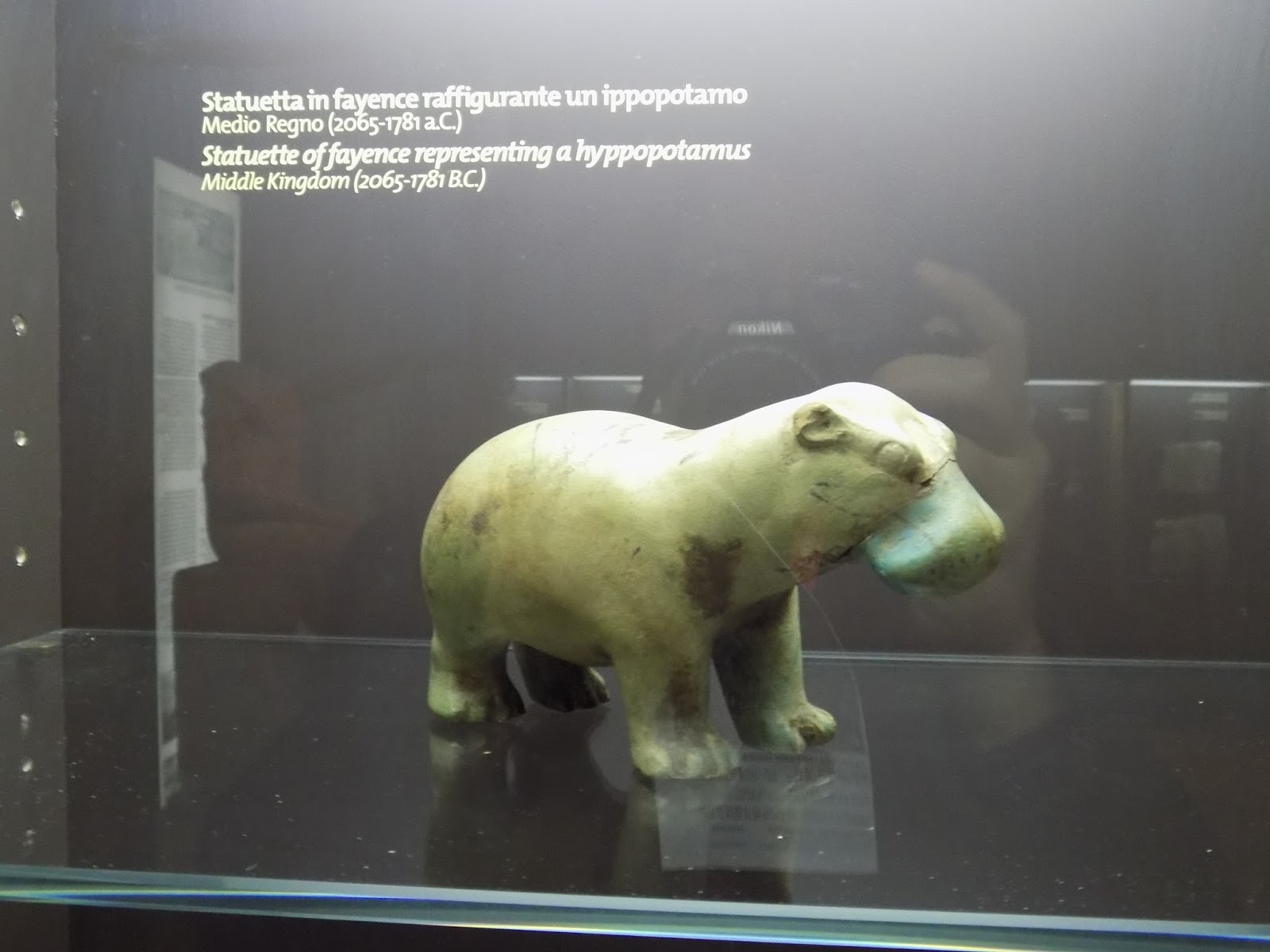
And an Egyptian hippopotamus:


Their Egyptian exhibit, without being flashy, was quite good, in fact; they had several mummies, but I didn't get a photograph of them through the glass that I liked very well, so you'll just have to imagine them.

From there we went (after gelato) to visit the Capelle Medici -- but it's one of the museums that close early, and all the museums of Florence start turning people away about half an hour before closing time, and we were just over, so we couldn't see that, either. Since the Capelle is right by the Basilica di San Lorenzo, we did that instead.


St. Lawrence was the first cathedral of Florence, before the seat of the bishop was moved to Saint Reparata, where the current Duomo is. The original church on the site went back at least to the fourth century and the current version of the church was designed by Brunelleschi. Funding became uneven, however, and the construction ended up taking longer than Brunelleschi intended; budget cuts forced him to modify his designs; and the church was still not finished when he died.

One of the curious features of the church is quite visible in the photograph above: it has no outer facade. Ordinarily the rough stone surface that you see would have had a marble facade hung on it, like all of the churches in Florence. For instance, here is Santa Maria Novella for comparison:


Michelangelo was picked to design the facade, and he did design one. However, he was pulled off the project to do other things, the originally intended funding was diverted to other projects, and the facade was never built. There is actually something of a debate in Florence today as to whether the church should be kept as-is or whether it should be completed according to Michelangelo's plan.

San Lorenzo is famous for having some of the last and greatest works of the Renaissance sculptor, Donato di Niccolò di Betto Bardi, best known by his nickname of Donatello. His works are found throughout Florence, but anyone interested in Florence has to see San Lorenzo. His work is a major part of the Sagrestia Vecchia that was completed in Brunelleschi's day, and it is the place he was buried:


There is a great deal of beauty in San Lorenzo, but for me the greatest attraction was this:


I had completely forgotten that Blessed Nicholas Steno had been buried in San Lorenzo; finding his funerary monument was a delightful moment. Steno was actually quite friendly with the Medicis. He became in-house physician to Ferdinando II, and the Grand Duke liked him so much that he was given an invitation to live in the Palazzo Vecchio, and all that was asked in exchange was that he start building up its natural history collections. He had already done his major work on glands and doing the groundwork to show that Descartes was wrong about the pituitary gland, but it was in Florence that Steno did his major work on muscles; it was in Florence that he began his work on stratigraphy and paleontology; and it was in Florence, watching the Corpus Christi procession, that he began to wonder if he, a Lutheran who had spent most of his adult life in freethinking circles, should become Catholic. He started reading the Church Fathers, and converted in 1667. It was in Florence that he was ordained a priest at the age of 37; he preached his first homily in the church of Santissima Annunziata. He went on mission to Lutheran regions of Europe for almost two decades, and then planned on returning to Florence. He died while still in Germany, but his body was shipped back at the request of Cosimo III, and they made sure that he was buried in San Lorenzo with all of the Medicis. Steno may have been born in Copenhagen, but he was truly a Florentine.

From San Lorenzo we went to the nearby Palazzo Medici Riccardi, about which I had known nothing at all beforehand. The palace was designed by Michelozzo di Bartolomeo for the Medici. It is (deliberately) unimposing from the outside; the Medicis had returned from exile and were trying to be less ostentatious about their power. Much later it was bought and expanded by the Riccardi family (hence the name), and now it is a functioning government building. Because it's in active use, the museum parts themselves only cover part of the palace, and it is quick stop. Here is a room:


And a garden:


And the same garden from the other direction:


There was also a small robotics exhibition in the museum:


And that was Monday.

to be continued

A Quick Trip to Italy, Part II

The museums of Florence have a splendid system called the Firenze Card, which gives you direct access to seventy-two of the museums of Florence for seventy-two hours. I cannot stress how much it is worth the price. To get your money's worth, you'd need to see four or five museums, but this is not a difficulty at all.

(1) Florence is highly walkable, and almost every museum is within a five- to ten-minute walk from another museum. It's not uncommon to have multiple museums in one piazza.

(2) Talk of 'museums' is a bit misleading if we are considering how much you are getting for the cost, since we tend to think of a museum as a completely separate thing from another museum. The card actually covers museum tickets, and some sights in Florence involve multiple museum tickets. If you see the Duomo, for instance, and want to take in all the sights of the Duomo, that's actually five distinct tickets -- one for the Battistero di San Giovanni, one for the Campanile di Giotto, one for the Cripta Santa Reparata, one for the Cupola, and one for the Museo dell'Opera del Duomo. (The Cathedral itself is free to visit.) The Palazzo Vecchio and the Torre d'Arnolfo are two distinct tickets despite being in the same building, and despite the fact that one is accessed through the other.

(3) You can visit more museums with the card than you otherwise could, because it reduces, massively, the number of lines you stand in and the amount of time you have to stand in them. You don't have to keep standing in line to get a ticket, because you have one for them all, and things are often set up so that those with the card have a separate line. (The most striking example of this was the Uffizi, notoriously a difficult museum to get into because you may have to stand in line for a couple of hours; through the Firenze Card line it took us less than ten minutes.)

For Monday, we went down to the Museo di Palazzo Vecchio to activate the card, and since we were there already, that's where we started.


Around 1300, the people of Florence decided to build a magistrate's hall that would be appropriate to their conception of the city, and so they enlisted Arnolfo di Cambio, who was also designing the Duomo, to build it. He incorporated certain elements of prior palaces on the spot, most notably (it seems) the rectangular tower that combines with the projecting crenallated battlement that makes the building so striking. Given the origin of the tower, it is not actually centered, but it's almost not noticeable if you just glance at it, given the position of the building in the square.

The original name was the Palazzo della Signoria, because it was the center of power for the Signoria, the ruling body of the Republic of France. The name was changed multiple times through the years as the governing authority in Fiorenza shifted; Cosimo I de'Medici made it his official seat in 1540. In 1549, however, Cosimo moved the seat of government again to the Palazzo Pitti, thus giving it its current name: the Old Palace. Despite no longer being the primary seat of government, the Palazzo Vecchio continued to play an important role in governance. It would again become the seat of government in the nineteenth century when Florence was the temporary capital of United Italy, and the Palazzo Vecchio was chosen symbolically as the seat of government from 1865-1871. Since then it has been a city museum, but for symbolic purposes it remains technically the seat of government for the City of Florence; the Mayor of Florence has an office there and it is a meeting place for the City Council.

One of the most noticeable things about the palace is its entrance. Michelangelo's David was originally designed for the entrance of the building, where it remained from 1504 to 1873. It was then moved to the Accademia Gallery, for preservation reasons, and a replica was put in its place in 1910, but if you want to see how the statue was intended to be experienced, you have to see the replica in the Piazza della Signoria:


The other statue flanking the entrance is the Hercules and Cacus of Baccio Bandinelli. It was originally supposed to be done by Michelangelo, and Bandinelli, unfortunately, has suffered intense criticism through the centuries for not having been born Michelangelo, and not doing a statue exactly the way Michelangelo would have, but the statue does work nicely in its place and apparently the Medici themselves were pleased with it. The club, as it turns out, is aluminum and is (obviously) not the original bronze club. Nobody knows what happened to the original club; it was only discovered that it was not the original club in the 1990s when the statue was undergoing restoration. The slaying of Cacus was an event during Hercules' Tenth Labor, and the two statues together therefore represent spiritual strength (David) and physical strength (Hercules) -- a message by the Medicis to any republicans left who might oppose them. But the Medicis also showed a bit of restraint by recognizing that their power was not absolute: the text on the frontispiece above the door has a Christogram and refers to Christ as King of kings and Lord of lords.

The inside is richly decorated in ways too many to enumerate. Here, for instance, is a ceiling:


A statue of a putto with a dolphin by Andrea del Verocchio:


The Salone dei Cinquecento is quite striking:


The Salone was built in 1494 by Simone del Pollaiolo. In 1494, the Medici were in exile; it was Girolamo Savanorola who held the reins of power. He commissioned the hall in order to serve as the meeting place of the Grand Council of Florence; when the Medicis returned, it was enlarged by Giorgio Vasari. Vasari and his assistants painted scenes from the life of Grand Duke Cosimo on the ceiling. The raised stage was designed and built by Bandinelli for Cosimo to hold audiences with ambassadors.

Throughout one finds various artifacts emblematic of Florence or of the Medici that have been donated by collectors. Here is a death mask for Dante:


And here is a bust of Machiavelli:


Two other things that caught my eye in particular. One is an embroidered icon from the fifteenth century, of very good workmanship:


Embroidered icons are an excellent idea in many ways; while they have existed through much of Christian history (particularly in situations in which one needs icons to be highly portable), they should be more common than they are. Given the time and skill required to produce detailed pictures by needlework, pictorial embroidery is able to be an art quite as high as painting. And here is a statue of Saint Catherine of Siena:


One of the most striking rooms is the Stanza delle Mappe geografiche, also sometimes called the Stanza della Guardaroba. Originally a storeroom for valuables, the walls were painted with maps by Fra Ignazio Dante, showing the world as it seemed to be in the sixteenth century. The maps are all Mercator projections. Gerardus Mercator had only published his world map using Mercator projections in 1569, and Fra Ignazio was painting the maps at about the same time, so these maps were literally at the cutting edge of cartography when they were painted. At the center of the room there is the mappa mundi, which unfortunately has seen better days. It still makes an impressive picture:


It is always worthwhile to ascend the Torre d'Arnolfo and look out at the city. This view from the Tower, looking eastward, is of the Basilica of Santa Croce, which, alas, we never had a chance to reach. It is also called the Tempio dell'Itale Glorie because some of the most famous Italians in history are buried there:


Here we have the Duomo, of course, which is to the north:


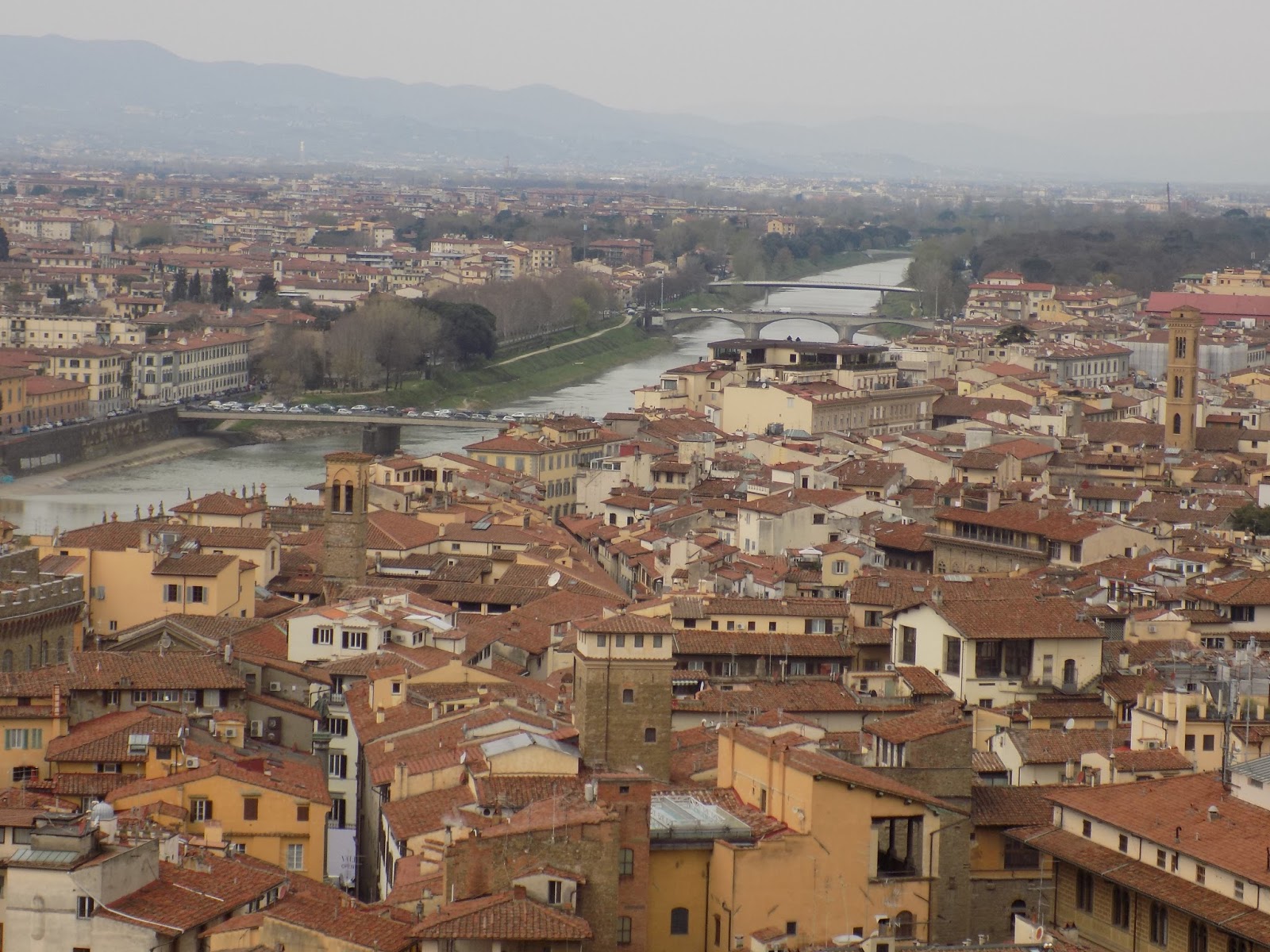
And looking westward we have the River Arno:


Down in the Piazza della Signoria, there are a few other things worth noting. One is the Fountain of Neptune sculpted by Bartolomeo Ammannati in the sixteenth century:


It is an impressive work, although it has taken a severe beating over the years, from damage by vandals to bombing by the Bourbons. And, of course, there is the famous Loggia dei Lanzi. It was originally the place Grand Duke Cosimo housed his German mercenaries (they were pikemen, hence the Lanzi nickname), but was re-worked as a terrace from which the princes of Florence could watch events going on in the square. It is now an open-air sculpture gallery:


In this picture you can see a statue of Menelaus holding Patroclus, a very old one from the third century BC, although it has obviously been restored and modified; The Rape of the Sabine Woman, by Giambologna, which is in some ways the most important statue on the terrace, being the earliest recorded single statue involving multiple figures that was designed to be seen from all sides; and a statue of Hercules and Nessus, also by Giambologna. In the background you can see two of several statues of women. There are other sculptures not visible in this photograph; here is a good 360-degree panoramic view of the entire Loggia.

to be continued

Lent XXXV

You know it has ever been my desire to become a Saint, but I have always felt, in comparing myself with the Saints, that I am as far removed from them as the grain of sand, which the passer-by tramples underfoot, is remote from the mountain whose summit is lost in the clouds.

Instead of being discouraged, I concluded that God would not inspire desires which could not be realised, and that I may aspire to sanctity in spite of my littleness.

Therese of Lisieux, Story of a Soul, Chapter IX

Sunday, March 20, 2016

A Quick Trip to Italy, Part I

Things have been quite slow around here, content-wise, for the past two weeks, because last week I was in Italy on a family vacation (and, of course, had to cram a lot of preparation into the week before). The trip was something of a whirlwind trip, a little of this and a little of that, but it was quite enjoyable.

We arrived in Milan on Sunday, March 13, but immediately took the high-speed train to Florence; Trenitalia was quite efficient and the entire train system in Italy is easy to use once you figure out how it works. It's less scenic than you might expect, though. Having come off a redeye flight and a train ride, we weren't in much of a condition to do anything that day, but it's impossible to miss the Cattedrale di Santa Maria del Fiore, usually just known as the Duomo di Fiorenza, and the hotel was a surprising well-run boutique hotel right next to it. The view of the Duomo from one room, in which you get a bit of the campanile or belltower (it was a more spectacular view at night, but there's so much light on the cathedral at night that it was difficult to get a good picture of it):


And the view from another:


The original church, Santa Reparata, was built somewhere around the fifth century; by the thirteenth century it was practically falling down and was utterly inadequate for the increasingly bustling town. A new church was designed by Arnolfo di Cambio in 1294; the final result was much larger than Arnolfo had planned, in part, I believe, because in the course of the construction, the relics of Saint Zenobius, patron saint of Florence, were re-discovered, thus stirring up greater interest in the project. Much of the ultimate look for the cathedral (and for later Renaissance churches) was influenced by the Baptistry, which had been built in the eleventh and twelfth centuries; Arnolfo, before designing the cathedral itself, had built up some of the decoration on it. I wasn't able to get a picture of the Battistero that I liked, so here's one from Wikimedia:

Firenze.Baptistry06.JPG
Georges Jansoone; CC BY-SA 3.0

In 1401, a design competition was held for a new set of bronze doors for the Baptistry ; the commission was won by Lorenzo Ghiberti, who worked for decades to complete them, and are some of the most famous doors in the world, known as the Porte del Paradiso (a name for them that is usually said to go back to Michelangelo). The current Baptistry doors are actually replicas; Ghiberti's originals are in the Museo dell'Opera del Duomo, which, unfortunately, was closed the entire time I was there.

Construction on the Campanile began in 1334 under Giotto di Bondone:


By 1418 a design competition was held for the one and only part of the cathedral that was still unbuilt, the dome. Filippo Brunelleschi managed just to edge out Ghiberti in the contest. The basic parameters had been set by Arnolfo di Cambio's design, but the dome called for was not obviously even technically possible -- it had to be a very large, very high dome without any buttresses, but without buttresses a dome that size would be subject to severe hoop stress, and thus naturally tend to start bulging out. In other large domes, you would usually have supported the dome from the inside while building it, but in this case the dome was being built over a working cathedral, which sharply limited what you could do to keep the dome in place during construction. Scaffolding would be a problem -- you would ordinarily need an immense amount of wood to build the supporting scaffolding, and Tuscany is not heavily wooded. And what materials would you use for that size? Stone would be too heavy. Other big domes, like that of Rome's Pantheon, used concrete, but you had to have the right recipe, and the old recipes were all lost. So Brunelleschi began a series of innovative architectural solutions to apparently insoluble problems: no supporting scaffolding was used; the dome was primarily built out of brick, which is both lighter and easier to work with than stone; the dome is in fact hollow, a double-shell, to make it lighter; the skeleton is quite rigid; the scaffolding for workers was cantilevered; and much more. Khan Academy has a good summary of the engineering genius Brunelleschi poured into the dome.


Thus Florence's most characteristic landmark. Ironically, I never actually had time to go in, or to go up and see the sights from Giotto's Campanile, which is a shame -- but there is so much to do in Florence that seeing it all is simply impossible.

to be continued
Strive Not the Less

Sonnet VII
by Petrarch
translated by Charles Tomlinson


Intemperance, Ease, and Pleasure's beds of down
So rule the world, that every virtue's dead;
And Nature's course is so by Fashion led,
That her wise teaching men now scarcely own;

And every light benign of Heaven is gone,
By which life's path, in honour, we may tread;
So that men gaze in wonder when 'tis said
There are who feed the stream of Helicon.

Thus speak the crowd, all basely bent on gain,
"Who now the laurel crown or myrtle prize?
Philosophy both poor and naked goes."

Who court the Muse have few to sympathise.
But, gentle Friend, strive not the less to obtain,
The wreath that such high work as thine bestows.

Maronite Year XXXIII

Sha'neenee, or Hosanna Sunday, is the usual Maronite name for what in the West is usually called Palm Sunday. Celebrating Christ's triumphal entry into Jerusalem, it emphasizes the lowliness of His coming, and begins the march of Passion Week.

Hosanna Sunday
Philippians 1:1-13; John 12:12-22

We are hardly worthy to praise Your name,
You who are seated on a lofty throne,
You whom the seraphim praise with great joy,
singing, "Holy, Holy, Holy," on high!
The cherubim beneath You bless Your deeds,
with rush of wind and fire hymn Your light.
We are hardly worthy of Your mercy,
but we will sing Your praise at Your coming:
Hosanna, Hosanna, Son of David!

We are hardly worthy to praise Your name;
divinity rode on humanity;
You chose an ass's colt to be Your steed;
You chose the acclamation of children;
from mouths of babes You have drawn Your defense;
You have taken sinners and made them pure.
Zion grew uneasy at Your entry,
but we will sing Your praise at Your coming:
Hosanna, Hosanna, Son of David!