Thursday, July 14, 2016

Decorum

A recent tweet from Arlington National Cemetery:


ADDED LATER:

And I had missed this one: Holocaust Museum to visitors: Please stop catching Pokémon here

A Person of Taste

To be a person of taste, it seems necessary, that one have, first, a lively and correct imagination; secondly, the power of distinct apprehension; thirdly, the capacity of being easily, strongly, and agreeably affected, with sublimity, beauty, harmony, exact imitation, &c.; fourthly, Sympathy, or Sensibility of heart; and, fifthly, Judgment, or Good Sense, which is the principal thing, and may not very improperly be said to comprehend all the rest.

James Beattie, Of Imagination, Chapter IV

Wednesday, July 13, 2016

Rabban Bar Sauma and Thirteenth-Century Ecumenism

In the thirteenth century a Chinese Christian belonging to the Church of the East decided to go on a pilgrimage to the Holy Land. His name was Rabban Bar Sauma, and he was born in Beijing and became a Christian priest. He set out on the pilgrimage with a student of his, named Rabban Markos, and they got as far as Persia, where they met with the Catholicos (patriarch) of the Church of the East, who was Mar Denha I. In the course of their travels they learned that the entire region around the Holy Land was in a state of tumult and war, so while they were wondering what to do, the Catholicos asked them to go to the court of Abaqa Khan, to get the documents officially recognizing Mar Denha as the patriarch. They did this, and Mar Denha intended to send them as messengers to China, but war to the east prevented that as well, so they stayed in Baghdad making themselves useful for a while. Mar Denha then died, and Rabban Markos was elected Catholicos of the Church of the East, taking the name Mar Yahballaha III. They went to Abaqa again to get the official confirmation letters, but Abaqa had died and his son Arghun had become ruler of the Ilkhanate.

The Mameluk territories to the south and west were extreme irritations to Ilkhanate, and so Arghun Khan hoped for an alliance between the Buddhist Mongols in the East and the Christian Franks in the West to fight together and conquer the Muslim Mamelukes Syria and the surrounding region. He asked Mar Yahballaha to recommend someone to go to the West with letters proposing it. Mar Yahballaha, of course, recommended his teacher Rabban Bar Sauma. So Rabban Bar Sauma, who had never been able to complete his pilgrimage to Jerusalem because of the dangers, in his old age now had a new pilgrimage.

It was quite a journey. He visited Constantinople and was stunned by Hagia Sophia; while there he met with Emperor Andronikos II Palaiologos. He sailed to Italy, and as they were sailing past Sicily, he saw the eruption of Mount Etna on June 18, 1287. On June 24, 1287, he saw from a distance the Battle of Sorento, a naval battle between France and Spain in the War of the Sicilian Vespers.

A big part of Bar Sauma's mission was to deliver the messages to Mar Papa, the Catholicos of the West, but when he got to Rome, the pope had recently died. So he toured St. Peter's and talked with Cardinals. Since they were thirteenth-century Catholic churchmen, they wanted to discuss and argue, and so they asked Bar Sauma what his views on various theological topics were, and he acquitted himself fairly well, although he had to cut them short and finally tell them that he wasn't there to debate theology to deliver his letters and received the blessing of the Mar Papa in Rome. Since there was no Mar Papa at the time, he continued on his way: Tuscany and Genoa, where he spent the winter, and then on to France, where he met King Philip the Fair. King Philip was interested in the alliance, and so arranged to have a French nobleman go back with Bar Sauma whenever he ended up going back. In Gascony he delivered the message to King Edward I of England, as well, who would eventually send an ambassador to Arghun Khan's court. (Despite the interest, however, very little ever came of the attempt to build a Franco-Mongol Alliance.)

Bar Sauma was a bit worried about not having delivered a message to Mar Papa -- it meant his mission was strictly speaking a failure, and Mongol governments were not exactly tolerant of failure. One of the people Bar Sauma had talked to, however, had business that took him to Rome, and so Bar Sauma received a message from the newly elected Mar Papa, Pope Nicholas IV, inviting him to Rome. So back to Rome he went to meet with the Pope and deliver his message; the Pope asked him to stay for the holy days, because it was halfway through Lent. He was treated with great hospitality, and he suggested to the Pope that he should celebrate the Divine Liturgy one day so that the Pope would know what the Use of the Church of the East was. The Pope thought this was an excellent idea, so Bar Sauma celebrated the Divine Liturgy to a very large crowd who were curious to see how Christians among the Mongols said Mass. The people were impressed, and said that it was the same rite as their own, just with differences you'd expect from the differences in language.

So Bar Sauma asked for something a bit more courageous: he asked if he could receive communion from the Pope himself. And on Palm Sunday, he did. It was a very emotional experience for him. He saw the service of Holy Thursday in St. John Lateran, and the Maundy footwashing, the Good Friday procession, Holy Saturday and the Easter Vigil, and then Easter Day at St. Mary Major, and a week later a consecration of bishops.

The Pope invited him to continue to stay in Rome, but Bar Sauma had to get back to let people know that he had finished his mission. He asked the Pope for relics to take back with him. The Pope pointed out that they couldn't give relics to everyone who came to Rome, or they'd soon have none, but because Bar Sauma's pilgrimage had been so unusually long, they would make an exception in this case, so they gave him some small relics. The Pope also sent with him a tiara and vestments for Mar Yahballaha and a papal bull recognizing Mar Yahballaha's authority and jurisdiction as Patriarch over the Church of the East, and naming Bar Sauma as Apostolic Visitor to the East. And so Bar Sauma returned to Baghdad in honor, where he would die in 1294.

But not before he wrote a book describing his extraordinary journey. The original Persian text doesn't seem to have survived, but a Syriac abridgement was made at some point, continuing the story through the entire reign of Mar Yahballaha. The text was completely translated into English in 1928 by Sir E. A. Wallis Budge, under the title, The Monks of Kublai Khan, Emperor of China, which you can read online.

Rabban Bar Sauma's visit may have piqued Pope Nicholas IV's interest in the East; not long afterward he sent several missions to various parts of the East. The most successful of these was that of John of Montecorvino, who founded a Catholic mission in Beijing that lasted for several decades. Mar Yahballaha, in turn, explicitly affirmed communion with Rome in a 1304 letter to Pope Benedict XI; but it was not a union that had much practical effect, or that lasted past his death.

Tuesday, July 12, 2016

Plato Was Closed; Mine Eyes No More Awake

Sonnet
by William Julius Mickle


Plato was closed; mine eyes no more awake;
But Plato's lore still vision'd round my head:
Meseem'd the Elysian dales around me spread,
Where spirits choose what mortal forms to take:
'Mine be the poet's eye; I crowns forsake.'
Sudden before me stood an awful shade;
On his firm mien simplicity array'd
In majesty, the Grecian bard bespake:
He thus: 'Bright shines the poet's lot untried;
Canst thou than mine to brighter fame aspire!
High o'er the' Olympian height my raptures tower'd,
Each Muse the fleet-wing'd handmaid of mine
Yet o'er their generous flight what sorrow plied,
While freezing every joy Dependence lour'd!'

William Julius Mickle was a Scottish poet most famous in his own day for translating the Lusiad. The narrator in this poem must have been reading the end of the Republic.

Monday, July 11, 2016

Themistocles in Plato's Gorgias

After this he equipped the Piraeus, because he had noticed the favorable shape of its harbors, and wished to attach the whole city to the sea; thus in a certain manner counteracting the policies of the ancient Athenian kings.

For they, as it is said, in their efforts to draw the citizens away from the sea and accustom them to live not by navigation but by agriculture, disseminated the story about Athena, how when Poseidon was contending with her for possession of the country, she displayed the sacred olive-tree of the Acropolis to the judges, and so won the day. But Themistocles did not, as Aristophanes the comic poet says, ‘knead the Piraeus on to the city,’ nay, he fastened the city to the Piraeus, and the land to the sea.
[Plutarch, Lives, Themistocles 19.2-3]

Themistocles (along with Pericles) was one of the architects of Athenian greatness. He is also (along with Pericles) something of a villain in the Platonic dialogues, and the above passage by Plutarch captures, I think, why this is, since Plato sees Themistocles as perverting the true nature of Athens. In the next sections Plutarch will note that the ancient Greeks thought of maritime empire as the "mother of democracy", because it puts the real power in the hands of those who control the ships; and I think the argument can be made that Themistocles' subversion of Athenian principles connects to Plato's skeptical views on the stability of democracy.

The place one can see the thematic opposition play out most clearly, although without any names, is in the Atlantis myth of the Timaeus and the Critias, in which the island is the symbolic representation of the ideal of maritime empire, which is opposed to the autochthonic, and thus land-focused, Athenians. The sea as a factor in Athenian corruption comes up elsewhere in the dialogues, e.g., in Laws. But it is in the Gorgias that Plato is fairly explicit about what, precisely, he sees wrong with the Themistoclean sea-dream.

Themistocles was the first politician fully to understand the implications of the overthrow of the Athenian kings and their replacement with the Demos: namely, that anyone could have any power that they wanted as long as they could convince enough people to give it to them. He is also very recognizable as a politician in our sense of the word. He moved to the poor part of town, playing the part of a man of the people, going from door to door and asking the poor citizens of Athens for their assistance, being careful to remember everyone's name. People, of course, loved it, and thus Themistocles built a constituency; on the basis of that, he campaigned for office. Being an excellent speaker, roused the crowds in his favor again and again. It is thus not surprising that Gorgias mentions him as an example of the power of rhetoric (455d-e):

GORGIAS: Well, Socrates, I'll try to reveal to you clearly everything oratory can accomplish. You yourself led the way nicely, for you do know, don't you, that these dockyards and walls of the Athenians and the equipping of the harbor came about through the advice of Themistocles and in some cases through that of Pericles, but not through that of the craftsman?

SOCRATES: That's what they say about Themistocles, Gorgias. I myself heard Pericles when he advised us on the middle wall.

Themistocles is certainly in mind when Socrates and Polus argue over whether one wants to be able to do whatever you like, "whether it's putting people to death or exiling them, or doing any and everything just as you see fit" (469c). One of the major early highlights of Themistocles' career was his convincing the people to ostracize (temporarily exile) his major political rival, Aristides. But another possible sign of it is when Socrates rejects Polus's idea by using the example of the "marvelous tyrannical power" of a dagger (469e):

On seeing it, you'd be likely to say, "But Socrates, everybody could have great power that way. For this way any house you see fit might be burned down, and so might the dockyards and triremes of the Athenians, and all their ships, both public and private." But then that's not what having great power is, doing what one sees fit.

We see a reverse of this in the life of Themistocles. At one point, it is said, Themistocles came up with a plan to guarantee Athenian sea superiority: he would burn the combined fleet of Athens's allies, which at the time was wintering at Pegasae. He told the Athenians that he had a plan that would be extremely advantageous to them -- but he couldn't tell them what it was beforehand because it needed to be done with secrecy. And the Athenian Assembly, in a moment of wisdom, told him to tell the plan to Aristides, and if Aristides also thought it was a good plan, he would be fully authorized. When Themistocles told Aristides, Aristides replied to the Assembly that there was no plan that could be more advantageous to the Athenians, and none that could be more unjust; so they refused.

Themistocles comes up again explicitly in the discussion between Callicles and Socrates. Socrates asks whether the oratory directed to the Athenian people is done with regard to the best; that is, whether such political oratory is concerned with making people better or gratifying them like children. Callicles responds that it is too simplistic to put it this way, because some do and some don't. Socrates concedes the point, and says that it suffices for his purposes: there is flattery, which is shameful, and there is encouragement to virtue, which is admirable. But has Callicles ever seen the latter? Callicles responds that none of their contemporaries seem to be such; and Socrates asks whether this is also true of former times. Callicles mentions Themistocles, Cimon, Militiades, and Pericles, all of whom were major players in Athenian military greatness. And Socrates' response is unequivocal (503c-d):

Yes, Callicles, if the excellence you were speaking of earlier, the filling up of appetites, both one's own and those of others, is the true kind. But if this is not, and if what we were compelled to agree on in our subsequent discussion is the true kind instead--that a man should satisfy those of his appetites that, when they are filled up, make him better, and not those that make him worse, and that this is a matter of craft--I don't see how I can say that any of these men has proved to be such a man.

Socrates will later press Callicles on the point again, and when Callicles insists that these Athenian heroes really did make the city better than it was, Socrates replies that if this is so, then when (say) Pericles started out, the people should have been worse, but as time went on, they got better. But, Socrates notes, as time went on the Athenians got tired of all of these people: Pericles was convicted of embezzlement (although he was later restored to office), Cimon was ostracized, Miltiades narrowly avoided being put to death, and Themistocles was ostracized and later, under encouragement from the Spartans, they tried to summon him to trial, probably on trumped-up charges, and he fled for his life.*

Callicles has throughout been arguing that someone who pursues philosophy rather than oratory can be charged on false charges and unable to defend themselves, so although it is not emphasized by Socrates, it is very relevant to the discussion. People like Themistocles work by flattering the people, and it is no more surprising that this makes the people worse than it is surprising if you became less athletic because you got nutritional advice from the doughnut shop, or that people become sick if they are given incentive to do things that are bad for their health. To be sure, people praise Themistocles for his achievements. But in reality they have sickened the city and erratic behavior is inevitable (519a):

For they filled the city with harbors and dockyards, walls, and tribute payments and such trash as that, but did so without justice and self-control. So, when that fit of sickness comes on, they'll blame their advisers of the moment and sing the praises of Themistocles and Cimon and Pericles, the ones who are to blame for their ills. Perhaps, if you're not careful, they'll lay their hands on you, and on my friend Alcibiades, when they lose not only what they gained but what they had originally as well, even though you aren't responsible for their ills but perhaps accessories to them.

Of course, this does not mean that they will not harm Socrates, either. But if the leaders of the city are already sickening the city, its behavior will be erratic regardless; the question is, what politics makes the city healthy rather than sick? And, of course, the answer Socrates gives is that he is the only one, or perhaps at best one of a few through history, who practice the "true politics", the kind that aims at what is really good for people rather than what they merely happen to like.


-----

* It is worth keeping this in mind when considering the argument Socrates gives in Plato's Meno that virtue cannot be taught because Themistocles, as a virtuous man, would have taught his sons more virtue than they show -- we should be wary of the ironic edge of the argument.

Quotations are from Plato, Gorgias, Zeyl, tr, in Plato: Collected Works, Hutchison, ed., Hackett (Indianapolis: 1997).

Sunday, July 10, 2016

A Quick Trip to Italy, Miscellanea VIII

Rome: Walking Away from Vatican City

More shots of Castel Sant'Angelo:


The Tiber River:


Whoever does Roman advertising for Sky Box Sets has an impeccable sense of location:


The entrance to the Parthenon:


Milan

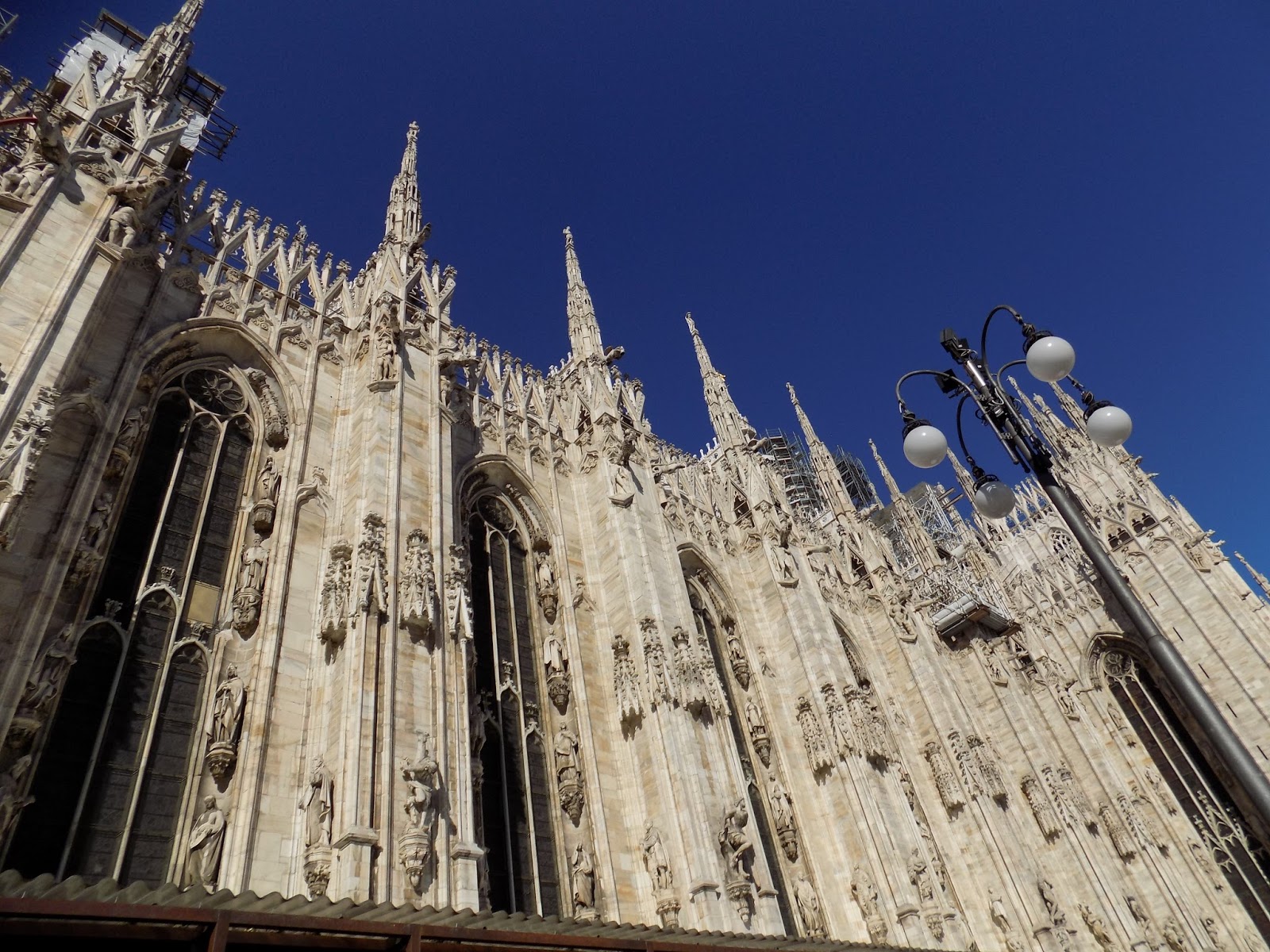
More external shots of the Duomo:


The equestrian statue of Vittorio Emmanuel in front. Because there were so many events going on, it was hard to get any good picture of it:


Inside the church:


Two more shots of Santa Maria delle Grazie:


Castello Sforzesco:


Can you spot the cat?

And those are the miscellaneous shots for the trip.

Maronite Year LIX

July 10 is the Feast of the Blessed Massabki Brothers, Abdel Mooti Massabki, Francis Massabki, Raphael Massabki. They lived in Damascus during a time when tensions were very high in the Ottoman Empire. A great civil war broke out in the region of Mount Lebanon and Syria in 1860 between Maronites and their Druze governors. The fighting was fierce, and the Maronites at an inevitable disadvantage against Druze forces backed by Ottoman troops. In July 1860, the fighting came to Damascus, and the results were brutal as much of the relatively peaceful Christian population was slaughtered by Druze and Muslim paramilitary groups while the government looked the other way -- thousands of Christians died in the Damascus Massacre, perhaps as many as ten thousand, and the Christian quarter of the city was almost entirely destroyed. The massacre might well have been total had it not been for cases of Christians being saved by their Muslim neighbors, especially in poor areas around the city. Of note as well was the work of Abdelkader El Djezairi, an Algerian Sufi freedom fighter who was living in exile in Damascus at the time; having forewarning of the trouble, he and his fellow Algerians sheltered hundreds of Christians in his house and sent his sons out into danger in order to bring Christians to safety.

But there were many who had no such protection, and no recourse but to pray. The Massabki brothers, prominent Maronites in the city, were praying in a Franciscan church on July 9, 1860 and given the choice to die or convert to Islam. They were beatified in 1926 by Pius XI.

Ninth Sunday of Pentecost
2 Corinthians 5:20-6:10; Luke 4:14-21

O Christ who knew no sin, but who was made sin for us,
in You we are transformed into divine holiness.
Who can praise Your mercy? We cannot count Your wonders,
which You performed on the day of Your resurrection.

With David we exclaim, 'This is the Lord's day; rejoice!'
This day has no equal; it is the crown of all feasts.
Let us welcome our Lord, who on Sunday has saved us.
O Lord, we ask that You forgive our sins and our faults.

Grant good works to us, Lord, rising like pleasing fragrance;
grant us genuine faith, an incense in Your presence;
grant us truth of witness, a temple for Your great name.
Send Your Spirit upon us in charity and hope.

Under lash, in prison, in the tumult of the mob,
in exhaustion and fast, in sleeplessness and torment,
in affliction, in need, in condemnation and fear,
grant us the patience of those who bear Your holy Cross.

Though they call us liars, may we speak Your holy truth.
Though they ignore our words, may we rest only in You.
Though they harm and slay us, may we live in Christ Jesus.
May our weapon on every side be true innocence.

Though they make us to mourn, let us in Spirit rejoice.
Though we are but beggars, may we enrich the whole world.
Though lacking legacy, may meekness inherit all.
May we be gracious with the grace that comes from Your Name.

May we be pure-minded, enlightened and forgiving;
may we rely on You -- in charity's graciousness,
in truth of the gospel, in the power of mercy --
whether we are honored or condemned, praised or betrayed.


The Feast of the Three Blessed Massabki Maronite Martyrs
Hebrews 12:1-9; Luke 12:6-10

Let us praise Christ the Martyr;
He shed His blood for our sins
and crowns those who persevere.
Behold the Massabki saints!
Their crown is of purest gold.
Holy martyrs, pray for us!

O brothers, You prayed in faith
and died in Christ, in His Church,
forgiving persecutors,
like the Lord upon His Cross.
Thus you are honored with Him!
Holy martyrs, pray for us!

Jesus said, "Follow." You did.
You heard the call of heaven
and for love of Christ endured.
Trusting in Christ's great mercy,
You won crowns of victory.
Holy martyrs, pray for us!