Tuesday, June 26, 2018

Scottish Poetry XXVI

On Reading Hutchison on the Passions
by Charlotte Lennox


Thou who thro' Nature's Faults can rove,
And shew what Springs the eager Passions move;
Teach us to combat Anger, Grief and Fear,
Recal the Sigh, and stop the falling Tear.
Oh, be thy soft Philosophy addrest,
To the untroubled Ear and tranquil Brest:
To these be all thy peaceful Notions taught,
Who idly rove amidst a Calm of Thought:
Whose Soul by Love or Hate were ne'er possesst,
Who ne'er were wretched, and who ne'er were blest:
Whose fainter Wishes, Pleasures, Fears remain,
Dreams but of Bliss and Shadows of a Pain;
Serenely stupid; so some shallow Stream
Flows thro' the winding Valleys still the same:
Whom no rude Wind can ever discompose,
Who fears no Winter Rain, or falling Snows;
But slowly down its flow'ry Borders creeps,
And the soft Zephyr on its Bosom sleeps.
Oh couldst thou teach the tortur'd Soul to know,
With Patience, each Extreme of human Woe;
To bear with Ills, and unrepining prove
The Frowns of Fortune, and the Racks of Love:
Still should my Breast some quiet Moments share,
Still rise superior to each threatning Care:
Nor fear approaching Ills, or distant Woes,
But in Philander's Absence find Repose.

'Hutchison' is Francis Hutcheson, the moral philosopher; in the period there is no consistency in how his name is spelled.

Monday, June 25, 2018

The Battle of the Little Bighorn

On June 25-26, 1876, one of the most interesting battles on American soil took place: Little Bighorn. The actual character of the battle is a bit complicated. It took place as part of a war between the Union and a loose confederation of Sioux, Cheyenne, and Arapaho, the Black Hills War, which was spurred by the discovery of gold in the Black Hills; the campaign itself was partly due to rising tensions created by the Sioux and Cheyenne pushing into Crow territory. Crow were traditional enemies of the Sioux and Cheyenne, and the Crow, whose power had been dwindling for some time, allied with the United States in order not to lose Crow Country. Six of the soldiers in Custer's army were Crow scouts, and the area near where the Little Bighorn River runs is right in the middle of the Crow Reservation.

Custer's loss at Little Bighorn has been attributed to many different factors, but one idea, once common, that can be reasonably eliminated is the idea that it was because of some great folly or incompetence on Custer's part. George Armstrong Custer was a competent general, if somewhat self-aggrandizing, and an extraordinarily good cavalry commander; he understood the type of warfare in which he was involved, and he knew how to work with his Crow allies. This was a clash between two rising empires; it could have gone either way. That it did not is, I think, due to the fact that Custer was outmatched, not because he was stupid, but because on his own he could not be a match for the best minds and warriors of the Sioux-Cheyenne alliance at its peak. One notes that the common theme of those trying to argue for Custer's folly is that he should have easily been able to beat primitive Indians. But one has only to look at men like Sitting Bull and Crazy Horse to recognize that these are the kind of men of whom great empires are made.

On June 5, 1876, there was a big Sun Dance held at Rosebud Creek. There Sitting Bull, widely regarded as a very holy man, is said to have had a vision of Union soldiers falling from the sky and a voice saying, "I give you these because they have no ears." This, as well as a good measure of diplomatic skill allowed Sitting Bull, who was from a branch of the Sioux that was fairly insignificant at the time (the Hunkpapa) allowed Sitting Bull to pull together a tighter alliance of Sioux, Cheyenne, and Arapaho than had been possible before. When Custer's scouts spotted the Sioux encampment from fourteen miles away, he was dealing with an Indian army that was far more cohesive and focused than he or anyone else had known before, and was far larger than anyone could have expected. Some of Custer's scouts warned him that something strange was going on -- but it is difficult to convey a new thing. Custer's primary concern was to prevent the large group from scattering; his plan was to swoop in quickly, take a large number of hostages, and use it to force concessions from the enemy with minimal bloodshed and minimal need for further battles. In most cases it would have been a very good plan, and similar plans had been highly effective before. But Sitting Bull had started something new. He did it not by issuing commands -- Sioux chieftains generally worked by being chief mediators and negotiators rather than by trying to impose their will -- but by giving clarity of goal.

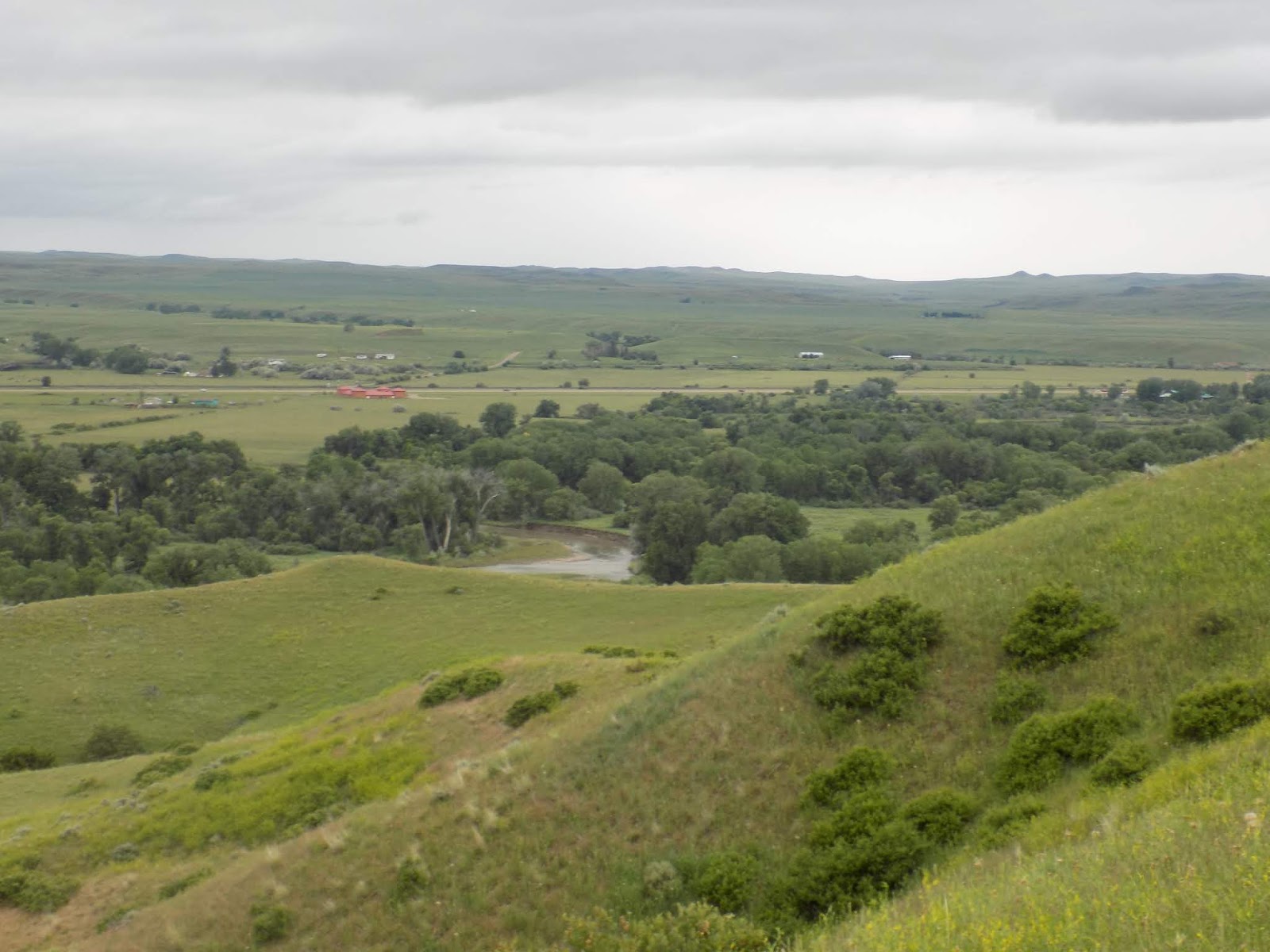
I was at Little Bighorn National Battlefield last Monday, so I have a few pictures. The Little Bighorn River, in Crow Country:


We know that the soldiers had difficult digging trenches because of how dry the soil was, so it would not have been this green in 1876.

The first engagements of the 7th Cavalry were between A, G, M Companies under Major Reno and the Sioux; the idea was to do a lightning strike and then rejoin the rest of the companies under General Custer. Almost as soon as the battle began to happen, however, it was clear that this would not work: the Sioux were not giving way, and Reno was not facing a small detachment but a major force. The Sioux were being organized by Chief Gall, a Hunkpapa associate of Sitting Bull, and an accomplished tactician. Gall recognized almost immediately that Custer's had to be engaging in a two-prong attack (he was one of very few who did), and at every step of the way would anticipate how best to organize Sioux and Cheyenne fire.

Reno managed to get his troops to what is now known as Reno hill, where they met up with Captain Benteen and Companies D, H, and K.


Benteen's men in the early morning of June 26 tried hastily to dig trenches to give cover to riflemen. With limited tools, they had to use whatever they had at hand, including mess plates and knives.


Indian marksmen fired at them from the ridges to their east:


As the time went on, the situation looked increasingly worse for Reno and Benteen. They were out of water in dry country, all the more frustrating because the river was right there, and out of reach because of Indian fire. In a desperate gamble, Benteen got volunteers on a probably-suicide mission to go to the river and bring back as much water as possible while others attempted to draw enemy fire; by a bare scrape of luck, they succeeded. Four of the riflemen and fifteen of the water carriers would later receive the Medal of Honor.

Captain Weir and Company D eventually manage to extricate themselves enough to rejoin Custer -- but too late. The details of what happened at Custer's Last Stand are obscure and confused, and have to be pieced together from conflicting reports, but repeated waves of Sioux and Cheyenne broke Companies L, I, and C, and some think that Crazy Horse led a flanking attack that led Custer to being irreparably surrounded. What is certain is that Gall having locked down Reno and Benteen for so long, he and others were able to go after Custer with full fury. Custer and others with him died on what has come to be known as Last Stand Hill:


A marker indicates more or less where he fell:


People were hastily buried days later, and only even later at times identified. Custer was eventually reinterred at West Point, but the large number of dead led the War Department to turn the battlefield into Custer National Cemetery, which continued to operate until 1978. Authority over the battlefield was transferred from the War Department to the Department of the Interior in the 1930s.


Increasing interest in the Sioux-Cheyenne side of the tale has led to more care being taken in marking and recording aspects of their fight. There is now a nicely done Indian memorial as well:


It's easier to track the places where Union soldiers fell than Sioux and Cheyenne soldiers, in part because the latter had the chance to remove their bodies rather than having to bury them hastily, but a few have been able to be identified, such as Closed Hand:


One of the few survivors of the Last Stand from the Union side was Curly (or Curley), a Crow Indian Scout, who reported the defeat of the 7th Cavalry. He went on to have a long life, and when he died in 1923 of pneumonia, he was buried at Custer National Cemetery:


The Sioux and Cheyenne had had an extraordinary victory, but in a sense their own success defeated them. Having won so resoundingly and not having a definite next move because of that, the alliance started losing its cohesion as warriors drifted back home. Meanwhile, the shock of the defeat led the United States to send thousands of more soldiers.

The mighty Crazy Horse surrendered in 1877 at Red Cloud Reservation. He was treated well for a while, since he was something of a legend even among Union soldiers, but rumors constantly sprang up about his setting out to war again, and he was eventually arrested. In transport, he was stabbed in the back with a bayonet, supposedly for attempting to escape; there have always been questions about his death. Sitting Bull and his men soon had to flee to Canada, where lack of bison made it difficult to feed themselves. He eventually had a falling-out with Gall, who surrendered to the United States and was transported to the Standing Rock Reservation. Sitting Bull himself surrenedered in 1881, and also transferred to Standing Rock, but as he was seen as a special threat, he and his band were kept separately from the other Hunkpapa for quite some time. To make ends meet, he got involved in Wild Westing, traveling around in Wild West shows, and actually made a rather considerable amount of money, although he gave most of it away to those in need. He and Gall became involved in the Ghost Dance Movement and were shot in bungled confrontations. So passed giants among men.

Scottish Poetry XXV

Address to a Haggis
by Robert Burns


Fair fa' your honest, sonsie face,
Great chieftain o the puddin'-race!
Aboon them a' ye tak your place,
Painch, tripe, or thairm:
Weel are ye worthy o' a grace
As lang's my arm.

The groaning trencher there ye fill,
Your hurdies like a distant hill,
Your pin wad help to mend a mill
In time o need,
While thro your pores the dews distil
Like amber bead.

His knife see rustic Labour dight,
An cut you up wi ready slight,
Trenching your gushing entrails bright,
Like onie ditch;
And then, O what a glorious sight,
Warm-reekin, rich!

Then, horn for horn, they stretch an strive:
Deil tak the hindmost, on they drive,
Till a' their weel-swall'd kytes belyve
Are bent like drums;
The auld Guidman, maist like to rive,
'Bethankit' hums.

Is there that owre his French ragout,
Or olio that wad staw a sow,
Or fricassee wad mak her spew
Wi perfect scunner,
Looks down wi sneering, scornfu view
On sic a dinner?

Poor devil! see him owre his trash,
As feckless as a wither'd rash,
His spindle shank a guid whip-lash,
His nieve a nit;
Thro bloody flood or field to dash,
O how unfit!

But mark the Rustic, haggis-fed,
The trembling earth resounds his tread,
Clap in his walie nieve a blade,
He'll make it whissle;
An legs an arms, an heads will sned,
Like taps o thrissle.

Ye Pow'rs, wha mak mankind your care,
And dish them out their bill o fare,
Auld Scotland wants nae skinking ware
That jaups in luggies:
But, if ye wish her gratefu prayer,
Gie her a Haggis

Sunday, June 24, 2018

A Quick Trip to Scotland, Part I

Things have been rather slow, and very Scottish, around here because I took a trip with family to Scotland at the beginning of June. It was a bit of a whirlwind trip, a bit of this and a bit of that, and plenty of interesting things to see.

We arrived in Edinburgh on June 2, very tired after the transatlantic flight. We did walk around a bit, though. Old Town Edinburgh has a very distinctive layout; the area is highly striated, so Old Town was built on what is more or less a big, long ridge of rock. It was a walled city, and Scottish troubles with the English meant that its walls were important far longer than with other walled cities. Because of that, the city did not start growing out of its walls until the eighteenth century, with the development of New Town. Until then, the population of Edinburgh was crammed within the medieval city, with the buildings growing up and up. It all sits more or less between Edinburgh Castle in the west and the Palace of Holyroodhouse, and more strikingly, Arthur's Seat, in the East. We spent some time walking around Princes Street Gardens. The most striking monument associated with the Gardens is the 'Gothic Rocket', the Scott Monument. It is quite a striking piece. (You can click on any of the photographs for a slightly larger view.)


After Sir Walter Scott's death, a big design competition was held; all the best architects vied for the chance of making the monument. One of the competitors, though, submitting a design under the pseudonym, John Morvo, was George Meikle Kemp. He was a working man, not a fancy architect; he loved architecture and could draw well, but he was a carpenter and joiner, and he had submitted under a pseudonym because he was worried that his lack of credentials would harm his chances. The competition gave prizes to the top three entries, and Kemp's was one of them. But the committee couldn't decide which of the three was best, so it had a second round in which any of the three could be revised or improved, and Kemp's revisions of his original design were enough to seal his victory. He died before he ever saw it finished, though.

Sir John Robert Steell was the sculptor who was chosen to do the sculpture at its base.


In Princes Street Gardens there are a number of other statues and monuments of note. I didn't get a good shot of the David Livingstone monument, right next to the Scott Monument; here is one from Wikimedia Commons:

David Livingstone statue, Princes Street Gardens, Edinburgh

It was done by Amelia Robertson Hill and erected in 1875.

Another striking monument in the Gardens was the Wojtek Memorial. Wojtek the Bear was a Syrian bear who was the mascot of the Polish II Corps in World War II; for accounting purposes he was officially enlisted (he eventually became a corporal), and he did some serious soldiering work, since according to multiple sources he helped move carts of ammunition at the Battle of Monte Cassino. After the War, he and his company ended up in Scotland, and Wojtek eventually retired and lived at the Edinburgh Zoo until he died in 1963.


Another noteworthy monument is the Scots American War Memorial, also known as The Call 1914. It was a gift from Scottish-Americans to the Scots in thanks for their service in World War I. The sculptor, R. Tait Mackenzie, was Scottish-Canadian who is most famous for his sculpture, The Ideal Scout, in Philadelphia.

The words scuplted on the monument itself end Ewart Alan Mackintosh's poem, "A Creed":

A Creed
by E. A. Mackintosh


Out of the womb of time and dust of the years forgotten,
Spirit and fire enclosed in mutable flesh and bone,
Came by a road unknown the thing that is me for ever,
The lonely soul of a man that stands by itself alone.

This is the right of my race, the heritage won by my fathers.
Theirs by the years of fighting, theirs by the price they paid,
Making a son like them, careless of hell or heaven,
A man that can look in the face of the gods and be not afraid.

Poor and weak is my strength and I cannot war against heaven.
Strong, too strong are the gods; but there is one thing that I can
Claim like a man unshamed, the full reward of my virtues,
Pay like a man the price for the sins I sinned as a man.

Now is the time of trial, the end of the years of fighting,
And the echoing gates roll back on the country I cannot see
If it be life that waits I shall live for ever unconquered.
If death I shall die at last strong in my pride and free.

Much less striking than either of these, but also of note, is the quiet Robert Louis Stevenson Memorial:


I didn't get a good picture of Ross Fountain, but accidentally got a picture of the top of the Ross Fountain with Edinburgh Castle in the background.


Later we went to Dunbar's Close Garden. On the way we passed the Kirk of the Canongate:


Canongate Kirk was completed for the Church of Scotland in 1691. Its churchyard is famous, although we didn't go in; Adam Smith, Dugald Stewart, and Robert Fergusson are all buried there. I did later get a picture of it from up on high:


Right outside is the statue of Robert Fergusson, the eitheenth-century poet:


He is most famous for his satirical poem about Edinburgh, "Auld Reekie", and for being one of the first influential poets to write in broad Scots. There is something very engaging about this statue -- a young Fergusson striding purposefully yet thoughtfully. And if you look at other pictures of it, it looks very different depending on the light and angle. Sometimes he looks more pleasant, sometimes more serious, sometimes more distracted. Given the quality, I'm afraid I was surprised to discover that it was quite recent; by David Annand, it was erected in 2004. I think this is very much the sort of thing that public art should be, yet today so very often is not: it makes the world better, and the artist is not thrusting himself forward, saying, 'Look at me!', but lets his craft show through the thing itself.

A 'close' is a passage that leads from street to some kind of court or enclosure; there are quite a few in Old Town, most of them not going anywhere of significance. Dunbar's Close, however, hides Dunbar's Close Garden, a charming little garden neatly tucked away and easily missed. The place was a garden in the seventeenth century; later generations built on top of it, but in the 1970s they cleared out the buildings and decided to make it a formal garden, open to the public, in a loosely seventeenth-century style.


As I said, the garden is quite nice, particularly as a way to get away from crowds for a bit, but the location of the garden is in itself remarkable, since on one side it is bordered by the graveyard of the Canongate Kirk, and on the other side you can see Panmure House. Panmure House was the residence of Adam Smith from 1772 to his death in 1790.


Not far away you can see The Queen's Gallery, which is linked to Holyrood Palace, with Arthur's Seat rising the background and the ugly abomination that is the new Scottish Parliament on the right.


We also saw the Old Calton Cemetry (which I will save for Part 2) and the New Calton Cemetery. The New Calton Burial Ground was made in the nineteenth century when a new road required moving a number of graves from Old Carlton. About 300 corpses were reinterred there. It has a striking watchtower, which was built to deter graverobbers:


This memorial seems to mark the division between Old Calton and New Calton fairly well. Andrew Fyfe himself was moved here from Old Calton when New Calton was built, but his son John, whose memorial plaque you can see on the left-hand side, seems to be the first person who was interred (rather than re-interred) here.


Probably the most notable of the vaults is that of the Stevenson family, an engineering family who specialized in lighthouses. One still sees their lighthouses in various places. Robert Louis Stevenson is not, however, buried in the family vault in Edinburgh but far away in Samoa.


Not far away is the Burns Monument.


Not far away again is Jacob's Ladder. I couldn't get a good picture of it, in part because it was closed off for renovation and in part because it's just hard to get a picture of from the top. It's a very steep stairway between New Street and Regent Road; you can see a video of it here.

We ate dinner near St. Andrew Square, in New Town, so I caught a picture of James Clerk Maxwell:


The statue is fairly recent, since it was finished in 2008; the sculptor is Alexander Stoddart, whose work we will see again. Wikimedia has a version that has better lighting.

And that was a day.


to be continued
Fortnightly Book, June 24

Descend into the crater of Yocul of Sneffels, which the shade of Scartaris caresses, before the kalends of July, audacious traveler, and you will reach the center of the earth. I did it. -- Arne Saknussemm

The next fortnightly book is Journey to the Center of the Earth, Voyages Extraordinaires #3, and my favorite of the popular Verne novels. This will be the first fortnightly book that I will be deliberately reading twice, in two different translations.

(1) I will be reading from the Heritage Press (New York) edition, a nicely made book with fifteen illustrations by Edward A. Wilson. It uses the Waverley typeface. The three-piece binding has a black leather back with gold title over a chambray lava-red cloth over the boards. It also has an introduction by Isaac Asimov. As Heritage Press editions go, it is an especially good one, and as I've noted before, I mention these bibliographic details occasionally because the physical book affects how one reads; this one is a pleasure.

(2) Which makes it so sad that its translation is awful. Verne's works, of course, were often subject to very bad translations done on very bad principles, and Journey is the most popular work to have had a very poor English translation. One of the signs of a bad translation are arbitrary changes, and we see this in spades here. The character names in the common translation (which I quote above) are:

Professor Von Hardwigg
Harry
Gretchen
Hans

The names in Verne's actual text are:

Professor Otto Lidenbrock
Axel
Gräben
Hans

The problem with Heritage Press, of course, is that they usually kept the books themselves cheap by using public domain translations when available, and this skimping leaves one with a very nice physical edition of a very poor translated edition. So I'll also be reading it in the Dover Thrift Edition; I am sure there are better translations, and it's a cheap paperback, but at least it gets the names right. (The difference between the translations is that all 'Hardwigg' translations derive from the 1871 George & Raffan edition, whereas the Dover translation derives from the distinct 1876 George Routledge and Sons edition.)

So I will, of course, be looking at the difference made by the difference in translations. Down the volcano we go!

Scottish Poetry XXIV

Baby
by George MacDonald


Where did you come from, baby dear ?
Out of the everywhere into here.

Where did you get those eyes so blue ?
Out of the sky as I came through.

What makes the light in them sparkle and spin ?
Some of the starry twinkles left in.

Where did you get that little tear ?
I found it waiting when I got here.

What makes your forehead so smooth and high ?
A soft hand stroked it as I went by.

What makes your cheek like a warm white rose ?
I saw something better than anyone knows.

Whence that three-cornered smile of bliss ?
Three angels gave me at once a kiss.

Where did you get this pearly ear ?
God spoke, and it came out to hear.

Where did you get those arms and hands ?
Love made itself into bonds and bands.

Feet, whence did you come, you darling things ?
From the same box as the cherubs' wings.

How did they all just come to be you ?
God thought about me, and so I grew.

But how did you come to us, my dear ?
God thought about you, and so I am here.

Saturday, June 23, 2018

Baptismal Obligations

Ireland more and more these days just seems to be thoroughly intellectually bankrupt.

McAleese told the newspaper that by baptizing children before they have reached the age of reason, the Church is creating “infant conscripts who are held to lifelong obligations of obedience.”

“You can’t impose, really, obligations on people who are only two weeks old and you can’t say to them at seven or eight or 14 or 19 ‘here is what you contracted, here is what you signed up to’ because the truth is they didn’t,” she said.

(1) It is extraordinary that someone could say this and not grasp that this would make it impossible to be an Irish citizen, or any other citizen, from birth. (The parallel is in fact quite close, because baptism is not a contract but an initiation into allegiance like citizenship.) Ireland itself imposes obligations like this; it is useless for an Irish nineteen-year-old to protest that Ireland has no authority over him just because he never explicitly contracted to be Irish. One can always repudiate citizenship; but, of course, one can always formally apostatize, as well.

(2) The theory of obligation involved in McAleese's claim is simply incoherent. You can't make contracts without prior obligations imposed by society; these obligations, being presupposed by all contracts, are imposed without contract, and involuntarily. These customary obligations themselves presuppose natural obligations of reason. Some of these obligations, both natural and customary, give parents and others operating in parental capacity a power to impose obligations -- again, obligations imposed by parents on their children are not contracts. In addition, everyone has a natural obligation to draw from the heritage given them by previous generations; this, in and of itself, even with no other consideration, would give reasons at least to respect baptismal obligations, even if there were no other reason, and even if some other obligation interfered, and even if one decided not to regard oneself as strictly obligated by them.

(3) Parentally imposed obligations are particularly relevant, because the authority of the Church to impose obligations is generally seen as a sort of spiritual parenthood.

(4) What, precisely, are baptismal obligations? They are of three kinds:

    (a) natural obligations specified by baptismal context;
    (b) positive obligations received by divine revelation;
    (c) positive obligations imposed by the Church.

The general positive obligations imposed by the Church are what are known as the precepts of the church, and there are somewhere between five and seven of them (depending on how they are broken up). The five you always find are:

1.You shall attend Mass on Sundays and on holy days of obligation.

2.You shall confess your sins at least once a year.

3.You shall receive the sacrament of the Eucharist at least once during the Easter season.

4.You shall observe the days of fasting and abstinence established by the Church.

5.You shall help to provide for the needs of the Church.

Precepts 6 and 7, when they are added to the list, are to observe the laws of Matrimony and to participate in the evangelization of the Church; they are arguably just positive republications of natural or divine obligations. It is generally understood that children, not being in full authority, are not strictly obligated to these (although their parents and godparents have a responsibility to train them to follow them as part of their way of life). What is function of these? It is to outline a minimum participation, and to provide a minimal guideline to the Catholic way of life. Beyond these, all the Church does is give local specifications of these, or certify that other obligations are natural or divine, or exhort to better behavior.

(5) Baptism confers rights in the Church; rights carry with them obligations for their proper exercise and use, just by being rights. If we only had obligations by contract, we'd only have rights by contract. (And, of course, contract rights, like contract obligations, presuppose non-contract rights and obligations.)

(6) The direct implication of McAleese's comment is that the Church has no power to impose law, and thus that canon law is not actually any kind of law. This is somewhat remarkable given that she has written a book on canon law but in fact is exactly in line with other comments she has made about canon law. But the problem is that, if the real problem is very existence of Church law, then it is immensely glib and facile to pretend that it is a simple matter of contract.

McAleese justifies herself the way it has become common to do so, in a vague and uncritical appeal to conscience:

In her interview with the Irish Times, she said, “My human right to inform my own conscience, my human right to express my conscience even if it is the case that it contradicts the magisterium, that right to conscience is supreme.”

The right of a well-formed conscience is supreme; an erroneous conscience, on the other hand, obligates, since that is the function of conscience, but does not itself excuse in any way. Everyone has the natural obligation to educate their conscience properly. Part of educating your conscience properly is recognizing that you have obligations to your parents, your forebears, your nation, and those with whom you are in society, regardless of whether you made an explicit contract to accept such obligations. If you regard yourself as a practicing Catholic and yet regard your conscience as having supreme veto over the practical obligations of being Catholic, the name for that is 'liar'.