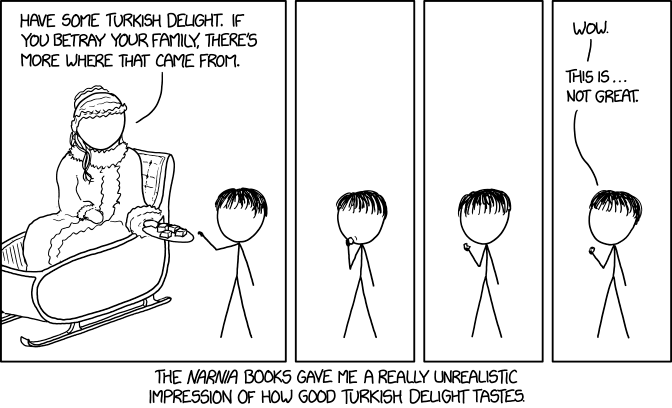
It reminds me of the Darwins' experiment with Turkish Delight. And, of course, that is part of what makes Turkish Delight a good symbol of most temptation: sensual, sweet, decadent to look at, and, when you try it, not that great.

For God, being good and loving to mankind, and caring for the souls made by Him — since He is by nature invisible and incomprehensible, having His being beyond all created existence, for which reason the race of mankind was likely to miss the way to the knowledge of Him, since they are made out of nothing while He is unmade — for this cause God by His own Word gave the Universe the Order it has, in order that since He is by nature invisible, men might be enabled to know Him at any rate by His works. For often the artist even when not seen is known by his works. And as they tell of Phidias the Sculptor that his works of art by their symmetry and by the proportion of their parts betray Phidias to those who see them although he is not there, so by the order of the Universe one ought to perceive God its maker and artificer, even though He be not seen with the bodily eyes. For God did not take His stand upon His invisible nature (let none plead that as an excuse) and leave Himself utterly unknown to men; but as I said above, He so ordered Creation that although He is by nature invisible He may yet be known by His works.
En somme, ce programme fut rédigé en s’inspirant de ces principes, qui sont la base de l’éducation anglo-saxonne :
« Toutes les fois qu’une chose vous effraye, faites-la.
« Ne perdez jamais l’occasion de faire un effort possible.
« Ne méprisez aucune fatigue, car il n’y en a pas d’inutile. »
À mettre ces préceptes en pratique, le corps devient solide, l’âme aussi.
In short, this program was formed so as to be inspired by these principles, which are the foundation of English education:
"Whenever something frightens you, do it."
"Never lose a chance to try."
"Do not despise hard work; it is never useless."
By putting these precepts into practice, the body becomes firm, and the mind as well.
If the modern man is indeed the heir of all the ages, he is often the kind of heir who tells the family solicitor to sell the whole damned estate, lock, stock, and barrel, and give him a little ready money to throw away at the races or the nightclubs. He is certainly not the kind of heir who ever visits his estate: and, if he really owns all the historic lands of ancient and modern history, he is a very absentee landlord. He does not really go down the mines on the historic property, whether they are the Caves of the Cave-Men or the Catacombs of the Christians, but is content with a very hasty and often misleading report from a very superficial and sometimes dishonest mining expert....Nevertheless, there are some of us who do hold that the metaphor of inheritance from human history is a true metaphor, and that any man who is cut off from the past, and content with the future, is a man most unjustly disinherited; and all the more unjustly if he is happy in his lot, and is not permitted even to know what he has lost. And I, for one, believe that the mind of man is at its largest, and especially at its broadest, when it feels the brotherhood of humanity linking it up with remote and primitive and even barbaric things.
So you see that all things pass. Then, seeing that they pass, they should be possessed with moderation in the light of reason, loved in such wise as they should be loved. And he who holds them thus will not hold them with the help of sin, but with grace; with generosity of heart, and not with avarice; in pity for the poor, and not in cruelty; in humility, not in pride; in gratitude, not in ingratitude: and will recognize that his possessions come from his Creator, and not himself. With this same temperate love he will love his children, his friends, his relatives, and all other rational beings. He will hold the condition of marriage as ordained, and ordained as a Sacrament; and will have in respect the days commanded by Holy Church. He will be and live like a man, and not a beast; and will be, not indeed ascetic, but continent and self-controlled. Such a man will be a fruitful tree, that will bear the fruits of virtue, and will be fragrant, shedding perfume although planted in the earth; and the seed that issues from him will be good and virtuous.
So you see that you can have God in any condition; for the condition is not what robs us of Him, but the evil will alone, which, when it is set on loving falsehood, is ill-ordered and corrupts a man's every work. But if he loves truth, he follows the footsteps of truth; so he hates what truth hates and loves what truth loves, and then his every work is good and perfect. Otherwise it would not be possible for him to share the life of grace, nor would any work of his bear living fruit.
What Are Heavy?
by Christina Rossetti
What are heavy? Sea-sand and sorrow:
What are brief? To-day and to-morrow:
What are frail? Spring blossoms and youth:
What are deep? The ocean and truth.
One of the improvements which do great honour to modern times and clearly indicates progress is the way in which the insane are now treated and cared for. The maxim which has emerged is to see at last human beings in the insane, and to treat them as human beings like ourselves. The same progress, worthy of the highest accolade, is taking place in the education of children. The age of reason is being recognised at an earlier and earlier age. I have no doubts that we will eventually discern a flash of intelligence in the first smile a baby gives its mother. In this way we will greatly perfect the valuable art by which the child's and the adult's reason can communicate with each other. A common language will be attained for mutual understanding between adult and baby.