Donder-thunder-donner-rain
Donder-thunder-donner-rain:
Clouds grow dark, grumble, crash;
tongues of storm, sparks of light
charge recklessly across the clouds,
bolts on black breaking night,
cracking, creasing, sky and mind
with clarity of fire.
Rushing, roaring winds inspire
rains in pouring, thoughts in streams,
endless drops that drip from heaven,
washing, wishing, on the streets.
Silence drenches rain-swept pathways;
clouds alone still have their say:
Donder-thunder-donner-rain.
Wednesday, February 20, 2019
Tuesday, February 19, 2019
Music on My Mind
Postmodern Jukebox (ft. Emily Goglia, Rob Paulsen, Maurice LaMarche), "Pinky and the Brain Theme". With the original voice actors, which is a very nice touch.
Poem Retrospective XIX
I don't quite remember how this poem came about, but it gelled in its stable form more quickly than my religious poems usually do.
Holy Wednesday
How gently falls the stroke of doom,
how swiftly sprouts the vice;
how quiet is the tread of gloom:
a man but asks the price --
the silver gained for traitor's guilt.
And what a paltry price!
The price for which to sell the world,
the price of devastation,
the price that soon a man will hurl
away in desolation:
for little bag of little coin,
the hope of every nation!
Yet are you any better here,
or, for that matter, I?
Too good to sell hope out of fear,
betray love lest we die?
Too wise to trade the deepest things
and some small pleasure buy?
Might someone then have caught your theft,
then caught you in a lie,
a false heart asking, sly and deft:
"Lord, how could it be I?"
Knowing well your deepest guilt:
"I ask you, is it I?"
Holy Wednesday
How gently falls the stroke of doom,
how swiftly sprouts the vice;
how quiet is the tread of gloom:
a man but asks the price --
the silver gained for traitor's guilt.
And what a paltry price!
The price for which to sell the world,
the price of devastation,
the price that soon a man will hurl
away in desolation:
for little bag of little coin,
the hope of every nation!
Yet are you any better here,
or, for that matter, I?
Too good to sell hope out of fear,
betray love lest we die?
Too wise to trade the deepest things
and some small pleasure buy?
Might someone then have caught your theft,
then caught you in a lie,
a false heart asking, sly and deft:
"Lord, how could it be I?"
Knowing well your deepest guilt:
"I ask you, is it I?"
Monday, February 18, 2019
Il Beato Angelico
Today is the memorial for Blessed Giovanni da Fiesole, better known to the world as Fra Angelico. Fiesole is just the town in which he took his vows; he was born Guido di Pietro. We know practically nothing about his early life; the earliest record we have for him is a payment for doing paintings in a church in 1417. At the time he was still operating under the name Guido, and was a member of a lay confraternity. He joined the Dominicans in 1423 and took the name Giovanni. One of the most innovative painters of his day, he is one of the greatest religious painters of all time.
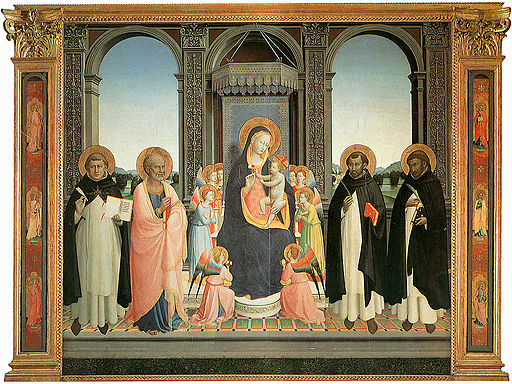

Fra Giovanni was a simple man and most holy in his habits, and one day when Pope Nicholas V desired him to dine with him, he had scruples of conscience about eating meat without his prior's leave, not considering the Pope's authority. He would not follow the ways of the world, but lived purely and holily, and was a great friend of the poor. He painted constantly, and would never represent anything but the saints. He might have been rich, but did not care about it, saying that true riches are nothing else than being content with little. He might have governed many, and would not, saying it was less troublesome to obey, and one was less liable to err in obeying. It was in his power to hold dignities among the friars and elsewhere, but he did not esteem them, affirming that he sought no other dignity than to escape hell and attain to Paradise. He was most kind and sober, keeping himself free from all worldly ties, often saying that he who practised art had need of quiet and to be able to live without cares, and that he who represents the things of Christ should always live with Christ. He was never seen in anger by the friars, which is a great thing, and seems to me almost impossible to believe; and he had a way of admonishing his friends with smiles. To those who sought his works he would answer, that they must content the prior, and then he would not fail. To sum up, this father, who can never be enough praised, was in all his works and words most humble and modest, and in his paintings facile and devout; and the saints whom he painted have more the air and likeness of saints than those of any one else. It was his habit never to retouch or alter any of his paintings, but to leave them as they came the first time, believing, as he said, that such was the will of God. Some say he would never take up his pencil until he had first made supplication, and he never made a crucifix but he was bathed in tears.[From Giorgio Vasari's Lives of the Artists]
Poem Retrospective XVIII
Magician
Her hair is sun turned into strand,
her skin is light like cream;
by endless ocean's endless wave
she endlessly shall dream:
a lady by the salted sea,
she sleeps forevermore;
forever on the sands I walk,
her beauty to adore.
I loved her deeply in my youth,
but she my brother wed;
I wove enchantment in the air
that struck my brother dead.
I spoke a word of ancient might
that turned her soul to sleep
and cast a spell on time itself,
eternal love to keep.
Now walk I on this weary sand
for ages none can tell,
and keep my heart upon her form,
and weep, and love in hell.
Her hair is sun turned into strand,
her skin is light like cream;
by endless ocean's endless wave
she endlessly shall dream:
a lady by the salted sea,
she sleeps forevermore;
forever on the sands I walk,
her beauty to adore.
I loved her deeply in my youth,
but she my brother wed;
I wove enchantment in the air
that struck my brother dead.
I spoke a word of ancient might
that turned her soul to sleep
and cast a spell on time itself,
eternal love to keep.
Now walk I on this weary sand
for ages none can tell,
and keep my heart upon her form,
and weep, and love in hell.
Sunday, February 17, 2019
Fortnightly Book, February 17
When we have to do with vice and vicious characters, I maintain it is better to depict them as they really are than as they would wish to appear. To represent a bad thing in its least offensive light, is doubtless the most agreeable course for a writer of fiction to pursue; but is it the most honest, or the safest? Is it better to reveal the snares and pitfalls of life to the young and thoughtless traveller, or to cover them with branches and flowers?
Of all the Brontë sisters, Anne Brontë has perhaps had the rockiest critical reception. This is particularly true of The Tenant of Wildfell Hall, the next fortnightly book. Contemporary reviews show that people regarded it as interesting, and it sold well, but it was also criticized for being too coarse, too violent, too disagreeable. Charlotte Brontë refused to have it reprinted after Anne's death, and critics in the aftermath largely seem to have agreed with her -- it did not fare well in the late nineteenth century and most of the twentieth century, in which its deliberately anti-Romantic approach was regarded as lacking in fire and spirit. The novel had its defenders, but the defenses are often qualified and backhanded. In the past few decades there has been an increasing tendency to push back at this general mix of disparagement and backhanded praise and argue that Anne is doing things more subtle than the critics had granted, and that the psychology of the work is richer than has usually been recognized. It is anyone's guess whether this will stick, since critics are not always particularly reliable across time, but it is worth noting that people have continued to read it. And that is, as I've said before, the only real test of quality for a literary work: that people who enjoy reading keep coming back to it.
In any case, I have never actually read the whole work, so we'll see how I find it.
Poem Retrospective XVII
Sometimes a poem just comes together because it's very much what you believe, and so says almost exactly what you want it to say. I suspect that the rhythm of the poem is partly echoing Runrig's "One Thing".
Reason and Grace
Nothing I am
and nothing I'll be;
my footsteps are washed
by the sands of the sea.
The waves rolling in
will cover all trace
and nothing remain
but reason and grace.
Shout out my name;
the echo will die,
lost on the wind
in the silence of sigh.
My name in the air
cannot hold me in place;
nothing's forever
but reason and grace.
Conquer the world;
the borders all break,
bursting like bubbles
or dreams when we wake;
put up the bronze
of the kings of the race;
it all will fall down
except reason and grace.
My tale will be finished,
the course will be run,
and darkness will fall
with the dousing of sun;
not a bit does it matter,
though tears touch my face:
there is nothing enduring
save reason and grace.
Reason and Grace
Nothing I am
and nothing I'll be;
my footsteps are washed
by the sands of the sea.
The waves rolling in
will cover all trace
and nothing remain
but reason and grace.
Shout out my name;
the echo will die,
lost on the wind
in the silence of sigh.
My name in the air
cannot hold me in place;
nothing's forever
but reason and grace.
Conquer the world;
the borders all break,
bursting like bubbles
or dreams when we wake;
put up the bronze
of the kings of the race;
it all will fall down
except reason and grace.
My tale will be finished,
the course will be run,
and darkness will fall
with the dousing of sun;
not a bit does it matter,
though tears touch my face:
there is nothing enduring
save reason and grace.
Subscribe to:
Posts (Atom)