Oulipo was a sort of reaction against surrealist poetry; the surrealists broke all rules and made the most of chance, so Oulipo built its poems out of rules and determinism. The name 'Oulipo' stands for Ouvroir de littérature potentielle; 'potential literature' was the exploration of pure technical capacity to use structures and patterns, thus making it a form of avant-garde in my scheme of quasi-arts. In any case, one Oulipo technique was S+7, in which you pick a text and replace every noun (substantif, hence the 'S') with the seventh noun after it in the dictionary. The second poem below -- I suppose for consistency I should call it a quasi-poem -- is a modified version, S+7/A+7, in which I took a sentence (from Kant, as it happens) and changed every noun to the seventh noun after it in a dictionary and every adjective to the seventh adjective after it in the same dictionary, and I did this three different times with three different dictionaries. One of the difficulties with this technique in English is that English has a small core of very common Anglo-Saxon vocabulary with an immense secondary vocabulary of latinate words, with the result that everything increases in pomposity, because every simple noun or adjective is likely to be replaced by a latinate one. Hence lectures; but the determinism of Oulipian writing against the chance of a dictionary ironically gives it a surreal feel, hence dreams.
Stormy Day
Darkening clouds growl and crash,
tongues of storm, lightning splash,
cavalry across the sky;
bolting stallions madly dash,
unafraid to blaze and die.
The world is hurled by roaring wind,
the wild bacchanals descend;
these showers flood; no roof, no shield
can from the dripping drops defend,
each drop a wish on pavement-field.
Those wishes wash my words away,
no language left, just heart to pray.
Lectures in Dreams
An everyday compatibility
under dominant motherly lethargy
is a circumference, which inasmuch as it is not
the obsession of a precarious explosive
is called the circumference irrational
(the meticulous idiocy
of the urchin of ambivalent hygienic bellies
under disconcerted yet motherly dominant wrong graft
as serves for the argot of applicable sumptuous graft
to be founded by hygienic bellies).
An ethnocentric compages
under documentary morganatic legroom
is a churl, which inasmuch as it is not
the obligee of a postgraduate explant
is called the churl inwrought
(the mesne identification
of the Unitarian of allusive humic Belgians
under disadvantageous yet morganatic documentary worshipful grab
as serves for the architrave of apian sudoriferous grab
to be founded by humic Belgians).
A eurythermal communique
under doddered Moresque lehua
is a churn, which inasmuch as it is not
the obligation of a postern expiration
is called the churn involuntary
(the Merovingian ideogram
of the unity of allied upstate humeral beliefs
under dirt yet Moresque doddered wormy gownsman,
as serves for the archine of aphotic sufficient gownsman
to be founded by humeral beliefs).
Wednesday, March 04, 2020
Triads and Julian of Norwich (Re-Post)
Since I'm reading Julian, I thought I would put this up; it's very weird reading something you originally wrote twenty-two years ago, and even on the blog it was posted thirteen years ago. The syntactic devices used in the building of Julian's theological interpretations of her visions are still, I think, important for understanding what she is doing, and the awkwardness of expression doesn't make my nineteen-year-old self any less right about it. I have corrected a few typos and unbearably awkward expressions, though.
**********
I came across the following some time ago when going through some papers; it is a short essay written in the summer of '98 (the date on the paper is 15.7.98), my sophomore year of college, for a course on women and literature in the later Medieval and Renaissance periods. Needless to say, there are a number of things I would do differently now, and it's all very clumsily expressed, but in the main it is right, and I thought it would be interesting to put it up.
Use of Triadic Form in Julian's Revelations of Divine Love
With careful examination one can find many literary, as opposed to theological or philosophical, qualities in Julian's Revelation of Divine Love. One such literary characteristic is Julian's use of syntactic features, such as parallelism or repetition, to further the themes of her work. This is perhaps most easily seen in her continual use of the triad to emphasize the Trinitarian aspects of the message of the Revelation.
By far the most common triad in Julian's work is that of might, wisdom, and goodness. The first instance of this occurs in the first chapter, in her summary of what will follow in Revelation XIII. The sense of the usage is that, just as God has made everything with might, wisdom, and goodness, everything will be made right again by means of the same might, wisdom, and goodness (1:38-40). This is shown to be a good preparatory summary in the fact that this same triad is mentioned in Revelation XIII in a context that elaborates on this very thought (35:26-35). In these passages, however, Julian is not speaking of might, wisdom, and goodness as general characteristics of the Godhead, but of the three together, functioning as a unity, being the very Godhead. Each of the three characteristics, might, wisdom, and goodness, is proper to one of the three Persons of the Trinity, the Father, the Son, and the Holy Spirit. THus, when Julian says in Revelation XIV that it is neither in the might of God, nor in the wisdom of God, nor in the goodness of God to be wrathful (46:33-35), she is saying that the very substance of God, threefold yet one, is not in any way wrathful. That this is the case is given in a passage later during the same Revelation. In this passage she gives the identification very clearly: "And thus in oure makyng god almyghty is oure kyndly fader, and god all wisdom is oure kindly mother, with the loue and the goodnes of the holy gost, whych is all one god, one lord" (58:12-14). Here are found the elements of might, wisdom,a nd goodness, each identified with one Person of the Trinity. Thus, might is the characteristic of God the Father; wisdom is the characteristic of God the Son, who is also referred to in Julian's works, as here, as the Mother; and goodness is a characteristic of God the Holy Spirit. For Julian, therefore, human interaction with the Godhead is highly Trinitarian. When a human being experiences God, it is an experience of "souereyne myghte, souereyne wysdom and souereyn goodnesse" (68:12-14).
Another triad is found on multiple occasions in the Revelations, which is sufficiently similar to the previous to be considered a variation, to wit, might, wisdom, and love. In matter of fact, the two triads are identical in their referents and interchangeable; what this new triad, the second most common in the work, does is to give an idea of what Julian means the reader to understand the work of the Holy Spirit to be. This is shown by Julian's assignation of the characteristic or property of love, along with the characteristic of goodness, to the Holy Spirit in the quotation from Revelation XIV above. The relationship between love and goodness as seen by Julian is even more clearly brought out in a passage that occurs earlier in the same Revelation. In this passage, Julian, speaking of how God created humanity, speaks of "loue made of the kyndly substanncyall goodnesse of the holy gost" along with the might of the Father and the wisdom of the Son (53:36-39). Love and goodness are, as was said, interchangeable in the triad, since they have the same referent, but in Julian give a somewhat more active implication than does goodness. Thus, one finds that when Christ in Revelation III speaks of himself as the one who leads all things to the end he has ordained, he uses this triad (11:53-56). In the same place the soul is said to be "examynyd" in the vision "myghtly, wysely, and louyngly" (11:56-57). This is an elaboration of the theme summarized for this Revelation in the first chapter, where Julian uses this triad for the first time (1:10-13). Might, wisdom, and love are also brough together in Revelation XIV, in a passage in which Julian speaks of the way in which God keeps the souls of the believers (62:5-10). Perhaps the most important use of the triad occurs earlier in this same Revelation during the discussion of how God has no wrath. In one sense, what is used here is not a triad but a tetrad, since it has four members: might, wisdom, charity, and unity (46:31-32). It can be easily seen, however, that unity does not function at the same level as the other three, because it is that which joins the other three together. The conclusion is obvious: here Julian is emphasizing the Trinity, not merely as the Godhead of Three Persons, but also, simultaneously, as one God. At times the property of goodness also serves as this function; one example of which can be seen at the end of Revelation I.
There are several lesser variants of these two primary triads that fulfill the same function of further Julian's Trinitarian theme. Some of these triads are similar in that they refer to God the Father with the property kind. These are often less obviously Trinitarian than the triads given above, but the Trinitarian trace can still be found in them. In a pssage found in the long Reverlation XIV, Julian uses the triad kind, mercy, and grace, in a way that, upon investigation, can be seen to refer to the Trinity: "For in kynde we haue oure lyfe and oure beyng, and in mercy and grace we haue oure encre and oure fulfyllyng" (56:43-44). Kind, or nature, is reserved to God the Father, whos it he beginning point of the Trinitarian procession of Persons, and so is, in a sense, the very substance of the Godhead. In mercy one can immediately see the saving action of God the Son, who died on the cross for the forgiveness of sins, while grace is a characteristic of God the Spirit, who is the gift given by God the Father and God the Son to the Church, as, for example, at Pentecost. A similar triad is found later on, when Julian is discussing the nature of Motherhood in the Godhead, which is, she says, nearest, readiest, and surest: "nerest for it is most of kynd, redyest for it is most of loue, and sekerest for it is most of trewth" (60:14-16). Kind, as has been seen, is a characteristic of the Father, and love, of course, of the Spirit. The relationship between wisdom and truth, should be obvious, particularly in how, if one applies to the Second Person of the Trinity, the other can also reasonably be said to apply.
Other variant triads refer less to the substance of the Persons of the Trinity and focus more on their operations. An example of this is found in Revelation I, where Julian says that God made human beings to himself, restored them by his Passion, and keeps them in his love (5:44-46). God the maker, God the restorer, and God the keeper are, in fact, the Father, the Son, and the Holy Spirit, as any sharp eye might perceive. In the same Revelation Julian speaks of how no one can know the homeliness of the Father in this life unless they receive it by a special showing from Christ or by an inwardly given grace of the Holy Spirit (7:55-58). These are just a few instances that show how dominated by the Trinity Julian's theological thought is.
Perhaps one of the most interesting uses to which Julian puts the triad to further her Trinitarian emphasis is in speaking of the human being. In Revelation XIV Julian says that "oure soule is a made trynyte lyke to the unmade trynyte" (55:40-41), an integral part of Julian's anthropology that could have been discovered from a study of her use of the triadic function. In several places Julian uses triads in describing the human being in such a way as to leave no doubt about how important the Trinity is in her view for understanding humanity. In one place, speaking of human nature when apart from God, she says that it is "vnmyghty and vnwyse of hym selfe, and also his wyll is ovyr leyde in thys tyme he is in tempest and in sorow and woe" (47:17-19). In this can be seen the transformation of the human soul, made in the image of the Trinity, into the reverse of the triad of might, wisdom, and love or goodness. Similarly, she says that the Christian's willing assent to the presence of God involves loving Him with all one's heart, soul, and might (52:23-26), in which one can also see the human type of the Trinitarian antitype. Further on she says, "Oure feyth comyth of the kynde loue of oure soule, and of the clere lyghte or oure reson, and of the stedfaste mynde whych we haue of god in oure furst makyng" (55:14-16). Here is shown the exact manner in which Julian conceives the human being to be made in God's image, once again Trinitarian in form: humanity has "stedfaste mynde" like the Father, reason like the Son, and love like the Holy Spirit.
Perhaps more important than these, however, is her assertion in Revelation XVI of the three ways in which God is worshipped and human beings are "sped, kepte and savyd," namely, one's own reason, the teaching authority of the Church, and the experience of the interior working of the Spirit (80:1-8). Each of these three are given to use by God and are, as a result to be respected and used. The human reason, in a sense, proceeds from God the Father, who created it. The teaching authority of the Church proceeds form God the Son because He is both the Head of the Church and the subject matter taught by the Church's gospel. These two, when added to the graces bestowed through the Holy Spirit, constitute what might be called Julian's theological epistemology. By means of these three gifts, which the Christian must continually use, one comes to know oneself and God; because from these three sources come the virtues of faith, hope, and charity, in which the entire Christian life is grounded (7:58-65).
So rich is Julian's work with triads, it is soon seen to be far beyond the capability of a short essay to investigate the entire depth of meaning Julian is able to place in her words by means of this simple syntactic device. It is certain, however, that she uses the mechanism with ease and mastery, giving every triad a use that is more than merely rhetorical. Nor can one say that only the Trinitarian aspects of Julian's revelations are shown by her use of the triad; as was seen above, some of her most obviously Trinitarian triads further anthropological, ethical, and epistemological themes as well. Given this, and the wealth of other well-used syntactic devices found in the Revelations of Divine Love, one can truly say that Julian of Norwich is a masterful writer.
**********
I came across the following some time ago when going through some papers; it is a short essay written in the summer of '98 (the date on the paper is 15.7.98), my sophomore year of college, for a course on women and literature in the later Medieval and Renaissance periods. Needless to say, there are a number of things I would do differently now, and it's all very clumsily expressed, but in the main it is right, and I thought it would be interesting to put it up.
Use of Triadic Form in Julian's Revelations of Divine Love
With careful examination one can find many literary, as opposed to theological or philosophical, qualities in Julian's Revelation of Divine Love. One such literary characteristic is Julian's use of syntactic features, such as parallelism or repetition, to further the themes of her work. This is perhaps most easily seen in her continual use of the triad to emphasize the Trinitarian aspects of the message of the Revelation.
By far the most common triad in Julian's work is that of might, wisdom, and goodness. The first instance of this occurs in the first chapter, in her summary of what will follow in Revelation XIII. The sense of the usage is that, just as God has made everything with might, wisdom, and goodness, everything will be made right again by means of the same might, wisdom, and goodness (1:38-40). This is shown to be a good preparatory summary in the fact that this same triad is mentioned in Revelation XIII in a context that elaborates on this very thought (35:26-35). In these passages, however, Julian is not speaking of might, wisdom, and goodness as general characteristics of the Godhead, but of the three together, functioning as a unity, being the very Godhead. Each of the three characteristics, might, wisdom, and goodness, is proper to one of the three Persons of the Trinity, the Father, the Son, and the Holy Spirit. THus, when Julian says in Revelation XIV that it is neither in the might of God, nor in the wisdom of God, nor in the goodness of God to be wrathful (46:33-35), she is saying that the very substance of God, threefold yet one, is not in any way wrathful. That this is the case is given in a passage later during the same Revelation. In this passage she gives the identification very clearly: "And thus in oure makyng god almyghty is oure kyndly fader, and god all wisdom is oure kindly mother, with the loue and the goodnes of the holy gost, whych is all one god, one lord" (58:12-14). Here are found the elements of might, wisdom,a nd goodness, each identified with one Person of the Trinity. Thus, might is the characteristic of God the Father; wisdom is the characteristic of God the Son, who is also referred to in Julian's works, as here, as the Mother; and goodness is a characteristic of God the Holy Spirit. For Julian, therefore, human interaction with the Godhead is highly Trinitarian. When a human being experiences God, it is an experience of "souereyne myghte, souereyne wysdom and souereyn goodnesse" (68:12-14).
Another triad is found on multiple occasions in the Revelations, which is sufficiently similar to the previous to be considered a variation, to wit, might, wisdom, and love. In matter of fact, the two triads are identical in their referents and interchangeable; what this new triad, the second most common in the work, does is to give an idea of what Julian means the reader to understand the work of the Holy Spirit to be. This is shown by Julian's assignation of the characteristic or property of love, along with the characteristic of goodness, to the Holy Spirit in the quotation from Revelation XIV above. The relationship between love and goodness as seen by Julian is even more clearly brought out in a passage that occurs earlier in the same Revelation. In this passage, Julian, speaking of how God created humanity, speaks of "loue made of the kyndly substanncyall goodnesse of the holy gost" along with the might of the Father and the wisdom of the Son (53:36-39). Love and goodness are, as was said, interchangeable in the triad, since they have the same referent, but in Julian give a somewhat more active implication than does goodness. Thus, one finds that when Christ in Revelation III speaks of himself as the one who leads all things to the end he has ordained, he uses this triad (11:53-56). In the same place the soul is said to be "examynyd" in the vision "myghtly, wysely, and louyngly" (11:56-57). This is an elaboration of the theme summarized for this Revelation in the first chapter, where Julian uses this triad for the first time (1:10-13). Might, wisdom, and love are also brough together in Revelation XIV, in a passage in which Julian speaks of the way in which God keeps the souls of the believers (62:5-10). Perhaps the most important use of the triad occurs earlier in this same Revelation during the discussion of how God has no wrath. In one sense, what is used here is not a triad but a tetrad, since it has four members: might, wisdom, charity, and unity (46:31-32). It can be easily seen, however, that unity does not function at the same level as the other three, because it is that which joins the other three together. The conclusion is obvious: here Julian is emphasizing the Trinity, not merely as the Godhead of Three Persons, but also, simultaneously, as one God. At times the property of goodness also serves as this function; one example of which can be seen at the end of Revelation I.
There are several lesser variants of these two primary triads that fulfill the same function of further Julian's Trinitarian theme. Some of these triads are similar in that they refer to God the Father with the property kind. These are often less obviously Trinitarian than the triads given above, but the Trinitarian trace can still be found in them. In a pssage found in the long Reverlation XIV, Julian uses the triad kind, mercy, and grace, in a way that, upon investigation, can be seen to refer to the Trinity: "For in kynde we haue oure lyfe and oure beyng, and in mercy and grace we haue oure encre and oure fulfyllyng" (56:43-44). Kind, or nature, is reserved to God the Father, whos it he beginning point of the Trinitarian procession of Persons, and so is, in a sense, the very substance of the Godhead. In mercy one can immediately see the saving action of God the Son, who died on the cross for the forgiveness of sins, while grace is a characteristic of God the Spirit, who is the gift given by God the Father and God the Son to the Church, as, for example, at Pentecost. A similar triad is found later on, when Julian is discussing the nature of Motherhood in the Godhead, which is, she says, nearest, readiest, and surest: "nerest for it is most of kynd, redyest for it is most of loue, and sekerest for it is most of trewth" (60:14-16). Kind, as has been seen, is a characteristic of the Father, and love, of course, of the Spirit. The relationship between wisdom and truth, should be obvious, particularly in how, if one applies to the Second Person of the Trinity, the other can also reasonably be said to apply.
Other variant triads refer less to the substance of the Persons of the Trinity and focus more on their operations. An example of this is found in Revelation I, where Julian says that God made human beings to himself, restored them by his Passion, and keeps them in his love (5:44-46). God the maker, God the restorer, and God the keeper are, in fact, the Father, the Son, and the Holy Spirit, as any sharp eye might perceive. In the same Revelation Julian speaks of how no one can know the homeliness of the Father in this life unless they receive it by a special showing from Christ or by an inwardly given grace of the Holy Spirit (7:55-58). These are just a few instances that show how dominated by the Trinity Julian's theological thought is.
Perhaps one of the most interesting uses to which Julian puts the triad to further her Trinitarian emphasis is in speaking of the human being. In Revelation XIV Julian says that "oure soule is a made trynyte lyke to the unmade trynyte" (55:40-41), an integral part of Julian's anthropology that could have been discovered from a study of her use of the triadic function. In several places Julian uses triads in describing the human being in such a way as to leave no doubt about how important the Trinity is in her view for understanding humanity. In one place, speaking of human nature when apart from God, she says that it is "vnmyghty and vnwyse of hym selfe, and also his wyll is ovyr leyde in thys tyme he is in tempest and in sorow and woe" (47:17-19). In this can be seen the transformation of the human soul, made in the image of the Trinity, into the reverse of the triad of might, wisdom, and love or goodness. Similarly, she says that the Christian's willing assent to the presence of God involves loving Him with all one's heart, soul, and might (52:23-26), in which one can also see the human type of the Trinitarian antitype. Further on she says, "Oure feyth comyth of the kynde loue of oure soule, and of the clere lyghte or oure reson, and of the stedfaste mynde whych we haue of god in oure furst makyng" (55:14-16). Here is shown the exact manner in which Julian conceives the human being to be made in God's image, once again Trinitarian in form: humanity has "stedfaste mynde" like the Father, reason like the Son, and love like the Holy Spirit.
Perhaps more important than these, however, is her assertion in Revelation XVI of the three ways in which God is worshipped and human beings are "sped, kepte and savyd," namely, one's own reason, the teaching authority of the Church, and the experience of the interior working of the Spirit (80:1-8). Each of these three are given to use by God and are, as a result to be respected and used. The human reason, in a sense, proceeds from God the Father, who created it. The teaching authority of the Church proceeds form God the Son because He is both the Head of the Church and the subject matter taught by the Church's gospel. These two, when added to the graces bestowed through the Holy Spirit, constitute what might be called Julian's theological epistemology. By means of these three gifts, which the Christian must continually use, one comes to know oneself and God; because from these three sources come the virtues of faith, hope, and charity, in which the entire Christian life is grounded (7:58-65).
So rich is Julian's work with triads, it is soon seen to be far beyond the capability of a short essay to investigate the entire depth of meaning Julian is able to place in her words by means of this simple syntactic device. It is certain, however, that she uses the mechanism with ease and mastery, giving every triad a use that is more than merely rhetorical. Nor can one say that only the Trinitarian aspects of Julian's revelations are shown by her use of the triad; as was seen above, some of her most obviously Trinitarian triads further anthropological, ethical, and epistemological themes as well. Given this, and the wealth of other well-used syntactic devices found in the Revelations of Divine Love, one can truly say that Julian of Norwich is a masterful writer.
Lent VII
Now, on the eighth day, the Child was circumcised, and was called Jesus. By thus offering His blood so soon for you as a price, He showed Himself to be your true and only Saviour; that the Saviour promised to our forefathers through word and sign, and like unto them in all things save ignorance and sin. For this reason, also, He received the mark of circumcision; that, coming in the likeness of sinful flesh, He might condemn sin in the flesh, and become our Salvation, and our eternal Justification, by beginning His life with an act of humility, the root and guardian of all virtues.
Bonaventure, The Tree of Life I.5.
[Bonaventure, The Works of Bonaventure I: Mystical Opuscula, José de Vinck, tr., Martino Pulbishing (Mansfield Centre, CT: 2016), p. 107.]
Tuesday, March 03, 2020
Lent VI
Upon the arrival, therefore, of the eighth day, on which it was customary for the circumcision in the flesh to be performed according to the enactment of the law, He receives His Name, even Jesus, which by interpretation signifies, the Salvation of the people. For so had God the Father willed that His Son should be named, when born in the flesh of a woman. For then especially was He made the salvation of the people, and not of one only, but of many, or rather of every nation, and of the whole world. He received His name, therefore, on the same occasion on which He was circumcised.
But come, and let us again search and see, what is the riddle, and to what mysteries the occurrence directs us. The blessed Paul has said, "Circumcision is nothing, and uncircumcision is nothing." To this it is probable that some may object, Did the God of all then command by the all-wise Moses a thing of no account to be observed, with a punishment decreed against those that transgressed it? Yes, I say: for as far as regards the nature of the thing, of that, I mean, which is done in the flesh, it is absolutely nothing, but it is pregnant with the graceful type of a mystery, or rather contains the hidden manifestation of the truth. For on the eighth day Christ arose from the dead, and gave us the spiritual circumcision.
Cyril of Alexandria, Commentary on Luke, Sermon III.
Monday, March 02, 2020
Ethics and Reasoning V (Kant)
On Kant's approach to ethical reasoning, as previously noted, all our reasoning has to be be grounded on the assumption that moral law is unconditional. One of the implications of this is that it does not depend on human nature. It is thus perhaps not surprising that people sometimes come away with a sense that Kantian ethics is very inhuman. But while Kant does not think moral law depends on human nature or human life, Kant does think that human nature responds to moral law so that we can say that, in at least some ways, human nature is well suited to a moral life. Kant's discussions of these aspects of human nature and life are scattered, but we can roughly divide them into three groups, insofar as they relate primarily to self-cultivation, to aesthetics, or to religion.
I. Self-cultivation
In The Metaphysics of Morals, Kant suggests that we have four natural predispositions fitting us to follow the moral law that, indeed, are effects of the fact that we can recognize moral law at all. These four predispositions are our moral endowments. They are not the source of our obligations, and if we lacked them, we could not be obligated to get them. But these four are, as it were, the grip of moral law on us. They are moral sentiment, conscience, love of neighbor, and reverence for self.
(1) Moral sentiment. It has commonly been thought that we have a sort of feeling of approval or disapproval that is specifically moral; some people had even thought that this could be the foundation of morality. Kant, of course, doesn't think so, but he does think we really do have such a feeling, a sense that something is consonant or dissonant with moral law. When we feel the necessity of duty, this is moral sentiment. Without it we would still be under moral law but our capacity to act according to it would be deadened; we would be no different in our action from a beast.
(2) Conscience. Conscience is our practical reason not insofar as it considers moral law as such but insofar as it judges our own action under it. This is why it is inevitable that we will tend to think of it as a sort of inner tribunal before which we are judged. Because this judgment is subjective, i.e., about us in particular rather than about the universal and unconditional, moral law does not depend on it. But we could not recognize ourselves as responsible, and especially not morally responsible, for our own actions without it. Our conscience, properly speaking, cannot err because it is practical reason itself; but we do need to cultivate it in the sense that we need to pay close attention to it as the monitor of our particular actions and learn how not to be misled by nonrational factors.
(3) Love of our neighbor, which Kant also calls philanthropy. Love in this sense (unlike, say, benevolent action) is not the sort of thing that Kant thinks we can do by choice, so Kant thinks we have no obligation to love our neighbor. However, we can do good things to our neighbor until a love of them spontaneously arises, and this love consolidates our ability to recognize them as ends in themselves.
(4) Reverence for ourselves. Respect for the law draws out of us a reverence for ourselves as ends in ourselves; this reverence is again not something to which we are obligated, but it is a kind of emotional fortification of our ability to recognize ourselves as having dignity. It is by this reverence, for instance, that we recognize ourselves as the equal of other rational beings.
These four, again, are not the source of moral obligation; but being in a sense the natural response of human nature to moral law, they color our moral duties -- perhaps in a sense we can even say that they humanize them. For instance, we have a duty to benefit the poor, but recognizing that the poor have their own self-reverence, we find ourselves needing to benefit them in a way that would not humiliate them. From love of neighbor we recognize that our duty to do good to others has to involve taking their ends and interests as our own, as long as these are not immoral. And so forth.
Virtue, which is a kind of firmness in the doing of our duty, which we need if we are to follow moral law consistently, according to its very notion has to be cultivated. It is in this sense that ethics needs to be taught. It is taught, first, by ethical catechetics, leading those who are wholly untutored to understand their duties and what is required for them. This cannot, of course, be based on any conveniences or benefits provided by doing one's duty -- that would be to treat morality as if it were not morality -- but rather the point is to make the student see more clearly what he has the natural predisposition to see, namely, that vice is shameful and virtue is honorable.
The actual cultivation of virtue requires ethical ascetics, a self-discipline guided by rules. These rules will need to have a two results if followed: firmness and cheerfulness in the performance of our duties. Kant takes his inspiration on the firmness side from the Stoics and on the cheerfulness side from the Epicureans. The firmness rule derived from the Stoics is summed up in the slogan, bear and forbear; we are to endure misfortune without complaint and abstain from unnecessary enjoyments. He uses the metaphor of a healthy diet: by doing these things we are keeping our minds healthy in a way that makes the vigorous pursuit of our duty possible. The cheerfulness rule derived from the Epicureans is to cultivate a serene frame of mind focused on joy and not (for instance) constant self-criticism and self-punishment. The Epicurean rule Kant regards as differentiating his ethical ascetics from the asceticism of the monasteries, which he regards as immoral and hypocritical.
II. Aesthetics
Another way in which our natures can be seen to be responsive to moral law is in the field of aesthetics, because our aesthetic judgments, while they must be sharply distinguished from our moral judgments, nonetheless have a sort of relation to them. Kant takes aesthetics in the broad sense to be the way we combine the particular and the universal, and the most obvious aesthetic judgments are perhaps judgments of taste, by which we judge things as beautiful or ugly. These judgments have four common features:
(1) They arise from a satisfaction that is immediate in our reflective experience.
(2) This satisfaction is disinterested, not dependent on what is useful or beneficial to us.
(3) They relate the freedom of our imagination to a sort of law.
(4) They are put forward as valid for everyone on the basis of experience; to judge something beautiful is to go beyond judging that you yourself like it, and implies that you think other human beings could judge similarly.
Moral judgments, Kant thinks, also have four common features, which have similarities to the features of aesthetic judgment, despite in each case there being some difference:
(1) They arise from a satisfaction that is immediate in understanding its concept.
(2) This satisfaction is disinterested, in that moral judgment has a sort of priority over any interest.
(3) They relate the freedom of will to the universal laws of reason.
(4) They are put forward as absolutely universal for all rational beings.
Thus even though the beautiful and the morally good are very different, the cast of mind, the shape of our thought, the process of thinking, when we judge something to be beautiful is analogous to the same cast of mind when we judge something to be morally good. On the basis of this Kant argues that the beautiful is the symbol of the morally good.
The significance of this is at least twofold. First, it explains why our aesthetic and moral vocabularies blur into each other. Second, it means that at least a judicious cultivation of our sense of beauty can serve an indirect moral purpose by breaking us out of a selfish regard for what is only in our own interest. As he puts it in The Critique of Judgment:
There is, however, another kind of aesthetic judgment that in some ways has an even closer relationship with moral judgment, and this is the judgment that something is sublime.
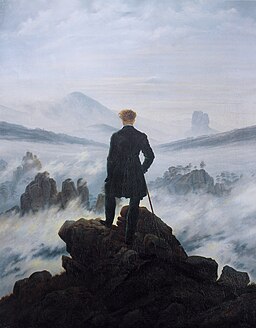
Caspar David Friedrich, Wanderer Above the Sea of Mist
The sublime is what inspires awe, and its nature was a big puzzle that early modern philosophers devoted a fair amount of time trying to clarify. It seems very paradoxical; the awe we have in experiencing the sublime seems related to fear, dread, and humiliation, giving us a sense of our own insignificance, but it is not a negative emotion, being instead often energizing and exhilarating. The sublime pleases us even while it overwhelms us. It is associated with beauty, but paradigmatic cases of beauty are all of things that have clear boundaries and structure, whereas the sublime seems boundless. And the contrast with beauty makes the paradoxical character of sublimity even greater: beauty has the pleasantness that goes with a nice 'fit' between our minds and the world, but the sublime is pleasant despite the fact that it almost seems to do violence to our imaginations, as being too much for them. Kant would take several previous lines of thought and weave them into one of the most influential theories of the sublime that has ever been proposed. The key idea in his account is that the paradoxes of sublimity arise because the experience contrasts two aspects of our own mind: our limited, sensible, animal self and our rational self. In the experience we are recognizing the insignificance of our limited animal lives but this recognition itself shows the significance of our reason, which can surpass our animal limits even to the point of thinking about infinity and universality. The sublime is that which is such that merely being able to think it shows we have a mental capability that exceeds the limitations of sense.
This is important in that sublimity is a way in which the moral law enters into our sensible experience. The moral law itself is purely intellectual and thus has no necessarily associated aesthetic experience. However, in certain moral experiences we have feelings that suggest the unconditional character of moral law to our minds, and this creates precisely the contrast required for experience of the moral law as sublime. The experience Kant particularly has in mind is that of moral sacrifice, in which out of our freedom we experience a deep feeling of deprivation of some sensible good; this simultaneously expresses our sensible insignificance and intelligible dignity, and thus the natural human response to a clear recognition of moral law is awe, or respect, or reverence, toward the moral law as sublime. The moral law, again, is the moral law regardless of whether we ever experience its sublimity; but experience of its sublimity helps us to maintain its priority over every sensible interest and benefit.
III. Religion
Even granted that there is something in human nature that is responsive to moral law, one may still worry about our ability to live a moral life. The moral law itself is something pure and constant and unconditional; human beings are quite limited and wavering. Whether our maxims are moral may not depend on whatever other ends we have in view, but it is nonetheless true that as human beings we have to have other ends in view. We are not simply acting on moral law, like pure rational beings; we have to coordinate being animals in the world with the absolute primacy of moral law, and that continually raises the possibility of our failing to act morally. Can we really do what moral law requires? We can press the matter by considering three obvious obstacles that we as human beings, both animal and rational, have in our attempt to live according to moral law.
(1) It's clear that our own experience of our choices recognizes a significant influence from the world around us -- we don't act in a void, but are influenced by other things. And it is very easy for us to conclude that the world around us is a world of strict cause and effect, in which everything happens according to laws of nature. But if this is true of ourselves as well, then we will in fact often not be able to act morally, because external causes will come together in such a way as to make us fail. Kant doesn't think we can know with certainty that this is not the case.
(2) Moral law is absolutely perfect. But human beings cannot jump to a state of absolute perfection; moral action is something we have to cultivate and in which we have to grow. We live morally by working constantly to become more moral. As we do so, the moral law holds out for our goal the completely moral life. But this is a goal we cannot achieve in a lifetime. If death is the end, it is an end that will inevitably come before we have achieved what moral law requires of us, and so is an end that guarantees our moral failure. Again, Kant thinks that as far as we certainly know, this may well be the case.
(3) Moral law requires us to work toward the most complete good for the whole community of rational beings, which he calls the highest good. The complete good is, of course, a society in conformity with moral law, but moral law requires us to work for the happiness of those who are worthy of happiness. But, says Kant, there is no necessary connection, as far as we can see, between morality and happiness. Moral law does not in any way depend on happiness and happiness is not distributed according to desert (that is, moral law) but according to natural causes. We do not have control over the entire frame of nature. If this is the case, we may be doomed from the beginning to fail to do what moral law requires. And again, Kant thinks we can't know certainly that this is not true.
This seems a pretty miserable state in which to be, one in which we are constantly required to do things at which we will inevitably fail. However, Kant sees a way out. He doesn't (unlike some people) think we can know that our three problematic scenarios are false, but practical action doesn't depend on knowledge alone. In practical action it can also be reasonable to act on hope, if the hope is an adequate ground. We don't have certain principles in these cases, but we can have postulates for practical purposes. A postulate is something we assume not necessarily because it is true but because it simplifies a problem so that it can be solved. Moral law tells us we always have to choose what is moral, no matter what. Now, moral law is reason itself legislating for itself, so by definition what moral law requires of us is rational, and an assumption that we have to make in order to do what is rational is also rational. So even though we don't know, we can postulate that we have free will that enables us always to choose what is right. Maybe this is true, maybe it is not, but moral law itself gives us reason to hope that it is true, and even if we didn't think we had free will, acting morally would still involve acting as if we had something like free will. This deals with our first problematic scenario. Likewise, we can postulate that we have immortality -- that death is not the end of our moral progress. We can also postulate that there is a cause capable of weaving our actions into a world in which morality and nature, virtue and happiness, eventually work as one, namely, God. The moral law, again, doesn't depend on any of these three postulates. But Kant does insist that the moral law licenses hoping that something like them is true, and, further, that life according to moral law will be a life that works very much as if they are true.
The existence of God raises the question of the relationship between morality and religion, and Kant thinks that in fact religion has a role to play in the moral life. The moral law, being unconditional, does not depend on divine commands in the way a divine command theorist would claim. However, Kant holds that if you accept the moral law on its own terms you can recognize the duties required by moral law as also commanded by God; they can be seen as commands of the God we have postulated to exist, the one who is unifying virtue and happiness in the long run. This is what Kant always means when he talks about religion: morality taken as commanded by God making possible the highest good. Moral law inevitably leads to religion in this sense because moral law requires of us what is only actually attainable if something like a divine agent is organizing the world, in the long run, as a moral system. The moral law likewise requires us to work for a moral society, the ethical commonwealth, a community based wholly on moral laws; but such a commonwealth could only be constituted as a people, rather than a mere fiction, if it has a governing power establishing a public regime based wholly on moral law. Since moral law does not confine itself to external behavior, but governs internal thought, this governing power would have to have jurisdiction over the heart as well as the body, and that quite clearly starts sounding like God. The ethical commonwealth towards which moral law requires us to work can only be fully conceived if it is a people living under divine commands, namely, a Kingdom of God, in which the laws are moral laws, and only moral laws.
Such an ethical commonwealth does not fully exist, although moral law requires us to work toward it. However, we can form actual societies that are our best approximations to it. Only God could guarantee that the ethical commonwealth will eventually come about. The sublime idea of the ethical commonwealth dwindles, Kant says, when fallible human beings try to fulfill their obligation to work toward it; the best we can do at any given moment is not an ethical commonwealth but what Kant calls a church. The true church is the community that most harmonizes with the idea of the ethical commonwealth, and will have four characteristics:
(1) It will be based on the universal laws of morality and therefore one.
(2) It will be pure, recognizing no legitimate motivations except those that are moral, and thus will reject all superstition and fanaticism.
(3) It will be free, involving neither a hierarchy nor a community governed by special inspirations.
(4) It will have an immutable constitution; its purely administrative guidelines may change, but its fundamental laws, being the laws of morality, cannot.
It's quite blatantly obvious that this is Kant's proposal for replacing the traditionally understood Notes of the Church in Christianity (One, Holy, Catholic, Apostolic). And Kant is quite straightforward about it, rejecting all church structures as those of the true and universal church except those that see the church as a sort of family under an invisible divine Head, with no popes or patriarchs, no bishops, and no prophets. However, in practice all churches, i.e., actual representations of the ethical commonwealth, are colored by some historical origin or other; what we normally call churches are non-universal communities that water down the principles of the true church, and in particular, they try to add laws and rites that are not purely moral. All human beings are capable of being part of the universal church to the extent that they purely devote themselves to moral laws as divine commands, a life of pure religious faith; this is true regardless of whatever religious tradition they may be a part. Despite the watered-down character of religious traditions, Kant thinks it can be fine to be a part of a religious tradition as long as you take the pure religious faith that makes you a member of the universal church as the standard for interpreting the customs of your religious tradition, and not vice versa. Over time, a religious tradition interpreted this way brings the community belonging to it closer and closer to the ethical commonwealth.
Thus Kant's conception of religion and of a church actually plays a considerable role in his ethics; insofar as we are participating in the church, as long as we are doing it in a proper way, we are engaging and improving in our moral lives, not merely as individuals but as an entire community growing closer and closer to the true moral community of the ethical commonwealth -- by way of the church, the merely possible kingdom of ends comes closer and closer to actuality (although only if we postulate something like God can we hope that it will actually be achieved). This is an aspect of Kantian ethics that is often missed. It is very easy to interpret Kantianism as an ethics wholly concerned with isolated individuals, because the choices we make are expressed in maxims that are governed directly by a moral law we each can know by our individual reason. But while the moral law applies directly and immediately to each rational being without the intermediation of any other rational beings, Kant thinks of the moral law itself as something that can only be conceived adequately if it is understood as something uniting an at-least-possible community (a kingdom of ends), which the moral law itself requires us to work to make more than merely possible. Religion, in his very specific sense, is how Kant thinks this works in practice. The possible kingdom of ends, conceived as something we can hope to achieve, is conceived as Kingdom of God, which we approximate by way of the church, interpreted as subject to moral law rather than a source of it. Many Kantians today simply drop all of Kant's discussion of religion, but in so doing they are dropping the part of Kant's ethics that makes the moral life an actual communal and cooperative effort.
In any case, Kant's full moral interpretation of religion is somewhat difficult (and shifts about a bit throughout his career); this is just enough to give a sense of how it serves as yet another way in which Kant recognizes that the human pursuit of moral law must in practice go beyond mere rational recognition of one's duty.
We have to this point considered consequentialism and deontology. There is a third approach that needs to be considered, which is usually called virtue ethics, and that is what the next post will begin to discuss.
I. Self-cultivation
In The Metaphysics of Morals, Kant suggests that we have four natural predispositions fitting us to follow the moral law that, indeed, are effects of the fact that we can recognize moral law at all. These four predispositions are our moral endowments. They are not the source of our obligations, and if we lacked them, we could not be obligated to get them. But these four are, as it were, the grip of moral law on us. They are moral sentiment, conscience, love of neighbor, and reverence for self.
(1) Moral sentiment. It has commonly been thought that we have a sort of feeling of approval or disapproval that is specifically moral; some people had even thought that this could be the foundation of morality. Kant, of course, doesn't think so, but he does think we really do have such a feeling, a sense that something is consonant or dissonant with moral law. When we feel the necessity of duty, this is moral sentiment. Without it we would still be under moral law but our capacity to act according to it would be deadened; we would be no different in our action from a beast.
(2) Conscience. Conscience is our practical reason not insofar as it considers moral law as such but insofar as it judges our own action under it. This is why it is inevitable that we will tend to think of it as a sort of inner tribunal before which we are judged. Because this judgment is subjective, i.e., about us in particular rather than about the universal and unconditional, moral law does not depend on it. But we could not recognize ourselves as responsible, and especially not morally responsible, for our own actions without it. Our conscience, properly speaking, cannot err because it is practical reason itself; but we do need to cultivate it in the sense that we need to pay close attention to it as the monitor of our particular actions and learn how not to be misled by nonrational factors.
(3) Love of our neighbor, which Kant also calls philanthropy. Love in this sense (unlike, say, benevolent action) is not the sort of thing that Kant thinks we can do by choice, so Kant thinks we have no obligation to love our neighbor. However, we can do good things to our neighbor until a love of them spontaneously arises, and this love consolidates our ability to recognize them as ends in themselves.
(4) Reverence for ourselves. Respect for the law draws out of us a reverence for ourselves as ends in ourselves; this reverence is again not something to which we are obligated, but it is a kind of emotional fortification of our ability to recognize ourselves as having dignity. It is by this reverence, for instance, that we recognize ourselves as the equal of other rational beings.
These four, again, are not the source of moral obligation; but being in a sense the natural response of human nature to moral law, they color our moral duties -- perhaps in a sense we can even say that they humanize them. For instance, we have a duty to benefit the poor, but recognizing that the poor have their own self-reverence, we find ourselves needing to benefit them in a way that would not humiliate them. From love of neighbor we recognize that our duty to do good to others has to involve taking their ends and interests as our own, as long as these are not immoral. And so forth.
Virtue, which is a kind of firmness in the doing of our duty, which we need if we are to follow moral law consistently, according to its very notion has to be cultivated. It is in this sense that ethics needs to be taught. It is taught, first, by ethical catechetics, leading those who are wholly untutored to understand their duties and what is required for them. This cannot, of course, be based on any conveniences or benefits provided by doing one's duty -- that would be to treat morality as if it were not morality -- but rather the point is to make the student see more clearly what he has the natural predisposition to see, namely, that vice is shameful and virtue is honorable.
The actual cultivation of virtue requires ethical ascetics, a self-discipline guided by rules. These rules will need to have a two results if followed: firmness and cheerfulness in the performance of our duties. Kant takes his inspiration on the firmness side from the Stoics and on the cheerfulness side from the Epicureans. The firmness rule derived from the Stoics is summed up in the slogan, bear and forbear; we are to endure misfortune without complaint and abstain from unnecessary enjoyments. He uses the metaphor of a healthy diet: by doing these things we are keeping our minds healthy in a way that makes the vigorous pursuit of our duty possible. The cheerfulness rule derived from the Epicureans is to cultivate a serene frame of mind focused on joy and not (for instance) constant self-criticism and self-punishment. The Epicurean rule Kant regards as differentiating his ethical ascetics from the asceticism of the monasteries, which he regards as immoral and hypocritical.
II. Aesthetics
Another way in which our natures can be seen to be responsive to moral law is in the field of aesthetics, because our aesthetic judgments, while they must be sharply distinguished from our moral judgments, nonetheless have a sort of relation to them. Kant takes aesthetics in the broad sense to be the way we combine the particular and the universal, and the most obvious aesthetic judgments are perhaps judgments of taste, by which we judge things as beautiful or ugly. These judgments have four common features:
(1) They arise from a satisfaction that is immediate in our reflective experience.
(2) This satisfaction is disinterested, not dependent on what is useful or beneficial to us.
(3) They relate the freedom of our imagination to a sort of law.
(4) They are put forward as valid for everyone on the basis of experience; to judge something beautiful is to go beyond judging that you yourself like it, and implies that you think other human beings could judge similarly.
Moral judgments, Kant thinks, also have four common features, which have similarities to the features of aesthetic judgment, despite in each case there being some difference:
(1) They arise from a satisfaction that is immediate in understanding its concept.
(2) This satisfaction is disinterested, in that moral judgment has a sort of priority over any interest.
(3) They relate the freedom of will to the universal laws of reason.
(4) They are put forward as absolutely universal for all rational beings.
Thus even though the beautiful and the morally good are very different, the cast of mind, the shape of our thought, the process of thinking, when we judge something to be beautiful is analogous to the same cast of mind when we judge something to be morally good. On the basis of this Kant argues that the beautiful is the symbol of the morally good.
The significance of this is at least twofold. First, it explains why our aesthetic and moral vocabularies blur into each other. Second, it means that at least a judicious cultivation of our sense of beauty can serve an indirect moral purpose by breaking us out of a selfish regard for what is only in our own interest. As he puts it in The Critique of Judgment:
A reference to this analogy is usual even with the common Understanding [of men], and we often describe beautiful objects of nature or art by names that seem to put a moral appreciation at their basis. We call buildings or trees majestic and magnificent, landscapes laughing and gay; even colours are called innocent, modest, tender, because they excite sensations which have something analogous to the consciousness of the state of mind brought about by moral judgements. Taste makes possible the transition, without any violent leap, from the charm of Sense to habitual moral interest; for it represents the Imagination in its freedom as capable of purposive determination for the Understanding, and so teaches us to find even in objects of sense a free satisfaction apart from any charm of sense.
There is, however, another kind of aesthetic judgment that in some ways has an even closer relationship with moral judgment, and this is the judgment that something is sublime.

Caspar David Friedrich, Wanderer Above the Sea of Mist
The sublime is what inspires awe, and its nature was a big puzzle that early modern philosophers devoted a fair amount of time trying to clarify. It seems very paradoxical; the awe we have in experiencing the sublime seems related to fear, dread, and humiliation, giving us a sense of our own insignificance, but it is not a negative emotion, being instead often energizing and exhilarating. The sublime pleases us even while it overwhelms us. It is associated with beauty, but paradigmatic cases of beauty are all of things that have clear boundaries and structure, whereas the sublime seems boundless. And the contrast with beauty makes the paradoxical character of sublimity even greater: beauty has the pleasantness that goes with a nice 'fit' between our minds and the world, but the sublime is pleasant despite the fact that it almost seems to do violence to our imaginations, as being too much for them. Kant would take several previous lines of thought and weave them into one of the most influential theories of the sublime that has ever been proposed. The key idea in his account is that the paradoxes of sublimity arise because the experience contrasts two aspects of our own mind: our limited, sensible, animal self and our rational self. In the experience we are recognizing the insignificance of our limited animal lives but this recognition itself shows the significance of our reason, which can surpass our animal limits even to the point of thinking about infinity and universality. The sublime is that which is such that merely being able to think it shows we have a mental capability that exceeds the limitations of sense.
This is important in that sublimity is a way in which the moral law enters into our sensible experience. The moral law itself is purely intellectual and thus has no necessarily associated aesthetic experience. However, in certain moral experiences we have feelings that suggest the unconditional character of moral law to our minds, and this creates precisely the contrast required for experience of the moral law as sublime. The experience Kant particularly has in mind is that of moral sacrifice, in which out of our freedom we experience a deep feeling of deprivation of some sensible good; this simultaneously expresses our sensible insignificance and intelligible dignity, and thus the natural human response to a clear recognition of moral law is awe, or respect, or reverence, toward the moral law as sublime. The moral law, again, is the moral law regardless of whether we ever experience its sublimity; but experience of its sublimity helps us to maintain its priority over every sensible interest and benefit.
III. Religion
Even granted that there is something in human nature that is responsive to moral law, one may still worry about our ability to live a moral life. The moral law itself is something pure and constant and unconditional; human beings are quite limited and wavering. Whether our maxims are moral may not depend on whatever other ends we have in view, but it is nonetheless true that as human beings we have to have other ends in view. We are not simply acting on moral law, like pure rational beings; we have to coordinate being animals in the world with the absolute primacy of moral law, and that continually raises the possibility of our failing to act morally. Can we really do what moral law requires? We can press the matter by considering three obvious obstacles that we as human beings, both animal and rational, have in our attempt to live according to moral law.
(1) It's clear that our own experience of our choices recognizes a significant influence from the world around us -- we don't act in a void, but are influenced by other things. And it is very easy for us to conclude that the world around us is a world of strict cause and effect, in which everything happens according to laws of nature. But if this is true of ourselves as well, then we will in fact often not be able to act morally, because external causes will come together in such a way as to make us fail. Kant doesn't think we can know with certainty that this is not the case.
(2) Moral law is absolutely perfect. But human beings cannot jump to a state of absolute perfection; moral action is something we have to cultivate and in which we have to grow. We live morally by working constantly to become more moral. As we do so, the moral law holds out for our goal the completely moral life. But this is a goal we cannot achieve in a lifetime. If death is the end, it is an end that will inevitably come before we have achieved what moral law requires of us, and so is an end that guarantees our moral failure. Again, Kant thinks that as far as we certainly know, this may well be the case.
(3) Moral law requires us to work toward the most complete good for the whole community of rational beings, which he calls the highest good. The complete good is, of course, a society in conformity with moral law, but moral law requires us to work for the happiness of those who are worthy of happiness. But, says Kant, there is no necessary connection, as far as we can see, between morality and happiness. Moral law does not in any way depend on happiness and happiness is not distributed according to desert (that is, moral law) but according to natural causes. We do not have control over the entire frame of nature. If this is the case, we may be doomed from the beginning to fail to do what moral law requires. And again, Kant thinks we can't know certainly that this is not true.
This seems a pretty miserable state in which to be, one in which we are constantly required to do things at which we will inevitably fail. However, Kant sees a way out. He doesn't (unlike some people) think we can know that our three problematic scenarios are false, but practical action doesn't depend on knowledge alone. In practical action it can also be reasonable to act on hope, if the hope is an adequate ground. We don't have certain principles in these cases, but we can have postulates for practical purposes. A postulate is something we assume not necessarily because it is true but because it simplifies a problem so that it can be solved. Moral law tells us we always have to choose what is moral, no matter what. Now, moral law is reason itself legislating for itself, so by definition what moral law requires of us is rational, and an assumption that we have to make in order to do what is rational is also rational. So even though we don't know, we can postulate that we have free will that enables us always to choose what is right. Maybe this is true, maybe it is not, but moral law itself gives us reason to hope that it is true, and even if we didn't think we had free will, acting morally would still involve acting as if we had something like free will. This deals with our first problematic scenario. Likewise, we can postulate that we have immortality -- that death is not the end of our moral progress. We can also postulate that there is a cause capable of weaving our actions into a world in which morality and nature, virtue and happiness, eventually work as one, namely, God. The moral law, again, doesn't depend on any of these three postulates. But Kant does insist that the moral law licenses hoping that something like them is true, and, further, that life according to moral law will be a life that works very much as if they are true.
The existence of God raises the question of the relationship between morality and religion, and Kant thinks that in fact religion has a role to play in the moral life. The moral law, being unconditional, does not depend on divine commands in the way a divine command theorist would claim. However, Kant holds that if you accept the moral law on its own terms you can recognize the duties required by moral law as also commanded by God; they can be seen as commands of the God we have postulated to exist, the one who is unifying virtue and happiness in the long run. This is what Kant always means when he talks about religion: morality taken as commanded by God making possible the highest good. Moral law inevitably leads to religion in this sense because moral law requires of us what is only actually attainable if something like a divine agent is organizing the world, in the long run, as a moral system. The moral law likewise requires us to work for a moral society, the ethical commonwealth, a community based wholly on moral laws; but such a commonwealth could only be constituted as a people, rather than a mere fiction, if it has a governing power establishing a public regime based wholly on moral law. Since moral law does not confine itself to external behavior, but governs internal thought, this governing power would have to have jurisdiction over the heart as well as the body, and that quite clearly starts sounding like God. The ethical commonwealth towards which moral law requires us to work can only be fully conceived if it is a people living under divine commands, namely, a Kingdom of God, in which the laws are moral laws, and only moral laws.
Such an ethical commonwealth does not fully exist, although moral law requires us to work toward it. However, we can form actual societies that are our best approximations to it. Only God could guarantee that the ethical commonwealth will eventually come about. The sublime idea of the ethical commonwealth dwindles, Kant says, when fallible human beings try to fulfill their obligation to work toward it; the best we can do at any given moment is not an ethical commonwealth but what Kant calls a church. The true church is the community that most harmonizes with the idea of the ethical commonwealth, and will have four characteristics:
(1) It will be based on the universal laws of morality and therefore one.
(2) It will be pure, recognizing no legitimate motivations except those that are moral, and thus will reject all superstition and fanaticism.
(3) It will be free, involving neither a hierarchy nor a community governed by special inspirations.
(4) It will have an immutable constitution; its purely administrative guidelines may change, but its fundamental laws, being the laws of morality, cannot.
It's quite blatantly obvious that this is Kant's proposal for replacing the traditionally understood Notes of the Church in Christianity (One, Holy, Catholic, Apostolic). And Kant is quite straightforward about it, rejecting all church structures as those of the true and universal church except those that see the church as a sort of family under an invisible divine Head, with no popes or patriarchs, no bishops, and no prophets. However, in practice all churches, i.e., actual representations of the ethical commonwealth, are colored by some historical origin or other; what we normally call churches are non-universal communities that water down the principles of the true church, and in particular, they try to add laws and rites that are not purely moral. All human beings are capable of being part of the universal church to the extent that they purely devote themselves to moral laws as divine commands, a life of pure religious faith; this is true regardless of whatever religious tradition they may be a part. Despite the watered-down character of religious traditions, Kant thinks it can be fine to be a part of a religious tradition as long as you take the pure religious faith that makes you a member of the universal church as the standard for interpreting the customs of your religious tradition, and not vice versa. Over time, a religious tradition interpreted this way brings the community belonging to it closer and closer to the ethical commonwealth.
Thus Kant's conception of religion and of a church actually plays a considerable role in his ethics; insofar as we are participating in the church, as long as we are doing it in a proper way, we are engaging and improving in our moral lives, not merely as individuals but as an entire community growing closer and closer to the true moral community of the ethical commonwealth -- by way of the church, the merely possible kingdom of ends comes closer and closer to actuality (although only if we postulate something like God can we hope that it will actually be achieved). This is an aspect of Kantian ethics that is often missed. It is very easy to interpret Kantianism as an ethics wholly concerned with isolated individuals, because the choices we make are expressed in maxims that are governed directly by a moral law we each can know by our individual reason. But while the moral law applies directly and immediately to each rational being without the intermediation of any other rational beings, Kant thinks of the moral law itself as something that can only be conceived adequately if it is understood as something uniting an at-least-possible community (a kingdom of ends), which the moral law itself requires us to work to make more than merely possible. Religion, in his very specific sense, is how Kant thinks this works in practice. The possible kingdom of ends, conceived as something we can hope to achieve, is conceived as Kingdom of God, which we approximate by way of the church, interpreted as subject to moral law rather than a source of it. Many Kantians today simply drop all of Kant's discussion of religion, but in so doing they are dropping the part of Kant's ethics that makes the moral life an actual communal and cooperative effort.
In any case, Kant's full moral interpretation of religion is somewhat difficult (and shifts about a bit throughout his career); this is just enough to give a sense of how it serves as yet another way in which Kant recognizes that the human pursuit of moral law must in practice go beyond mere rational recognition of one's duty.
We have to this point considered consequentialism and deontology. There is a third approach that needs to be considered, which is usually called virtue ethics, and that is what the next post will begin to discuss.
Lent V
Christ willed to be born in Bethlehem for two reasons. First, because "He was made . . . of the seed of David according to the flesh," as it is written (Romans 1:3); to whom also was a special promise made concerning Christ; according to 2 Samuel 23:1: "The man to whom it was appointed concerning the Christ of the God of Jacob . . . said." Therefore He willed to be born at Bethlehem, where David was born, in order that by the very birthplace the promise made to David might be shown to be fulfilled. The Evangelist points this out by saying: "Because He was of the house and of the family of David." Secondly, because, as Gregory says (Hom. viii in Evang.): "Bethlehem is interpreted 'the house of bread.' It is Christ Himself who said, 'I am the living Bread which came down from heaven.'"
Thomas Aquinas, Summa Theologiae 3.35.7.
Sunday, March 01, 2020
Fortnightly Book, March 1
In 1373 in Norwich, a woman about thirty years of age came down so sick that she had good reason to think that she was going to die. After the priest performed the last rites, she began to have a series of visions -- fifteen distinguishable ones over the course of a few hours, and then another the next day. Within a few days, she was completely recovered. And the result was (in two different versions) one of the most remarkable English texts of the day.
We do not know if it was her original name, but she is known to the world as Julian of Norwich. She was an anchorite -- we don't know if she was already an anchorite when she had her visions, or if she become one in response to them. An anchorite lives a particular kind of religious life which can be thought of as half-way between a cenobitic life and an eremitic life; that is, an anchorite is something like a monk or nun and something like a hermit. Standardly, an anchorite would live permanently in a small cell adjoined to a church or chapel, able to participate in the sacraments of the church and talk with those who came by to do so, but otherwise completely cut off from the world; in fact, standardly, the beginning of the anchoritic life was a funeral service in which the anchorite was 'buried' in their anchorhold, and from then on they could never leave it. In Julian's day it was a very popular form of religous life in England, both to join and to support; anchorites were often the spiritual center of their local community, available at all times to give advice or to pray for you. Julian's anchorhold is usually thought to be that of St. Julian's Church, which was named either after St. Julian the Hospitaller or St. Julian of Le Mans; she may have chosen the church because she shared its name, or she may have taken the name by which we know her from the church. We don't know. While Norwich by the end of the Middle Ages had a lot of anchoritic cells, Julian seems to be the first anchorite in Norwich of which we have any knowledge. Not counting her own works, she is mentioned in several wills and was visited by Margery Kempe.
Sometime shortly after her discovery she wrote down her visions in a book known as the Shewings (or later, as the Revelations of Divine Love), which is often called today the Short Text. Later, having had extensive time to reflect on the visions and come to understand things she might not have originally considered significant, she rewrote the work into the from known as the Long Text. The Short Text largely languished in libraries until it was published in 1911; the Long Text was copied and preserved, largely by Benedictine nuns, and was translated into French in the seventeenth century, where it stayed popular enough eventually to lead to republication of the English version in the nineteenth century. Wikipedia has a really nice graphic of the manuscript history of both versions. The book is often considered one of the great works of fourteenth-century English literature.
So Julian's Revelations is the next fortnightly book. I'll be reading it in the Norton Critical Edition, The Showings of Julian of Norwich, edited by Denise Baker; it is a Long Text version, derived from the Paris Manuscript, the scribe of which modernized some of the vocabulary and grammar into sixteenth century English, without making any massive changes to the main text.
We do not know if it was her original name, but she is known to the world as Julian of Norwich. She was an anchorite -- we don't know if she was already an anchorite when she had her visions, or if she become one in response to them. An anchorite lives a particular kind of religious life which can be thought of as half-way between a cenobitic life and an eremitic life; that is, an anchorite is something like a monk or nun and something like a hermit. Standardly, an anchorite would live permanently in a small cell adjoined to a church or chapel, able to participate in the sacraments of the church and talk with those who came by to do so, but otherwise completely cut off from the world; in fact, standardly, the beginning of the anchoritic life was a funeral service in which the anchorite was 'buried' in their anchorhold, and from then on they could never leave it. In Julian's day it was a very popular form of religous life in England, both to join and to support; anchorites were often the spiritual center of their local community, available at all times to give advice or to pray for you. Julian's anchorhold is usually thought to be that of St. Julian's Church, which was named either after St. Julian the Hospitaller or St. Julian of Le Mans; she may have chosen the church because she shared its name, or she may have taken the name by which we know her from the church. We don't know. While Norwich by the end of the Middle Ages had a lot of anchoritic cells, Julian seems to be the first anchorite in Norwich of which we have any knowledge. Not counting her own works, she is mentioned in several wills and was visited by Margery Kempe.
Sometime shortly after her discovery she wrote down her visions in a book known as the Shewings (or later, as the Revelations of Divine Love), which is often called today the Short Text. Later, having had extensive time to reflect on the visions and come to understand things she might not have originally considered significant, she rewrote the work into the from known as the Long Text. The Short Text largely languished in libraries until it was published in 1911; the Long Text was copied and preserved, largely by Benedictine nuns, and was translated into French in the seventeenth century, where it stayed popular enough eventually to lead to republication of the English version in the nineteenth century. Wikipedia has a really nice graphic of the manuscript history of both versions. The book is often considered one of the great works of fourteenth-century English literature.

So Julian's Revelations is the next fortnightly book. I'll be reading it in the Norton Critical Edition, The Showings of Julian of Norwich, edited by Denise Baker; it is a Long Text version, derived from the Paris Manuscript, the scribe of which modernized some of the vocabulary and grammar into sixteenth century English, without making any massive changes to the main text.
Subscribe to:
Posts (Atom)