So the presumptive nominees of the major parties for President are, on the one hand, a billionaire who is universally recognized to be self-aggrandizing, and, on the other, a dynastic politician no one trusts who is under investigation by the FBI for violating national security law. I don't vote major party in presidential elections, so I don't have anything more to say about that except:
At this point, to be sure, it really wouldn't be surprising if we got to the voting booth and turned out to be rickrolled.
I once had an idea for a story in which the American President, President Beltrane, is a fantastically popular supervillain who vacations in his volcano lair, has a vice president who is an inarticulate Frankenstein-monster named Henchman, and whose campaign promises and policies consist of a mix of supervillain schemes and taking real political slogans to an insane limit. For instance, as a tax-cutting measure he holds Ireland for ransom in order to pay for government paperclips, and he advocates forcing everyone to undergo weekly physical examinations at the doctor's office because it's not universal health care if there are people not receiving it. But looking at this election, I find that there are just infinitely many ways in which I am not imaginative enough.
Wednesday, June 08, 2016
Links for Thinking
* MrsDarwin's review of the Whit Stillman movie, Love and Friendship
* Whewell's Gazette 2.43 for all those interested in the history of science
* Greg Restall on logical pluralism for 3AM
* Ali Minai has a fascinating discussion of the early history of Islam in light of its coins.
* At the SEP:
Julie Maybee, Hegel's Dialectics
Katerina Ierodiakonou, Theophrastus
* Adolfo Giuliani, Civilian Treatises on Presumptions, 1580-1620 (PDF)
* Amod Lele discusses the Garfield and Van Norden article on philosophical curricula.
* Ken Wharton and Huw Price on least action principles
* How Nigeria came to dominate Scrabble
* Gwen Bradford on the philosophical analysis of the concept of achievement.
* Rebecca Stark on Job 38:41
* Richard Beck on shape-note singing. I happen to have a copy of the Sacred Selections hymnal he mentions; the 1964 edition of it, I believe.
* There was some recent hubbub over the possible discovery of Aristotle's tomb in Stagira recently. (Strictly speaking, it was a hubbub over a paper that was delivered at the World Aristotle Congress suggesting that a tomb discovered several years ago might be Aristotle's.) David Meadows looks at the actual evidence for the claim.
* Adam Frank on Dogen
* Medieval dining
* An interesting page on the geometry of the Basilica of Sagrada Familia
* The Melkite Catholic Archbishop of Aleppo criticizes those who think that taking in refugees is actually solving any problem.
* David Mills on the allergy some Catholics have to the word 'mercy'
* First communion for Syriac Catholic refugees
* Whewell's Gazette 2.43 for all those interested in the history of science
* Greg Restall on logical pluralism for 3AM
* Ali Minai has a fascinating discussion of the early history of Islam in light of its coins.
* At the SEP:
Julie Maybee, Hegel's Dialectics
Katerina Ierodiakonou, Theophrastus
* Adolfo Giuliani, Civilian Treatises on Presumptions, 1580-1620 (PDF)
* Amod Lele discusses the Garfield and Van Norden article on philosophical curricula.
* Ken Wharton and Huw Price on least action principles
* How Nigeria came to dominate Scrabble
* Gwen Bradford on the philosophical analysis of the concept of achievement.
* Rebecca Stark on Job 38:41
* Richard Beck on shape-note singing. I happen to have a copy of the Sacred Selections hymnal he mentions; the 1964 edition of it, I believe.
* There was some recent hubbub over the possible discovery of Aristotle's tomb in Stagira recently. (Strictly speaking, it was a hubbub over a paper that was delivered at the World Aristotle Congress suggesting that a tomb discovered several years ago might be Aristotle's.) David Meadows looks at the actual evidence for the claim.
* Adam Frank on Dogen
* Medieval dining
* An interesting page on the geometry of the Basilica of Sagrada Familia
* The Melkite Catholic Archbishop of Aleppo criticizes those who think that taking in refugees is actually solving any problem.
* David Mills on the allergy some Catholics have to the word 'mercy'
* First communion for Syriac Catholic refugees
Tuesday, June 07, 2016
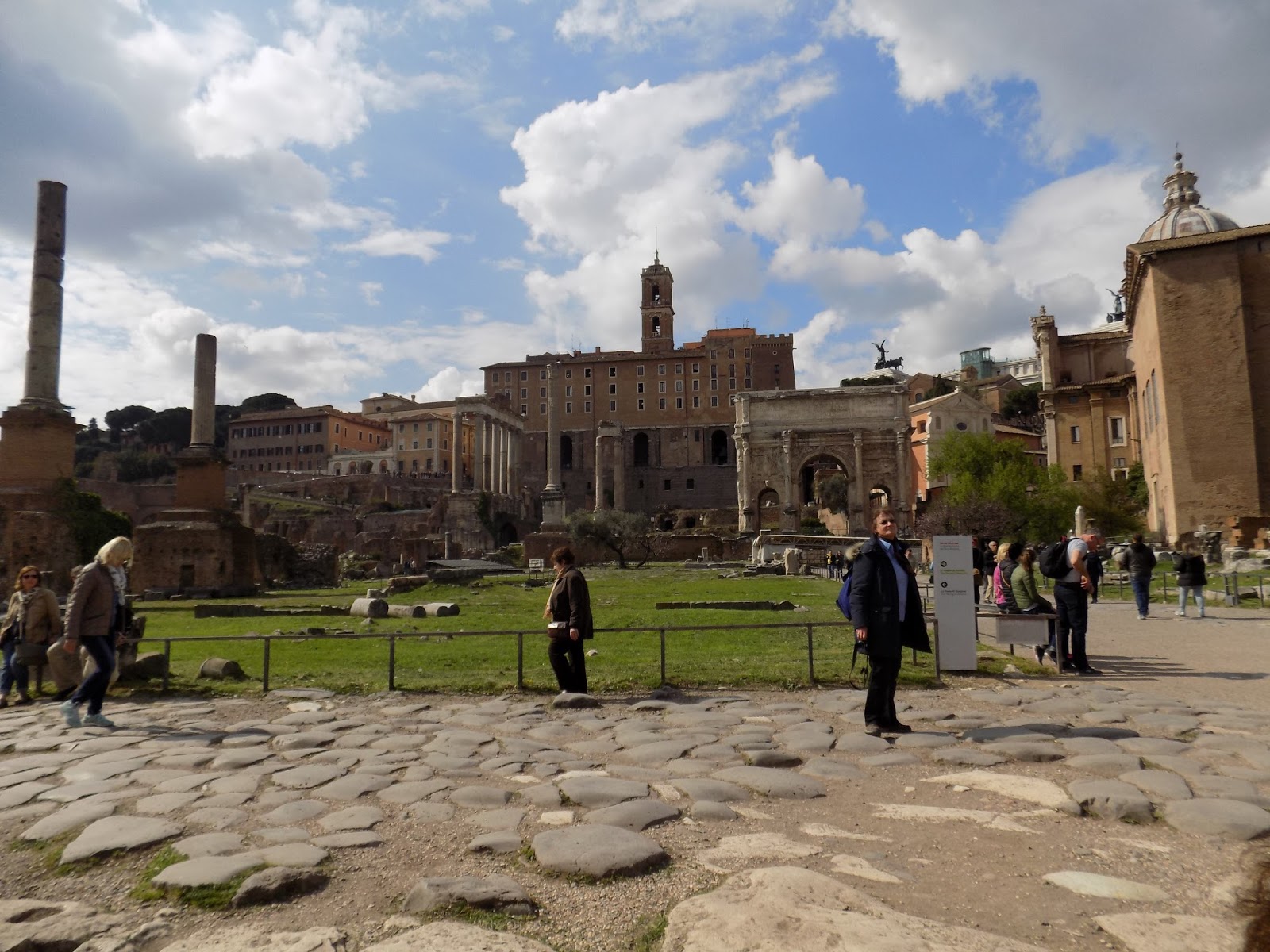
A Quick Trip to Italy, Miscellanea VI
Rome: Forum
A bit of fresco:
More pictures of the Basilica Aemilia:
A little bit beyond:
The seagulls like the Forum area. Here is a Roman seagull crying out:
Another shot of the Temple of Antoninus and Faustina:
Near the House of the Vestal Virgins:
The church of Santa Francesca Romana (also sometimes known as Santa Maria Nova):
I mentioned before that we were at the forum just after the ides of March. Just before that, though, on March 9, is the feast day of Saint Frances of Rome, and I'm told that on that day, the entire street up to the Colosseum crowds with cars. St. Frances, you see, is the patron saint of automobiles, so on her feast day, Romans go to her church in order to get their cars blessed. (A very rational thing to do if you drive in Rome.)
The Basilica of Constantine from a different angle:
The Arch of Titus, from the Colosseum side:
Additional shots of the Colosseum:
to be continued
A bit of fresco:
More pictures of the Basilica Aemilia:
A little bit beyond:
The seagulls like the Forum area. Here is a Roman seagull crying out:
Another shot of the Temple of Antoninus and Faustina:
Near the House of the Vestal Virgins:
The church of Santa Francesca Romana (also sometimes known as Santa Maria Nova):
I mentioned before that we were at the forum just after the ides of March. Just before that, though, on March 9, is the feast day of Saint Frances of Rome, and I'm told that on that day, the entire street up to the Colosseum crowds with cars. St. Frances, you see, is the patron saint of automobiles, so on her feast day, Romans go to her church in order to get their cars blessed. (A very rational thing to do if you drive in Rome.)
The Basilica of Constantine from a different angle:
The Arch of Titus, from the Colosseum side:
Additional shots of the Colosseum:
to be continued
Fiercer Hunger than the Body's Need
The One Thing Needful
by Bram Stoker
In Martha's house the weary Master lay,
Spent with his faring through the burning day.
The busy hostess bustled through the room
On household cares intent, and at His feet
The gentle Mary took her wonted seat.
Soft came His words in music through the gloom.
Cumbered about much serving Martha wrought--
Her sister listening as the Master taught--
Till something fretful an appeal she made:
"Doth it not matter that on me doth fall
The burden; Mary helpeth not at all?
Master, command her that she give me aid."
"Ah, Martha, Martha! Thou are full of care,
And many things thy needless trouble share."
Thus with the love that chides the Master spake:
"One thing alone is needful. That good part
Hath Mary chosen from her loving heart;
And that part from her shall I never take."
****
One thing alone we lack. Our souls, indeed,
Have fiercer hunger than the body's need.
Ah, happy they that look in loving eyes.
The harsh world round them fades. The Master's Voice
In sweetest music bids their souls rejoice
And wakes an echo there that never dies.
Yes, it's that Bram Stoker.
Monday, June 06, 2016
Intuitions Aren't Bedrock
Some people have been discussing Dale Dorsey's recent post, Intuitive bedrock and the philosophical enterprise:
One of the things I have been pointing out on this blog since I was in graduate school is that 'intuitions' aren't unitary things, and I have always been baffled at any suggestion that they are somehow a ne plus ultra. If we compare what contemporary philosophers say about intuitions and look at approaches from other times that at least cover part of the same ground -- Aristotelian topics, the Nyaya account of pramanas, and Scottish Enlightenment accounts of common sense, for example, all of which are finer-grained than contemporary talk of 'intuitions' -- we see clearly enough that we could be, and should be, much more precise about what is going on when they come up. And when we do we may realize that different kinds of intuitions are involved, or that the intuitions are not all equally evident, or even that some of the intuitions are not even coherent.
Intuitions are beginnings, not bedrocks. Conflicts of intuitions are the kinds of thing reasonable people wonder about, and wondering is the beginning of philosophy. Philosophy doesn't bottom out on them; the rational person will precisely start to wonder about what goes into these intuitions that leads to the differences.
One of the great temptations for philosophers through the century is to confuse features of communication and features of reason -- we always present our philosophy in certain ways, and it can be tempting to assume that those formats are just the way reason works, as if reason could not work in some other way entirely. For instance, someone may do all their philosophy in debates, and if they did, they might be tempted to think of good reasoning as being entirely disputational, because that's the way they polish it up in their own context. It has been difficult over the past century to convince many academic philosophers that you could perfectly well do philosophy with poetry or fiction, despite the fact that it certainly has been done -- because these are not usually features of how academic philosophers in this day and age communicate. And there are other ways in which this can be manifested. I think we see one of them in this case of intuitions. Appeal to intuitions has spread fairly widely in academic texts, and I think a plausible reason why is that you can't fully develop the argument in the formats academic texts usually have. If you are writing a thirty page paper on some very complicated topic, there are going to be things that you just have to ask the reader to take for granted for the sake of the argument; and when an academic philosopher appeals to the intuitive, that's precisely what's happening -- he or she is summarizing a reason for thinking that it's reasonable to accept this. It's something inevitable in the nature of the format, and it's certainly better that it be flagged and insisted upon than that it slide by without comment.
But in real life, we are not wholly bounded by page limits and the fact that we are writing about topic A and can't also write about topic B.Faced with conflicts among these intuitive appeals, we don't have to just throw up our hands and say, "Irreconcilable difference!" Reasoning itself doesn't bottom out like that. We can perfectly well ask more questions, look into the matter more deeply, test for consistency, analyze into constituent parts, compare to other cases, and any of a very large variety of rational activities.
I am sympathetic to Dorsey's notion of an 'atlas-drawing' approach to philosophy; it is, I think, an important part of philosophy, more important than is sometimes realized. It's also the sort of thing I do as a historian of philosophy -- just map out the positions to determine what positions there are. But there is no "phenomenon of intuitive bedrock". There are merely points at which inquiry begins to form along different lines.
In so many areas of inquiry (though, perhaps, not all), philosophical argument ends up bottoming out in a mere clash of intuitions, of considered judgments. But what happens now? Because these considered judgments will help determine the content and structure of our philosophical theorizing, to determine (once and for all) what the good life is for a person (or whether we should be descriptivists or causal theorists of reference, or whether justified true belief counts as knowledge or not, or — if Lewis Carroll is to be believed — whether modus ponens is a valid rule of inference) we — or so it would appear — need to settle which of these intuitions are the right ones.
To put my cards on the table, this seems like an impossible task. Indeed, it’s a task that seems (almost by definition) outside the bounds of philosophical argument.
One of the things I have been pointing out on this blog since I was in graduate school is that 'intuitions' aren't unitary things, and I have always been baffled at any suggestion that they are somehow a ne plus ultra. If we compare what contemporary philosophers say about intuitions and look at approaches from other times that at least cover part of the same ground -- Aristotelian topics, the Nyaya account of pramanas, and Scottish Enlightenment accounts of common sense, for example, all of which are finer-grained than contemporary talk of 'intuitions' -- we see clearly enough that we could be, and should be, much more precise about what is going on when they come up. And when we do we may realize that different kinds of intuitions are involved, or that the intuitions are not all equally evident, or even that some of the intuitions are not even coherent.
Intuitions are beginnings, not bedrocks. Conflicts of intuitions are the kinds of thing reasonable people wonder about, and wondering is the beginning of philosophy. Philosophy doesn't bottom out on them; the rational person will precisely start to wonder about what goes into these intuitions that leads to the differences.
One of the great temptations for philosophers through the century is to confuse features of communication and features of reason -- we always present our philosophy in certain ways, and it can be tempting to assume that those formats are just the way reason works, as if reason could not work in some other way entirely. For instance, someone may do all their philosophy in debates, and if they did, they might be tempted to think of good reasoning as being entirely disputational, because that's the way they polish it up in their own context. It has been difficult over the past century to convince many academic philosophers that you could perfectly well do philosophy with poetry or fiction, despite the fact that it certainly has been done -- because these are not usually features of how academic philosophers in this day and age communicate. And there are other ways in which this can be manifested. I think we see one of them in this case of intuitions. Appeal to intuitions has spread fairly widely in academic texts, and I think a plausible reason why is that you can't fully develop the argument in the formats academic texts usually have. If you are writing a thirty page paper on some very complicated topic, there are going to be things that you just have to ask the reader to take for granted for the sake of the argument; and when an academic philosopher appeals to the intuitive, that's precisely what's happening -- he or she is summarizing a reason for thinking that it's reasonable to accept this. It's something inevitable in the nature of the format, and it's certainly better that it be flagged and insisted upon than that it slide by without comment.
But in real life, we are not wholly bounded by page limits and the fact that we are writing about topic A and can't also write about topic B.Faced with conflicts among these intuitive appeals, we don't have to just throw up our hands and say, "Irreconcilable difference!" Reasoning itself doesn't bottom out like that. We can perfectly well ask more questions, look into the matter more deeply, test for consistency, analyze into constituent parts, compare to other cases, and any of a very large variety of rational activities.
I am sympathetic to Dorsey's notion of an 'atlas-drawing' approach to philosophy; it is, I think, an important part of philosophy, more important than is sometimes realized. It's also the sort of thing I do as a historian of philosophy -- just map out the positions to determine what positions there are. But there is no "phenomenon of intuitive bedrock". There are merely points at which inquiry begins to form along different lines.
Sunday, June 05, 2016
Fortnightly Book, June 5
The recommendations are in, and it looks like there is a slight preference for either Prometheus or Ibsen, so I've decided to go with the double volume of Aeschylus's Prometheus Bound and Shelley's Prometheus Unbound, and see if I can get Ibsen in later this year.
Greek tragedies come in threes with a satyr play to top them off. Prometheus Bound was the first of the Prometheia trilogy, and the only extant play in the trilogy. (The only extant trilogy by Aeschylus is the Oresteia, which will also eventually be a Fortnightly Book; there is no extant four-play set by Aeschylus, despite the fact that all the plays we have would have belonged to such a tetralogy.) We know the names of the other two tragedies in the trilogy: Prometheus Unbound and Prometheus Fire-bringer. We have fragments of the second, and know that it concerned the unbinding of Prometheus by Heracles. Of the third play in the trilogy we know practically nothing that is not speculative. We can reasonably guess that it would have reconciled Prometheus and Zeus and, possibly, provided an origin story for the torch relay the Athenians ran in honor of Prometheus.
Prometheus Bound is famously a play without much plot -- it would not be far off to say that almost the only thing that happens in it is that Prometheus is bound. Most of the actual story has already happened when the play opens (leading to an occasionally rebellious minority of scholars to suggest every so often that it may have actually been the second in the play, with Prometheus Fire-bringer actually being the first). It is a tragedy of character, then, rather than a tragedy of plot. Prometheus comes off sympathetically, and Zeus badly; the play ends with Prometheus accusing Zeus of injustice, with nothing forthcoming in response. But there is much foreshadowing of what is to come.
Shelley's Prometheus Unbound was intended to be a new sequel to Aeschylus's play, and yet not just a sequel. He wrote it while touring Italy with Mary Shelley -- reflecting on it in Milan, beginning it in Rome, and finishing it in Florence. If Prometheus Bound ends with the injustice of Zeus, Prometheus Unbound ends with the victory of Prometheus.
The Heritage Press volume also contains Mary Shelley's "Notes on Prometheus Unbound". Her explanation for Shelley's choice of subject:
The volume is illustrated by John Farleigh, best known for his wood engravings, with sixteen full-page line-and-wash drawings. Aeschylus is translated by the classicist and novelist Rex Warner, who provides the introduction. It is typeset in Spectrum typeface by Hendrik Clewitts, a former assistant to Jan van Krimpen, who invented the font.
Greek tragedies come in threes with a satyr play to top them off. Prometheus Bound was the first of the Prometheia trilogy, and the only extant play in the trilogy. (The only extant trilogy by Aeschylus is the Oresteia, which will also eventually be a Fortnightly Book; there is no extant four-play set by Aeschylus, despite the fact that all the plays we have would have belonged to such a tetralogy.) We know the names of the other two tragedies in the trilogy: Prometheus Unbound and Prometheus Fire-bringer. We have fragments of the second, and know that it concerned the unbinding of Prometheus by Heracles. Of the third play in the trilogy we know practically nothing that is not speculative. We can reasonably guess that it would have reconciled Prometheus and Zeus and, possibly, provided an origin story for the torch relay the Athenians ran in honor of Prometheus.
Prometheus Bound is famously a play without much plot -- it would not be far off to say that almost the only thing that happens in it is that Prometheus is bound. Most of the actual story has already happened when the play opens (leading to an occasionally rebellious minority of scholars to suggest every so often that it may have actually been the second in the play, with Prometheus Fire-bringer actually being the first). It is a tragedy of character, then, rather than a tragedy of plot. Prometheus comes off sympathetically, and Zeus badly; the play ends with Prometheus accusing Zeus of injustice, with nothing forthcoming in response. But there is much foreshadowing of what is to come.
Shelley's Prometheus Unbound was intended to be a new sequel to Aeschylus's play, and yet not just a sequel. He wrote it while touring Italy with Mary Shelley -- reflecting on it in Milan, beginning it in Rome, and finishing it in Florence. If Prometheus Bound ends with the injustice of Zeus, Prometheus Unbound ends with the victory of Prometheus.
The Heritage Press volume also contains Mary Shelley's "Notes on Prometheus Unbound". Her explanation for Shelley's choice of subject:
The father of Greek tragedy does not possess the pathos of Sophocles, nor the variety and tenderness of Euripides; the interest on which he founds his dramas is often elevated above human vicissitudes into the mighty passions and throes of gods and demi-gods: such fascinated the abstract imagination of Shelley.
The volume is illustrated by John Farleigh, best known for his wood engravings, with sixteen full-page line-and-wash drawings. Aeschylus is translated by the classicist and novelist Rex Warner, who provides the introduction. It is typeset in Spectrum typeface by Hendrik Clewitts, a former assistant to Jan van Krimpen, who invented the font.
Maronite Year LII
Fourth Sunday of Pentecost
1 Corinthians 2:11-16; Luke 10:21-24
Only the Spirit of God knows the thoughts of God;
but we do not receive the spirit of the world,
but the Spirit from God, who comes to enlighten.
Who can know the mind of the Lord?
But we receive the mind of Christ.
Raise your eyes and look upon the sublime heavens.
Who made them and marshals the muster of their host?
Who calls the stars by name, missing none in their count?
Our Lord made the furthest limits;
He is wise beyond our thinking.
O glorious feast, exalting angels and men,
praised from the mountaintops with psalms and Sunday hymns,
blessed are they who celebrate you with the gospel,
proclaiming it with joyous song,
bright in the sunrise of the week.
Grant, O Lord, that our works may be a gift to You,
that our just action may be a pleasing fragrance,
that our sincere faith may rise as a pure incense,
that we may witness to Your grace,
like a temple shining with light.
May we be made worthy by the gifts you give us
to proclaim Your resurrection with the angels,
to announce Your holy rising with the women,
to take joy in Your victory,
with the apostles rejoicing.
Lift up our eyes to see the holy saints of God.
Who raised them and draws together so great a host?
Who calls those stars by name, giving them their number?
Our Lord made the furthest limits;
He is wise beyond our thinking.
1 Corinthians 2:11-16; Luke 10:21-24
Only the Spirit of God knows the thoughts of God;
but we do not receive the spirit of the world,
but the Spirit from God, who comes to enlighten.
Who can know the mind of the Lord?
But we receive the mind of Christ.
Raise your eyes and look upon the sublime heavens.
Who made them and marshals the muster of their host?
Who calls the stars by name, missing none in their count?
Our Lord made the furthest limits;
He is wise beyond our thinking.
O glorious feast, exalting angels and men,
praised from the mountaintops with psalms and Sunday hymns,
blessed are they who celebrate you with the gospel,
proclaiming it with joyous song,
bright in the sunrise of the week.
Grant, O Lord, that our works may be a gift to You,
that our just action may be a pleasing fragrance,
that our sincere faith may rise as a pure incense,
that we may witness to Your grace,
like a temple shining with light.
May we be made worthy by the gifts you give us
to proclaim Your resurrection with the angels,
to announce Your holy rising with the women,
to take joy in Your victory,
with the apostles rejoicing.
Lift up our eyes to see the holy saints of God.
Who raised them and draws together so great a host?
Who calls those stars by name, giving them their number?
Our Lord made the furthest limits;
He is wise beyond our thinking.
Subscribe to:
Posts (Atom)